QUESTION IMAGE
Question
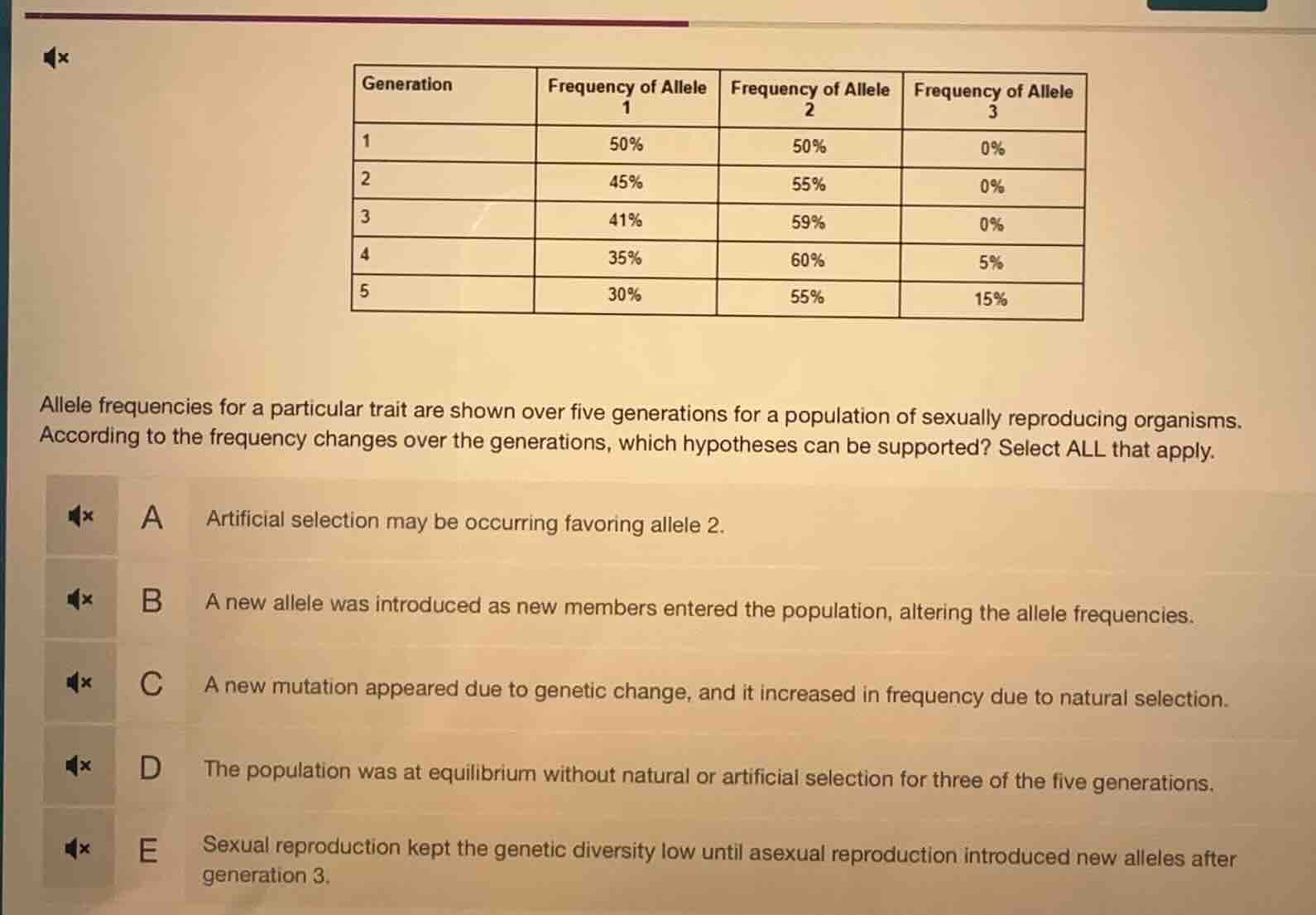
generation | frequency of allele 1 | frequency of allele 2 | frequency of allele 3
1 | 50% | 50% | 0%
2 | 45% | 55% | 0%
3 | 41% | 59% | 0%
4 | 35% | 60% | 5%
5 | 30% | 55% | 15%
allele frequencies for a particular trait are shown over five generations for a population of sexually reproducing organisms. according to the frequency changes over the generations, which hypotheses can be supported? select all that apply.
a artificial selection may be occurring favoring allele 2.
b a new allele was introduced as new members entered the population, altering the allele frequencies.
c a new mutation appeared due to genetic change, and it increased in frequency due to natural selection.
d the population was at equilibrium without natural or artificial selection for three of the five generations.
e sexual reproduction kept the genetic diversity low until asexual reproduction introduced new alleles after generation 3.
- Option A: From generation 1 to 3, Allele 2's frequency increases (50%→55%→59%), suggesting selection (artificial could be a factor) favoring it.
- Option B: Allele 3 appears at generation 4 (0% before), likely from new members (gene flow) entering the population.
- Option C: Allele 3 is new (starts at 0%), then increases (5%→15%), which could be a new mutation favored by natural selection.
- Option D: For generations 1 - 3, allele frequencies change (Allele 1: 50%→45%→41%, Allele 2: 50%→55%→59%), so the population is not at equilibrium (Hardy - Weinberg equilibrium requires no selection, mutation, etc., and constant frequencies). Eliminate D.
- Option E: The organism is sexually reproducing, and there's no indication of asexual reproduction introducing alleles. Also, sexual reproduction typically increases genetic diversity. Eliminate E.

Snap & solve any problem in the app
Get step-by-step solutions on Sovi AI
Photo-based solutions with guided steps
Explore more problems and detailed explanations
A. Artificial selection may be occurring favoring allele 2.
B. A new allele was introduced as new members entered the population, altering the allele frequencies.
C. A new mutation appeared due to genetic change, and it increased in frequency due to natural selection.