QUESTION IMAGE
Question
geographic distribution of power
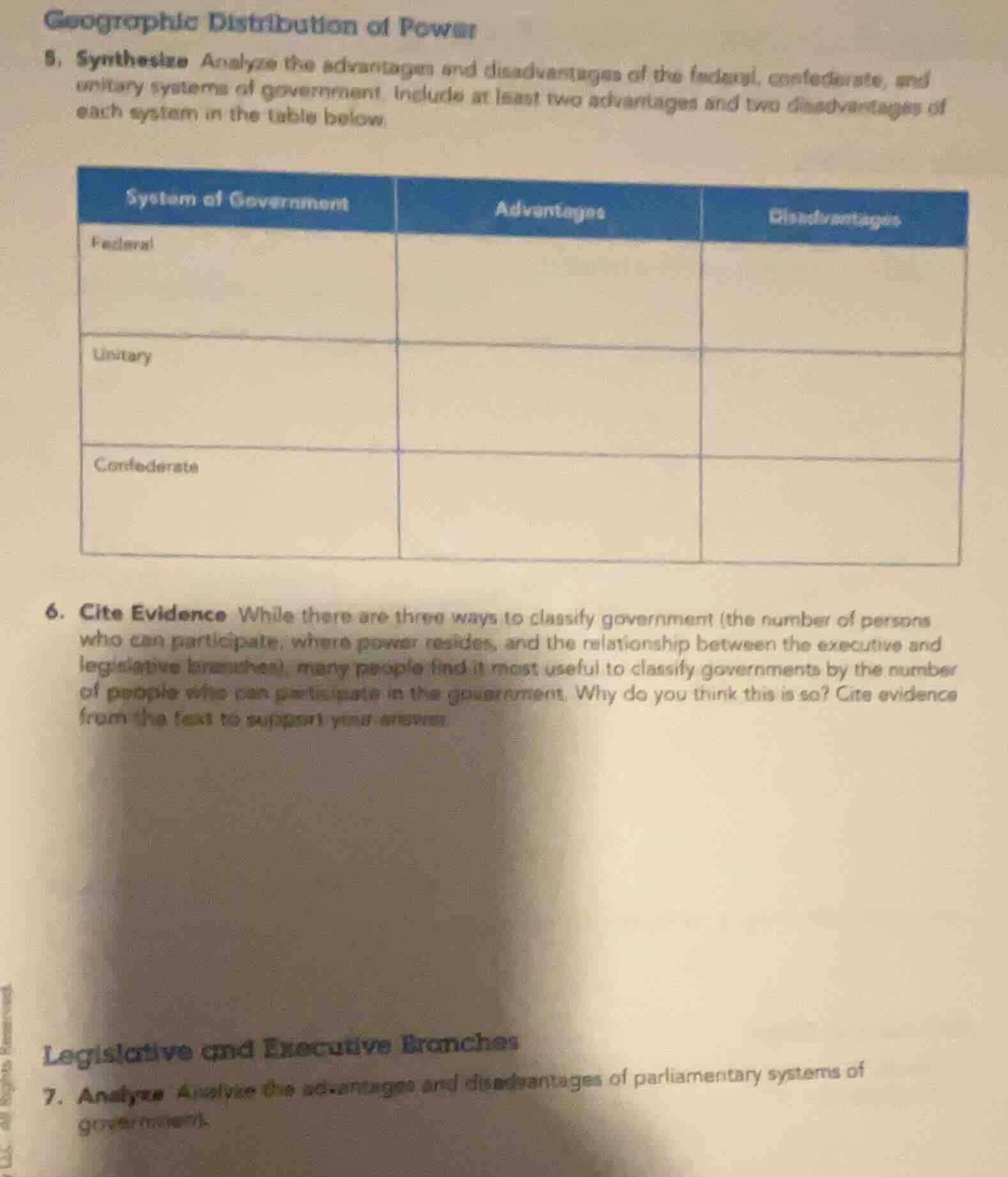
- synthesize analyze the advantages and disadvantages of the federal, confederate, and unitary systems of government. include at least two advantages and two disadvantages of each system in the table below.
| system of government | advantages | disadvantages |
|---|---|---|
| unitary | ||
| confederate |
- cite evidence while there are three ways to classify government (the number of persons who can participate, where power resides, and the relationship between the executive and legislative branches), many people find it most useful to classify governments by the number of people who can participate in the government. why do you think this is so? cite evidence from the text to support your answer.
legislative and executive branches
- analyze analyze the advantages and disadvantages of parliamentary systems of government.
For Question 5:
Each system's points are based on core characteristics of governmental power distribution:
- Federal: Balances national and local authority, allowing tailored policies but creating potential conflict.
- Unitary: Enables unified, efficient governance but can overlook local needs.
- Confederate: Protects state autonomy but struggles with national unity and action.
For Question 6:
Classifying by participant count is intuitive because it directly reflects how inclusive a government is, which shapes citizens' daily relationship with authority. Text evidence often notes this classification (e.g., autocracy vs. democracy) is the most accessible for understanding who holds and exercises power, as it clearly distinguishes systems where power is concentrated in a few versus shared with the public.
For Question 7:
Parliamentary systems' strengths and weaknesses stem from the direct link between the legislative and executive branches, which impacts stability and accountability.

Snap & solve any problem in the app
Get step-by-step solutions on Sovi AI
Photo-based solutions with guided steps
Explore more problems and detailed explanations
Question 5 Completed Table:
| System of Government | Advantages | Disadvantages |
|---|---|---|
| Unitary | 1. Enables consistent, unified national laws and policies<br>2. Streamlines decision-making for efficient national action | 1. Ignores unique local needs and cultural differences<br>2. Concentrates power, risking overcentralization and lack of local representation |
| Confederate | 1. Protects the sovereignty and autonomy of member states<br>2. Lets states collaborate on shared goals without losing self-rule | 1. Central government has limited power to enforce national laws or coordinate collective action<br>2. High risk of member states splitting, leading to instability |
---
Question 6:
Classifying governments by the number of people who can participate is most useful because it directly addresses the core question of who holds and exercises political power, which is the most relatable and clear framework for citizens to understand their role in governance. For example, this classification clearly distinguishes between autocracies (power held by one or a few) and democracies (power shared with the public), making it easy to grasp the fundamental nature of a government system at a glance.
---
Question 7:
Advantages of Parliamentary Systems:
- Executive accountability is strong: The prime minister and cabinet are directly answerable to the legislature, and can be removed via a vote of no confidence if they lose support.
- Legislative-executive alignment reduces gridlock: Since the executive is drawn from the majority party/coalition in the legislature, policy passage is typically more efficient.
Disadvantages of Parliamentary Systems:
- Instability is common: Coalition governments can collapse quickly if a party withdraws support, leading to frequent elections and policy disruption.
- Less direct executive accountability to voters: Voters elect legislative representatives, not the prime minister directly, so the executive is not chosen by a national popular vote.