QUESTION IMAGE
Question
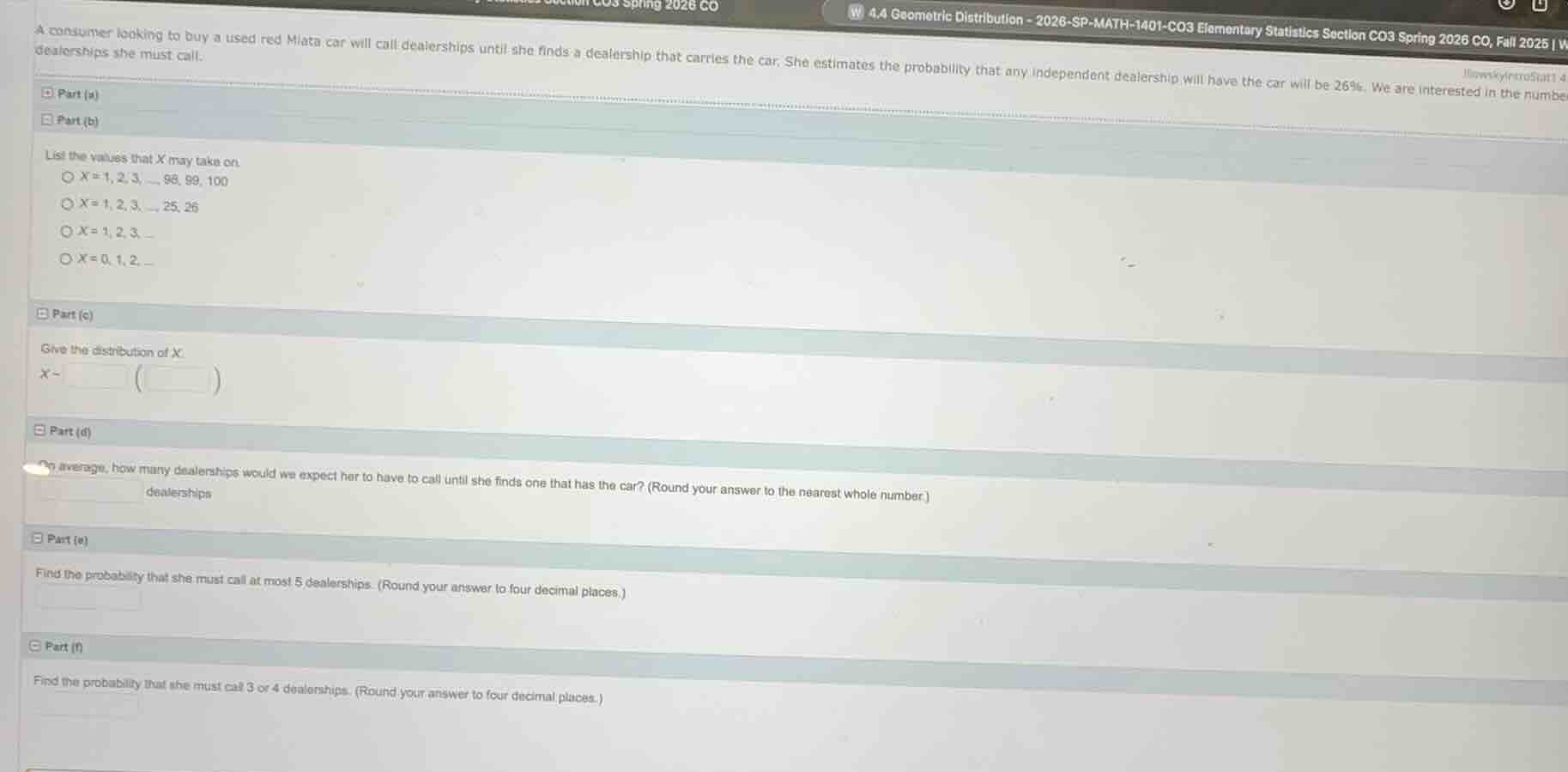
4.4 geometric distribution - 2026-sp-math-1401-co3 elementary statistics section co3 spring 2026 co, fall 2025 | wa consumer looking to buy a used red miata car will call dealerships until she finds a dealership that carries the car. she estimates the probability that any independent dealership will have the car will be 26%. we are interested in the number dealerships she must call.part (a)part (b)list the values that x may take on.○ x = 1, 2, 3, ..., 98, 99, 100○ x = 1, 2, 3, ..., 25, 26○ x = 1, 2, 3, ...○ x = 0, 1, 2, ...part (c)give the distribution of x.x ~ ( )part (d)on average, how many dealerships would we expect her to have to call until she finds one that has the car? (round your answer to the nearest whole number.)___ dealershipspart (e)find the probability that she must call at most 5 dealerships. (round your answer to four decimal places.)_part (f)find the probability that she must call 3 or 4 dealerships. (round your answer to four decimal places.)___
Part (b)
Step1: Identify X's possible values
X counts the number of dealerships called until success. It can be any positive integer (1, 2, 3, ...) since there's no upper limit to the number of calls needed.
Part (c)
Step1: Recognize distribution type
This is a geometric distribution, which models trials until the first success. The notation is $X \sim \text{Geometric}(p)$, where $p$ is the success probability.
$p = 0.26$, so $X \sim \text{Geometric}(0.26)$
Part (d)
Step1: Recall geometric mean formula
The expected value (mean) of a geometric distribution is $\mu = \frac{1}{p}$.
$\mu = \frac{1}{0.26}$
Step2: Calculate and round
$\frac{1}{0.26} \approx 3.846$, rounded to the nearest whole number is 4.
Part (e)
Step1: Define "at most 5" probability
$P(X \leq 5) = 1 - P(X > 5)$. For geometric distributions, $P(X > k) = (1-p)^k$.
Step2: Substitute values
$1-p = 1 - 0.26 = 0.74$, so $P(X \leq 5) = 1 - (0.74)^5$
Step3: Compute and round
$(0.74)^5 = 0.74 \times 0.74 \times 0.74 \times 0.74 \times 0.74 \approx 0.2219$
$1 - 0.2219 = 0.7781$
Part (f)
Step1: Define target probability
$P(X=3 \text{ or } X=4) = P(X=3) + P(X=4)$
Step2: Use geometric probability formula
The probability mass function is $P(X=k) = (1-p)^{k-1}p$.
For $k=3$: $P(X=3) = (0.74)^{2} \times 0.26$
For $k=4$: $P(X=4) = (0.74)^{3} \times 0.26$
Step3: Calculate each term
$(0.74)^2 = 0.5476$, so $P(X=3) = 0.5476 \times 0.26 \approx 0.1424$
$(0.74)^3 = 0.74 \times 0.5476 = 0.4052$, so $P(X=4) = 0.4052 \times 0.26 \approx 0.1053$
Step4: Sum and round
$0.1424 + 0.1053 = 0.2477$

Snap & solve any problem in the app
Get step-by-step solutions on Sovi AI
Photo-based solutions with guided steps
Explore more problems and detailed explanations
Part (b): $X = 1, 2, 3, ...$
Part (c): $X \sim \text{Geometric}(0.26)$
Part (d): 4 dealerships
Part (e): 0.7781
Part (f): 0.2477