QUESTION IMAGE
Question
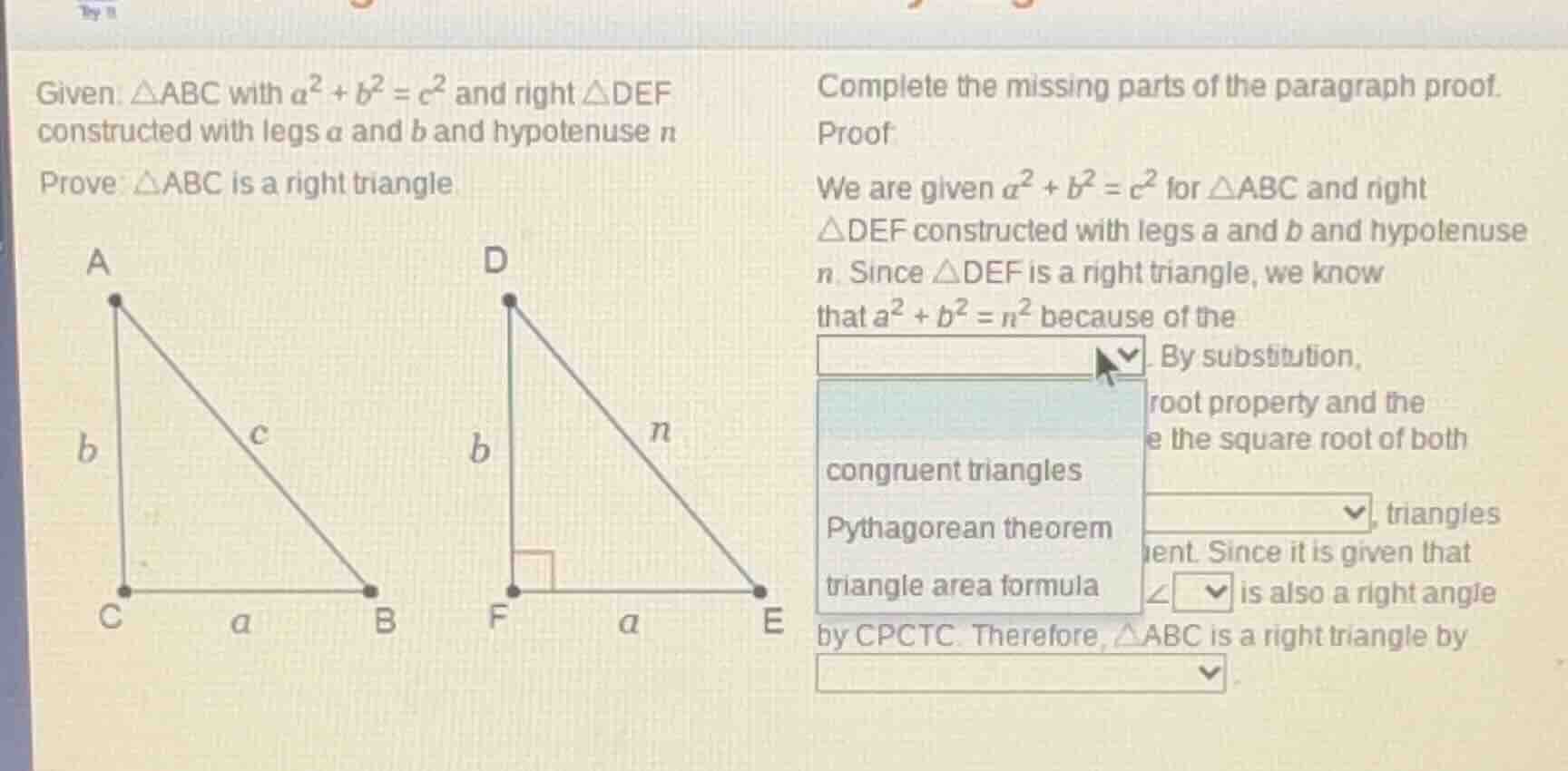
given: △abc with (a^2 + b^2 = c^2) and right △def constructed with legs (a) and (b) and hypotenuse (n) prove: △abc is a right triangle complete the missing parts of the paragraph proof. proof we are given (a^2 + b^2 = c^2) for △abc and right △def constructed with legs (a) and (b) and hypotenuse (n). since △def is a right triangle, we know that (a^2 + b^2 = n^2) because of the (\boldsymbol{\text{dropdown}}). by substitution, root property and the e the square root of both (\boldsymbol{\text{dropdown}}), triangles ent. since it is given that (angle \boldsymbol{\text{dropdown}}) is also a right angle by cpctc. therefore, △abc is a right triangle by (\boldsymbol{\text{dropdown}}).
- For the first blank: In a right triangle, the relationship between legs \(a,b\) and hypotenuse \(n\) (\(a^2 + b^2 = n^2\)) is defined by the Pythagorean theorem.
- After substitution \(c^2 = n^2\), taking square roots gives \(c = n\). With three pairs of equal sides (\(a=a\), \(b=b\), \(c=n\)), \(\triangle ABC \cong \triangle DEF\) by the Side-Side-Side (SSS) Congruence Postulate.
- By CPCTC (Corresponding Parts of Congruent Triangles are Congruent), \(\angle C\) (corresponding to right \(\angle F\)) is the right angle in \(\triangle ABC\).
- A triangle with one right angle is, by definition, a right triangle.

Snap & solve any problem in the app
Get step-by-step solutions on Sovi AI
Photo-based solutions with guided steps
Explore more problems and detailed explanations
- First blank: Pythagorean theorem
- Second blank: SSS Congruence Postulate
- Third blank: \(\angle C\)
- Fourth blank: definition of a right triangle