QUESTION IMAGE
Question
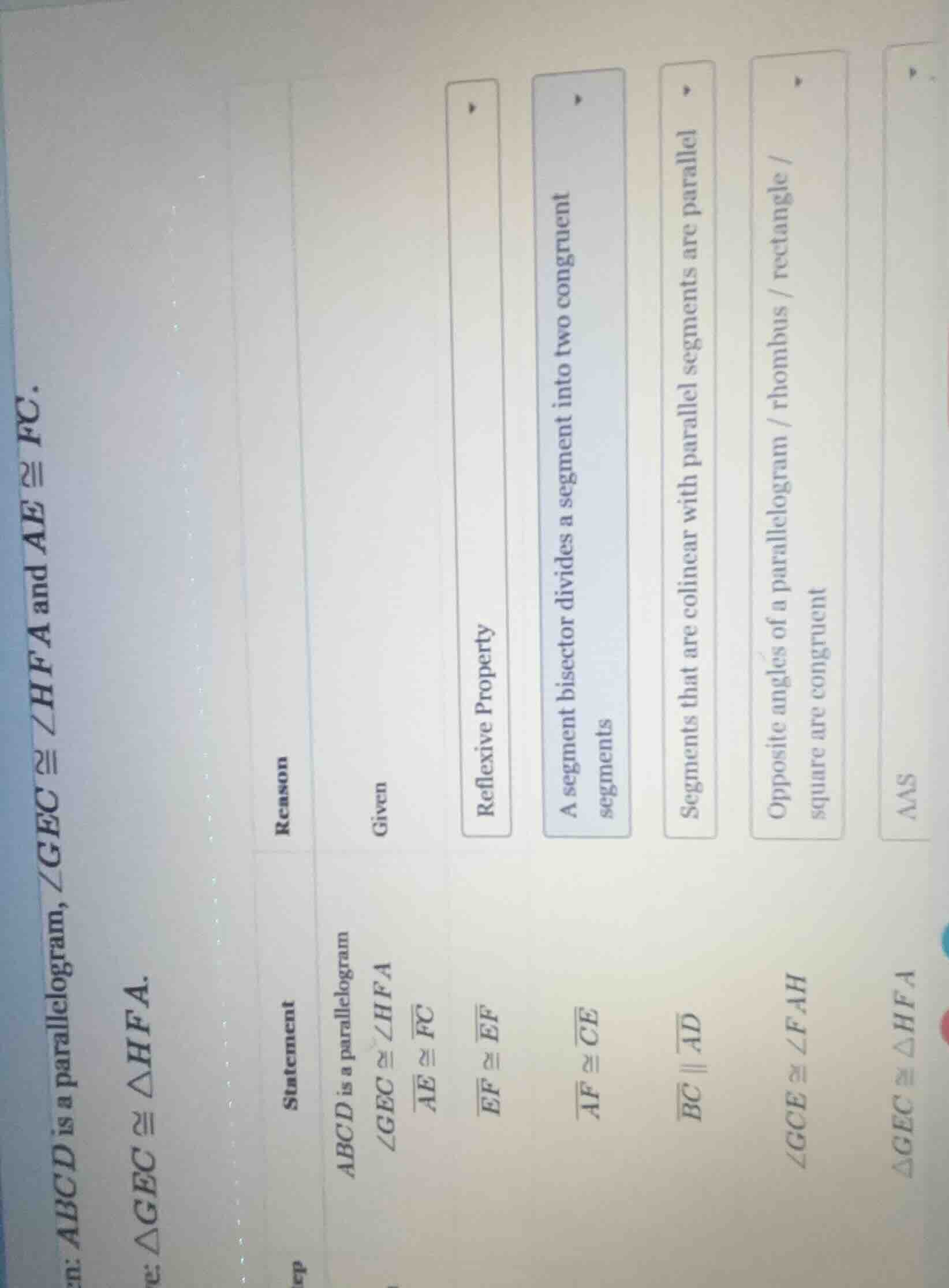
given: abcd is a parallelogram, ∠gec ≅ ∠hfa and ae ≅ fc. prove: △gec ≅ △hfa.
| step | statement | reason |
|---|---|---|
| 2 | ∠gec ≅ ∠hfa | given |
| 3 | ae ≅ fc | given |
| 4 | ef ≅ ef | reflexive property |
| 5 | af ≅ ce | a segment bisector divides a segment into two congruent segments (since ae + ef = af and fc + ef = ce, and ae ≅ fc, ef ≅ ef) |
| 6 | bc ∥ ad | segments that are colinear with parallel segments are parallel (opposite sides of a parallelogram are parallel) |
| 7 | ∠gce ≅ ∠fah | opposite angles of a parallelogram / rhombus / rectangle / square are congruent (alternate interior angles, since bc ∥ ad) |
| 8 | △gec ≅ △hfa | aas (angle - angle - side: ∠gec ≅ ∠hfa, ∠gce ≅ ∠fah, af ≅ ce) |
Step1: Analyze \( \overline{EF} \cong \overline{EF} \)
The reflexive property states that any segment is congruent to itself. So for \( \overline{EF} \), by the reflexive property, \( \overline{EF} \cong \overline{EF} \).
Step2: Analyze \( \overline{AF} \cong \overline{CE} \)
Given \( \overline{AE} \cong \overline{FC} \) (from the table, statement \( \overline{AE} \cong \overline{FC} \)) and \( \overline{EF} \cong \overline{EF} \) (from step 1). By the segment addition postulate, \( AF=AE + EF \) and \( CE=CF + FE \). Since \( AE = FC \) and \( EF = FE \) (reflexive), then \( AF=CE \), so \( \overline{AF} \cong \overline{CE} \) (a segment bisector divides a segment into two congruent segments, here we are combining segments, but the idea is that if \( AE\cong FC \) and \( EF\cong EF \), then \( AF\cong CE \) by adding congruent segments).
Step3: Analyze \( \overline{BC} \parallel \overline{AD} \)
In a parallelogram \( ABCD \), opposite sides are parallel. So \( BC \parallel AD \) (property of parallelogram: opposite sides are parallel).
Step4: Analyze \( \angle GCE \cong \angle FAH \)
Since \( BC \parallel AD \) (from step 3) and \( AB \) is a transversal (or considering the parallel sides and the angles formed), the alternate interior angles are congruent. Also, using the property of parallelogram (opposite angles of a parallelogram are congruent, and here we can derive the angle congruence from the parallel sides and transversals). So \( \angle GCE \cong \angle FAH \).
Step5: Prove \( \triangle GEC \cong \triangle HFA \)
We have \( \angle GEC \cong \angle HFA \) (given), \( \angle GCE \cong \angle FAH \) (from step 4), and \( \overline{AF} \cong \overline{CE} \) (from step 2). By the AAS (Angle - Angle - Side) congruence criterion, if two angles and a non - included side of one triangle are congruent to the corresponding two angles and non - included side of another triangle, then the triangles are congruent. So \( \triangle GEC \cong \triangle HFA \) by AAS.

Snap & solve any problem in the app
Get step-by-step solutions on Sovi AI
Photo-based solutions with guided steps
Explore more problems and detailed explanations
The proof shows that \( \triangle GEC \cong \triangle HFA \) using the AAS congruence criterion, with the necessary angle and side congruences derived from the properties of parallelograms and the reflexive property of congruent segments.