QUESTION IMAGE
Question
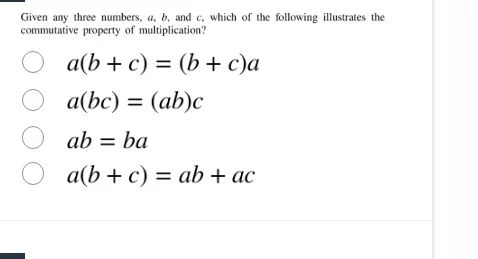
given any three numbers, a, b, and c, which of the following illustrates the commutative property of multiplication?\\(\bigcirc\\) \\(a(b + c) = (b + c)a\\)\\(\bigcirc\\) \\(a(bc) = (ab)c\\)\\(\bigcirc\\) \\(ab = ba\\)\\(\bigcirc\\) \\(a(b + c) = ab + ac\\)
Brief Explanations
The commutative property of multiplication states that the order of multiplying two numbers does not change the product. Let's analyze each option:
- Option 1: \(a(b + c)=(b + c)a\) - This shows the commutative property for multiplication with a sum, but the core commutative property of multiplication (for two numbers) is simpler.
- Option 2: \(a(bc)=(ab)c\) - This is the associative property of multiplication (grouping of factors), not commutative.
- Option 3: \(ab = ba\) - This directly shows that multiplying \(a\) and \(b\) in either order gives the same product, which is the commutative property of multiplication.
- Option 4: \(a(b + c)=ab + ac\) - This is the distributive property of multiplication over addition.

Snap & solve any problem in the app
Get step-by-step solutions on Sovi AI
Photo-based solutions with guided steps
Explore more problems and detailed explanations
C. \(ab = ba\)