QUESTION IMAGE
Question
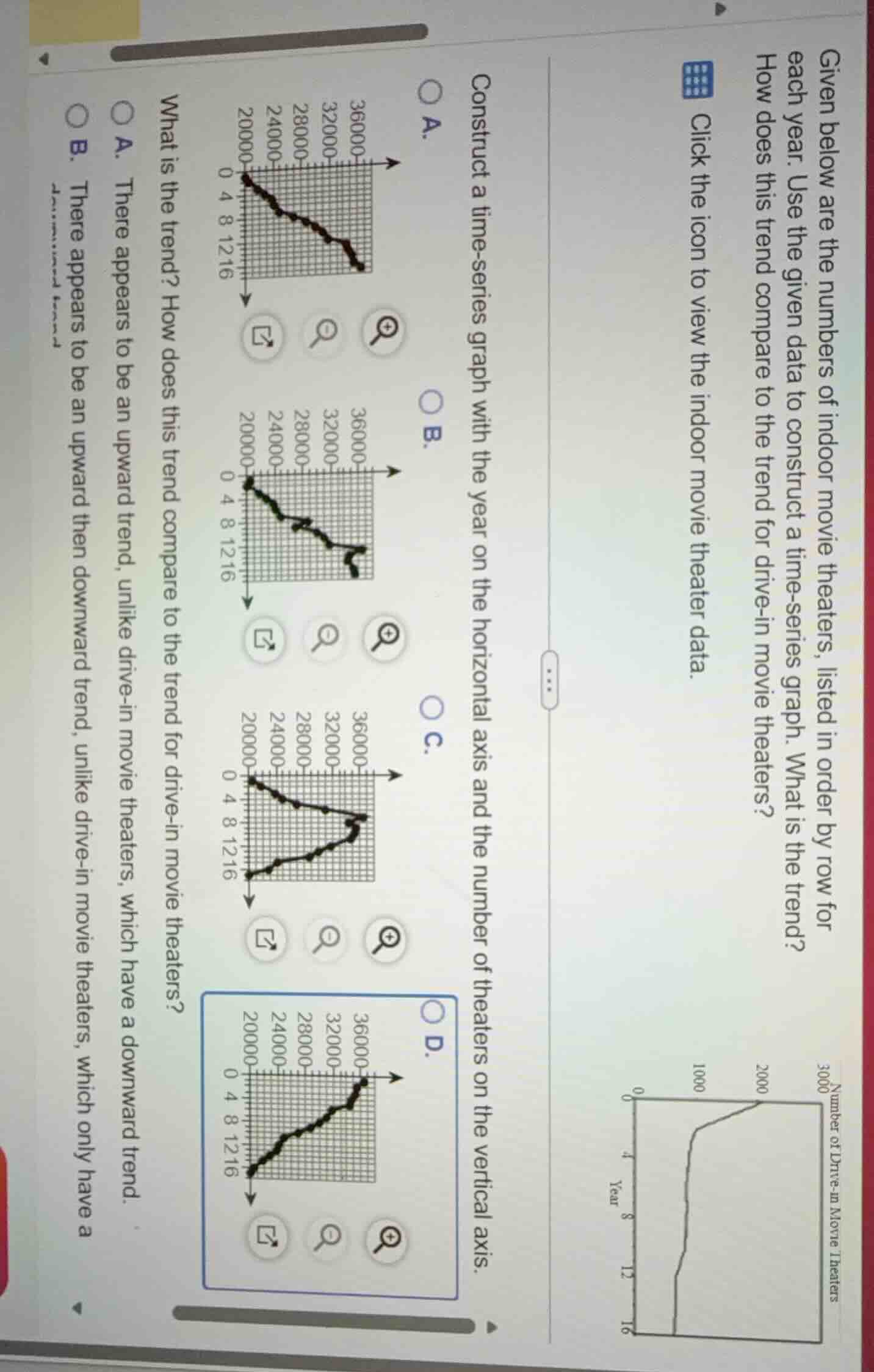
given below are the numbers of indoor movie theaters, listed in order by row for each year. use the given data to construct a time - series graph. what is the trend? how does this trend compare to the trend for drive - in movie theaters? click the icon to view the indoor movie theater data. construct a time - series graph with the year on the horizontal axis and the number of theaters on the vertical axis. what is the trend? how does this trend compare to the trend for drive - in movie theaters? a. there appears to be an upward trend, unlike drive - in movie theaters, which have a downward trend. b. there appears to be an upward then downward trend, unlike drive - in movie theaters, which only have a
To determine the trend for indoor movie theaters, we analyze the time - series graphs. Option D shows an upward trend (the number of theaters increases over time). Drive - in movie theaters typically have a downward trend (decreasing number over time). Option A describes a downward trend for indoor (matching A, B, C) which is wrong. Option B describes a mixed trend which doesn't match D. Option C also has a non - upward trend. Option D's graph shows an upward trend, contrasting with drive - in's downward trend, which matches option A's description of indoor having an upward trend unlike drive - in's downward.

Snap & solve any problem in the app
Get step-by-step solutions on Sovi AI
Photo-based solutions with guided steps
Explore more problems and detailed explanations
A. There appears to be an upward trend, unlike drive - in movie theaters, which have a downward trend.