QUESTION IMAGE
Question
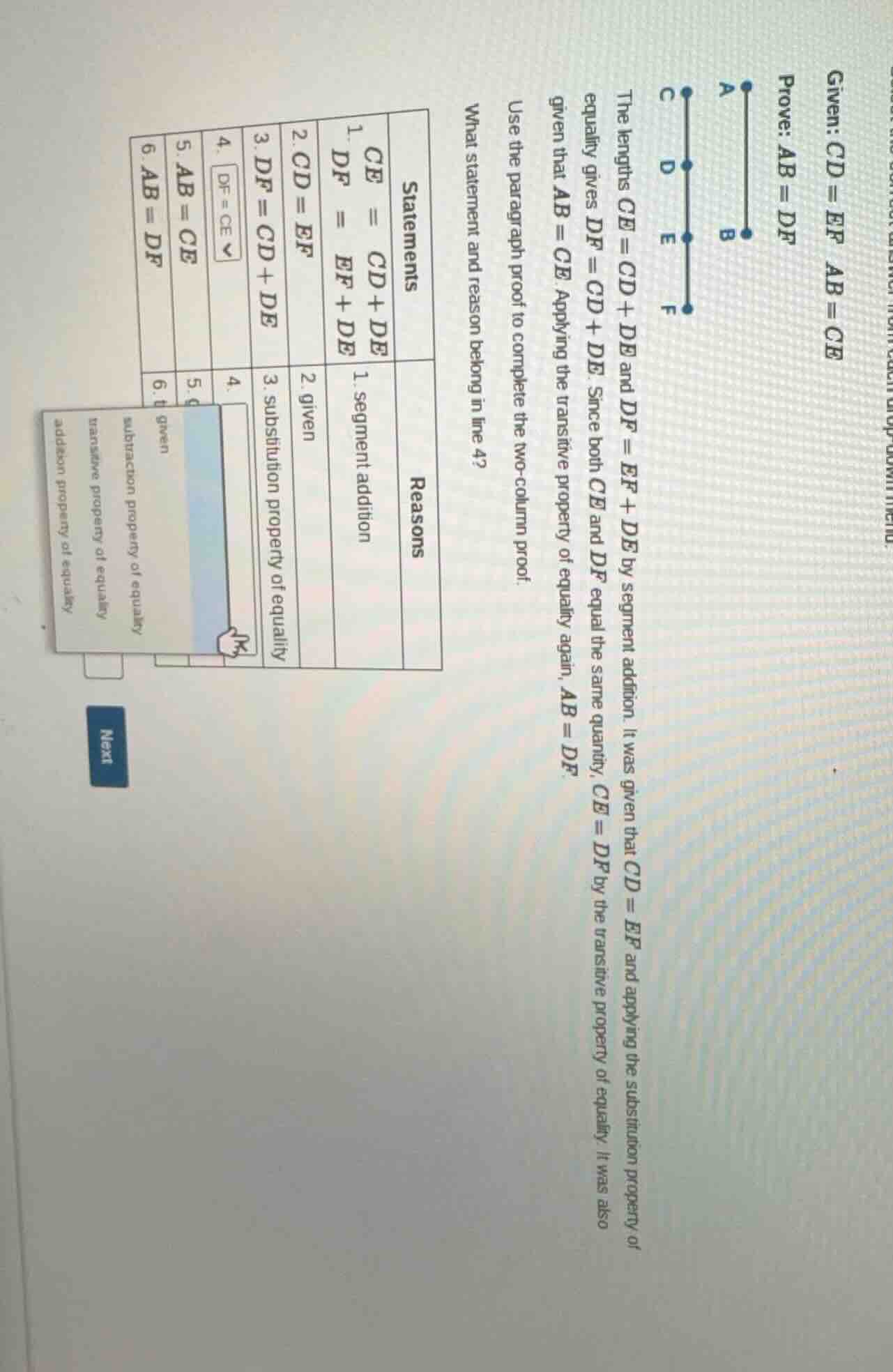
given: cd = ef, ab = ce
prove: ab = df
the lengths ce = cd + de and df = ef + de by segment addition. it was given that cd = ef and applying the substitution property of equality gives df = cd + de. since both ce and df equal the same quantity, ce = df by the transitive property of equality. it was also given that ab = ce. applying the transitive property of equality again, ab = df.
use the paragraph proof to complete the two - column proof.
what statement and reason belong in line 4?
| statements | reasons |
|---|---|
| 2. cd = ef | 2. given |
| 3. df = cd + de | 3. substitution property of equality |
| 4. df = ce | 4. ? |
| 5. ab = ce | 5. given |
| 6. ab = df | 6. transitive property of equality |
reasons options: subtraction property of equality, transitive property of equality, given, addition property of equality|
Step1: Analyze the proof structure
We know from the given information and previous steps that \( CD = EF \) (given), \( CE = CD + DE \) (segment addition), \( DF = EF + DE \) (segment addition). We need to find the reason for \( DF = CE \) in line 4.
Step2: Recall properties of equality
Since \( CD = EF \) (given), we can substitute \( CD \) with \( EF \) in the equation \( CE = CD + DE \). So \( CE = EF + DE \), and we also have \( DF = EF + DE \) (from segment addition). By the transitive property of equality (if \( a = b \) and \( b = c \), then \( a = c \)), we can say \( DF = CE \) because both \( DF \) and \( CE \) equal \( EF + DE \). But looking at the reasons provided, the reason for line 4 (where \( DF = CE \)) should be the substitution property? Wait, no, let's re - check. Wait, we have \( CD = EF \) (given), \( CE = CD + DE \) (segment addition), \( DF = EF + DE \) (segment addition). Then, substitute \( CD \) with \( EF \) in the equation for \( CE \), we get \( CE = EF + DE \), and \( DF = EF + DE \), so by substitution (or transitive), \( DF = CE \). But the reason options include "substitution property of equality" for line 3, and for line 4, since we have \( DF = EF + DE \) and \( CE = EF + DE \) (after substitution), the reason for \( DF = CE \) is the transitive property? Wait, no, the problem is asking for the statement and reason in line 4. Wait, the statement in line 4 is \( DF = CE \). Let's track the steps:
- \( CE = CD + DE \) (segment addition)
- \( CD = EF \) (given)
- \( DF = CD + DE \) (substitution: replace \( CD \) with \( EF \) in \( DF = EF + DE \)? Wait, no, \( DF = EF + DE \), and \( CD = EF \), so substitute \( CD \) for \( EF \) in \( DF = EF + DE \), we get \( DF = CD + DE \) (that's line 3, reason: substitution property of equality)
- Now, from line 1, \( CE = CD + DE \), and from line 3, \( DF = CD + DE \). So by the transitive property of equality (if \( a = b \) and \( c = b \), then \( a = c \)), we can say \( DF = CE \). But looking at the reason options for line 4, the options are "DF = CE", and the reason options include "given", "subtraction property", "negative property", "addition property", "transitive property"? Wait, no, the reason for line 4 (statement \( DF = CE \)) is that both \( DF \) and \( CE \) are equal to \( CD + DE \) (from line 3 and line 1), so by the transitive property of equality. But maybe the problem is simpler. Wait, the key is that we have \( AB = CE \) (given) and we want to prove \( AB = DF \). But for line 4, the statement is \( DF = CE \), and the reason should be the transitive property? Wait, no, let's look at the given information again. We know \( AB = CE \) (given), \( CD = EF \) (given), \( CE = CD + DE \) (segment addition), \( DF = EF + DE \) (segment addition). Then:
- Substitute \( CD \) with \( EF \) in \( CE = CD + DE \), we get \( CE = EF + DE \)
- \( DF = EF + DE \) (segment addition)
- So \( CE = DF \) (transitive property: \( CE = EF + DE \) and \( DF = EF + DE \), so \( CE = DF \))
- Then, since \( AB = CE \) (given), by transitive property, \( AB = DF \)
But for line 4, the statement is \( DF = CE \), and the reason is the transitive property of equality? Wait, but the reason options for line 4 (from the image, the reason column for line 4 has options like "given", "subtraction property of equality", "negative property of equality", "addition property of equality", "transitive property"? Wait, no, the user's image shows the reason for line 4 as a dropdown with options: "DF = CE", and the reason options are "given", "subtractio…

Snap & solve any problem in the app
Get step-by-step solutions on Sovi AI
Photo-based solutions with guided steps
Explore more problems and detailed explanations
The statement in line 4 is \( \boldsymbol{DF = CE} \) and the reason is the transitive property of equality (or substitution, but based on the step - by - step, since \( CE = CD + DE \) and \( DF = CD + DE \), by transitive, \( DF = CE \)). If we follow the given reason options (from the image, the reason for line 4 is likely the transitive property, but if we consider the options provided in the small box, the reason for \( DF = CE \) is that both are equal to \( CD + DE \), so the reason is the transitive property of equality.