QUESTION IMAGE
Question
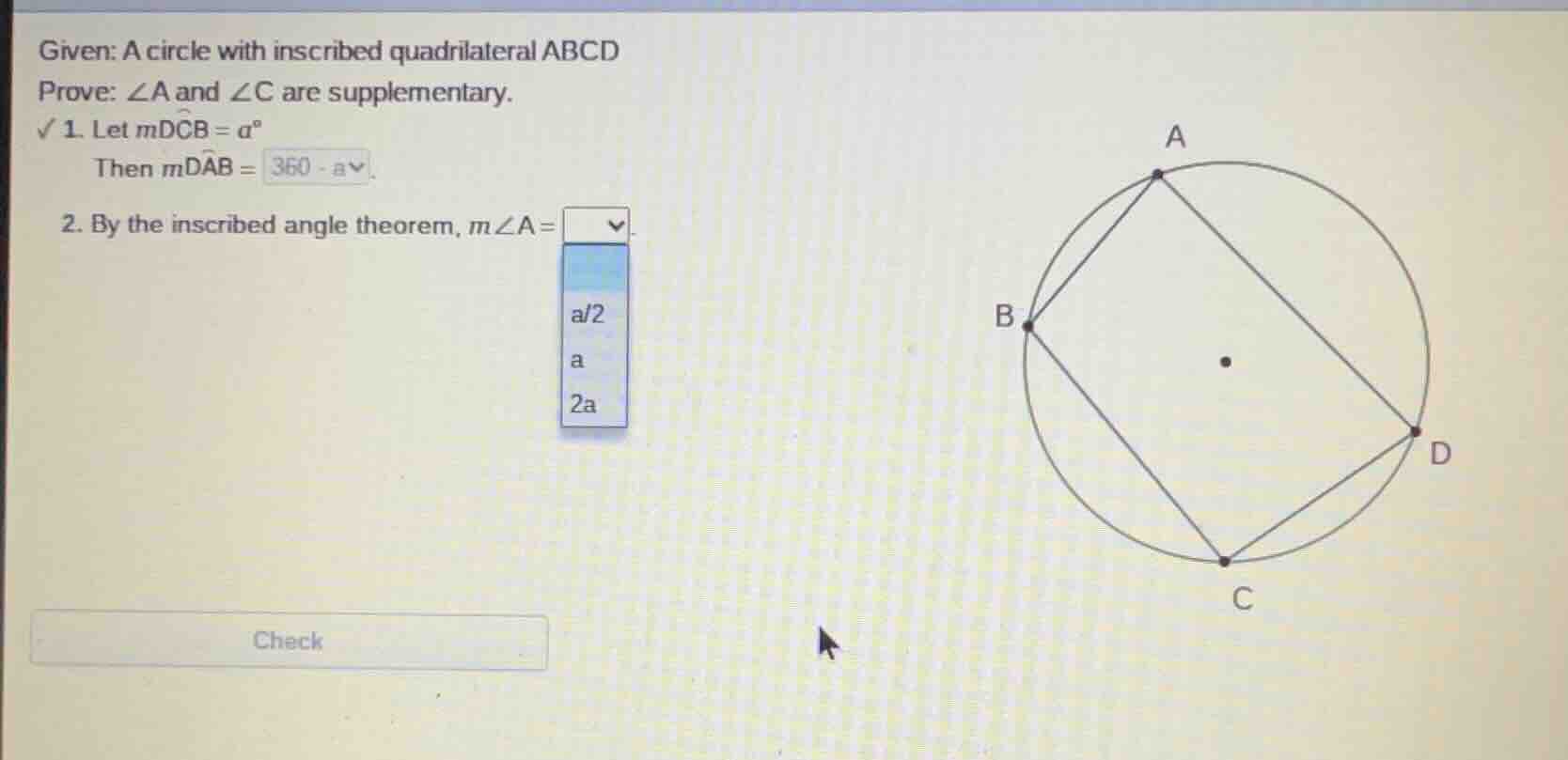
given: a circle with inscribed quadrilateral abcd
prove: ∠a and ∠c are supplementary.
- let ( mwidehat{dcb} = a^circ )
then ( mwidehat{dab} = 360 - a ).
- by the inscribed angle theorem, ( mangle a = )
options: ( \frac{a}{2} ), ( a ), ( 2a )
(image: a circle with inscribed quadrilateral abcd, vertices labeled a, b, c, d in order on the circle.)
Step1: Recall Inscribed Angle Theorem
The inscribed angle theorem states that an inscribed angle is half the measure of its intercepted arc. For \(\angle A\), it intercepts arc \(\overset{\frown}{DCB}\)? Wait, no, wait. Wait, in a cyclic quadrilateral \(ABCD\), \(\angle A\) intercepts arc \(\overset{\frown}{BCD}\)? Wait, no, actually, \(\angle A\) is an inscribed angle intercepting arc \(\overset{\frown}{BCD}\)? Wait, no, let's correct. Wait, the arc opposite to \(\angle A\) is arc \(\overset{\frown}{BCD}\)? Wait, no, in a cyclic quadrilateral, \(\angle A\) intercepts arc \(\overset{\frown}{BCD}\), and \(\angle C\) intercepts arc \(\overset{\frown}{BAD}\). Wait, but from step 1, we have \(m\overset{\frown}{DCB}=a^\circ\), so the arc intercepted by \(\angle A\) – wait, no, \(\angle A\) is formed by chords \(AB\) and \(AD\), so it intercepts arc \(\overset{\frown}{BCD}\)? Wait, no, maybe I got it wrong. Wait, actually, the measure of an inscribed angle is half the measure of its intercepted arc. So \(\angle A\) intercepts arc \(\overset{\frown}{BCD}\)? Wait, no, in the circle, quadrilateral \(ABCD\) is inscribed, so \(\angle A\) is at vertex \(A\), between \(AB\) and \(AD\), so the intercepted arc is \(\overset{\frown}{BCD}\). But from step 1, we have \(m\overset{\frown}{DCB}=a^\circ\), wait, maybe the arc \(\overset{\frown}{DAB}\) is \(360 - a\) (from step 1), but \(\angle A\) – wait, no, maybe I mixed up. Wait, no, let's re-express. The inscribed angle theorem: \(m\angle A=\frac{1}{2}m\overset{\frown}{BCD}\). But wait, in step 1, we let \(m\overset{\frown}{DCB}=a^\circ\), so maybe \(\overset{\frown}{DCB}\) is arc \(DCB\), so the arc intercepted by \(\angle A\) is arc \(DCB\)? Wait, no, that can't be. Wait, maybe the arc opposite to \(\angle A\) is arc \(DCB\), so \(\angle A\) is half of arc \(DCB\)? Wait, no, that would be if \(\angle A\) intercepts arc \(DCB\). Wait, but let's check the options. The options are \(a/2\), \(a\), \(2a\). From step 1, \(m\overset{\frown}{DCB}=a^\circ\), so if \(\angle A\) is an inscribed angle intercepting arc \(\overset{\frown}{DCB}\), then \(m\angle A=\frac{1}{2}m\overset{\frown}{DCB}=\frac{a}{2}\). Wait, that makes sense. Because the inscribed angle theorem says the measure of the inscribed angle is half the measure of its intercepted arc. So if \(\angle A\) intercepts arc \(\overset{\frown}{DCB}\) which has measure \(a^\circ\), then \(m\angle A=\frac{a}{2}\). So the correct option is \(a/2\).
Step2: Apply Inscribed Angle Theorem
By the inscribed angle theorem, the measure of an inscribed angle is half the measure of its intercepted arc. Here, \(\angle A\) is an inscribed angle intercepting arc \(\overset{\frown}{DCB}\) (with measure \(a^\circ\)), so \(m\angle A = \frac{1}{2} \times a = \frac{a}{2}\).

Snap & solve any problem in the app
Get step-by-step solutions on Sovi AI
Photo-based solutions with guided steps
Explore more problems and detailed explanations
\( \frac{a}{2} \) (corresponding to the option \( a/2 \))