QUESTION IMAGE
Question
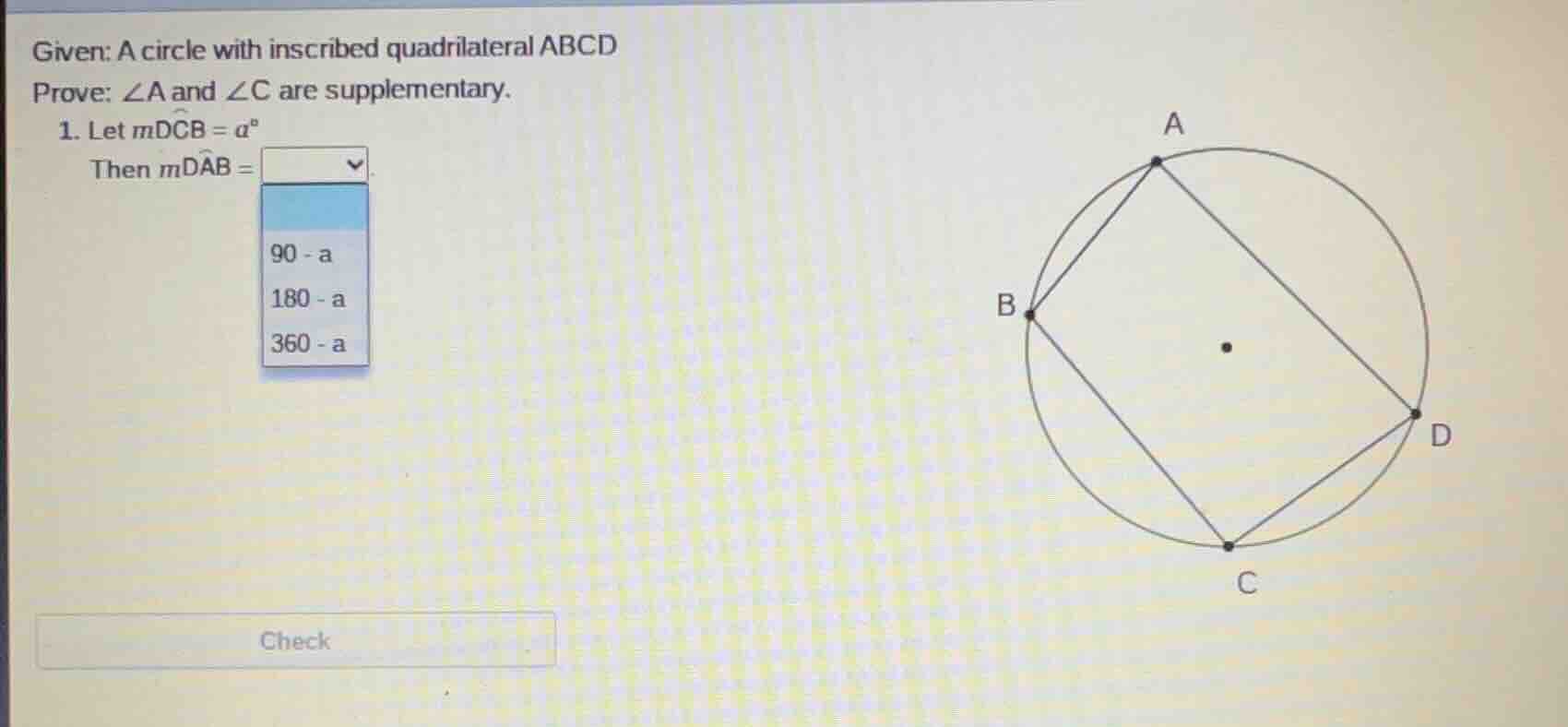
given: a circle with inscribed quadrilateral abcd
prove: ∠a and ∠c are supplementary.
- let ( mwidehat{dcb} = a^circ )
then ( mwidehat{dab} = )
options: 90 - a, 180 - a, 360 - a
Step1: Recall Inscribed Angle Theorem
The measure of an inscribed angle is half the measure of its intercepted arc. Also, for a cyclic quadrilateral (quadrilateral inscribed in a circle), the opposite angles subtend arcs that sum to the whole circle (360°), and the inscribed angle subtended by an arc and its opposite arc: the angle at \( A \) (\( \angle DAB \)) intercepts arc \( DCB \) and angle at \( C \) intercepts arc \( DAB \), but more directly, the measure of an inscribed angle is half the measure of its intercepted arc, and the sum of the measures of arcs \( DAB \) and \( DCB \) is \( 360^\circ \)? Wait, no, actually, for a cyclic quadrilateral, the inscribed angle \( \angle A \) ( \( \angle DAB \)) intercepts arc \( DCB \), and the measure of \( \angle A \) is half the measure of arc \( DCB \)? Wait, no, correction: the inscribed angle theorem says that the measure of an inscribed angle is half the measure of its intercepted arc. But for a cyclic quadrilateral, the opposite angles are supplementary because they subtend arcs that add up to \( 360^\circ \), so each angle is half the measure of its intercepted arc, and the sum of the two opposite angles' intercepted arcs is \( 360^\circ \), so the sum of the angles is \( \frac{1}{2}(360^\circ)= 180^\circ \). But in this case, we are looking at the arc \( DCB \) with measure \( a^\circ \), then the arc \( DAB \) would be \( 360^\circ - a^\circ \)? Wait, no, wait the problem is about the measure of the inscribed angle \( \angle DAB \). Wait, maybe I mixed up. Wait, the arc \( DCB \) is \( a^\circ \), then the arc \( DAB \) is the rest of the circle, so \( 360 - a \) degrees? But no, the inscribed angle \( \angle DAB \) intercepts arc \( DCB \)? Wait, no, point \( A \), \( B \), \( C \), \( D \) are on the circle, so quadrilateral \( ABCD \) is cyclic. The angle at \( A \) ( \( \angle DAB \)) intercepts arc \( DCB \), and the angle at \( C \) ( \( \angle DCB \)) intercepts arc \( DAB \). Wait, no, the measure of \( \angle DAB \) is half the measure of arc \( DCB \)? Wait, no, let's recall: in a circle, the measure of an inscribed angle is half the measure of its intercepted arc. So angle \( \angle DAB \) is an inscribed angle that intercepts arc \( DCB \). Wait, but if arc \( DCB \) is \( a^\circ \), then the measure of \( \angle DAB \) would be \( \frac{1}{2}a \)? No, that doesn't match the options. Wait, maybe the problem has a typo, or I misread. Wait, the options are \( 90 - a \), \( 180 - a \), \( 360 - a \). Wait, maybe the arc \( DCB \) is \( a^\circ \), and the arc \( DAB \) is \( 360 - a \), but the angle \( \angle DAB \) is an inscribed angle intercepting arc \( DCB \), but no, that can't be. Wait, maybe the problem is using the fact that in a cyclic quadrilateral, the sum of opposite angles is \( 180^\circ \), but here we are looking at the arc measure. Wait, no, the question is: Let \( m\widehat{DCB} = a^\circ \), then \( m\widehat{DAB} = \)? Wait, arc \( DAB \) and arc \( DCB \) are two arcs that make up the circle? Wait, no, the circle is 360 degrees, so arc \( DAB \) + arc \( DCB \) = 360 degrees? Wait, no, points \( A, B, C, D \) are on the circle, so the arcs between them: arc \( AB \), arc \( BC \), arc \( CD \), arc \( DA \). So arc \( DCB \) is arc \( DC \) + arc \( CB \), and arc \( DAB \) is arc \( DA \) + arc \( AB \). So together, arc \( DAB \) + arc \( DCB \) = arc \( DA \) + arc \( AB \) + arc \( DC \) + arc \( CB \) = 360 degrees. So \( m\widehat{DAB} + m\widehat{DCB} = 360^\circ \), so \( m\widehat{DAB} = 360^\circ - a^\circ \)? But the options includ…

Snap & solve any problem in the app
Get step-by-step solutions on Sovi AI
Photo-based solutions with guided steps
Explore more problems and detailed explanations
\( 360 - a \) (corresponding to the option with text "360 - a")