QUESTION IMAGE
Question
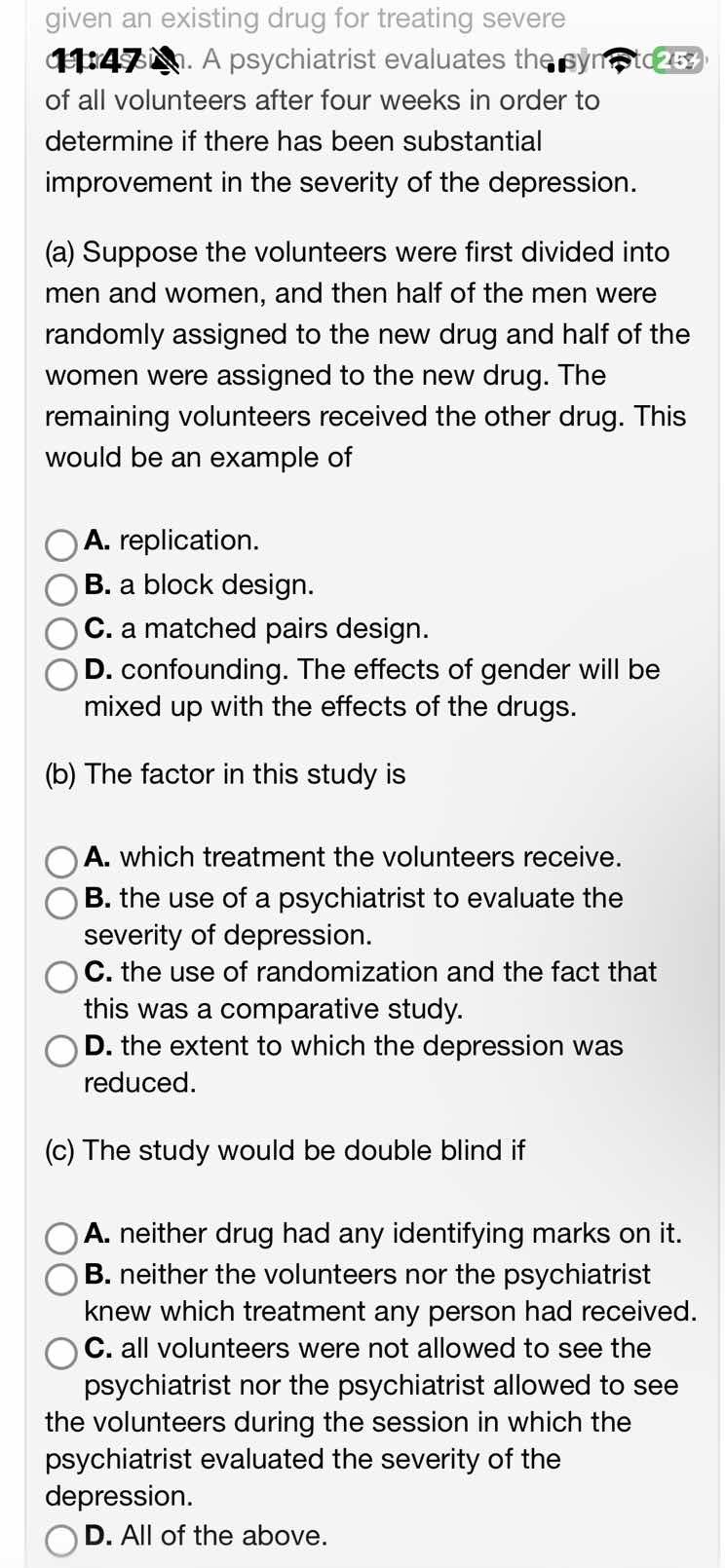
given an existing drug for treating severe depression. a psychiatrist evaluates the severity of all volunteers after four weeks in order to determine if there has been substantial improvement in the severity of the depression.
(a) suppose the volunteers were first divided into men and women, and then half of the men were randomly assigned to the new drug and half of the women were assigned to the new drug. the remaining volunteers received the other drug. this would be an example of
a. replication.
b. a block design.
c. a matched pairs design.
d. confounding. the effects of gender will be mixed up with the effects of the drugs.
(b) the factor in this study is
a. which treatment the volunteers receive.
b. the use of a psychiatrist to evaluate the severity of depression.
c. the use of randomization and the fact that this was a comparative study.
d. the extent to which the depression was reduced.
(c) the study would be double blind if
a. neither drug had any identifying marks on it.
b. neither the volunteers nor the psychiatrist knew which treatment any person had received.
c. all volunteers were not allowed to see the psychiatrist nor the psychiatrist allowed to see the volunteers during the session in which the psychiatrist evaluated the severity of the depression.
d. all of the above.
Part (a)
- Option A: Replication involves repeating an experiment, which is not the case here.
- Option B: A block design divides subjects into blocks (here, men and women as blocks) and then randomly assigns treatments within each block. This matches the description (dividing into men/women, then assigning half in each block to new drug).
- Option C: Matched pairs design pairs similar subjects, not dividing into groups like men and women and assigning within.
- Option D: Confounding would mix effects, but here we are controlling for gender by blocking, not confounding.
- A factor in a study is the variable that is manipulated or controlled.
- Option A: The treatment (which drug volunteers receive) is the factor being studied to see its effect on depression.
- Option B: The psychiatrist’s evaluation is a measurement tool, not a factor.
- Option C: Randomization and study type are aspects of the study design, not a factor.
- Option D: The extent of depression reduction is the response variable, not the factor.
- A double - blind study is one where neither the subjects (volunteers) nor the people assessing them (psychiatrist) know who got which treatment.
- Option A: Just unmarked drugs is single - blind (volunteers don't know, but psychiatrist might).
- Option B: This fits the definition of double - blind (both volunteers and psychiatrist are blind to treatment).
- Option C: Not seeing each other is not the definition of double - blind; double - blind is about not knowing treatment assignment.
- Option D: Since A and C are incorrect, D is wrong.

Snap & solve any problem in the app
Get step-by-step solutions on Sovi AI
Photo-based solutions with guided steps
Explore more problems and detailed explanations
B. a block design.