QUESTION IMAGE
Question
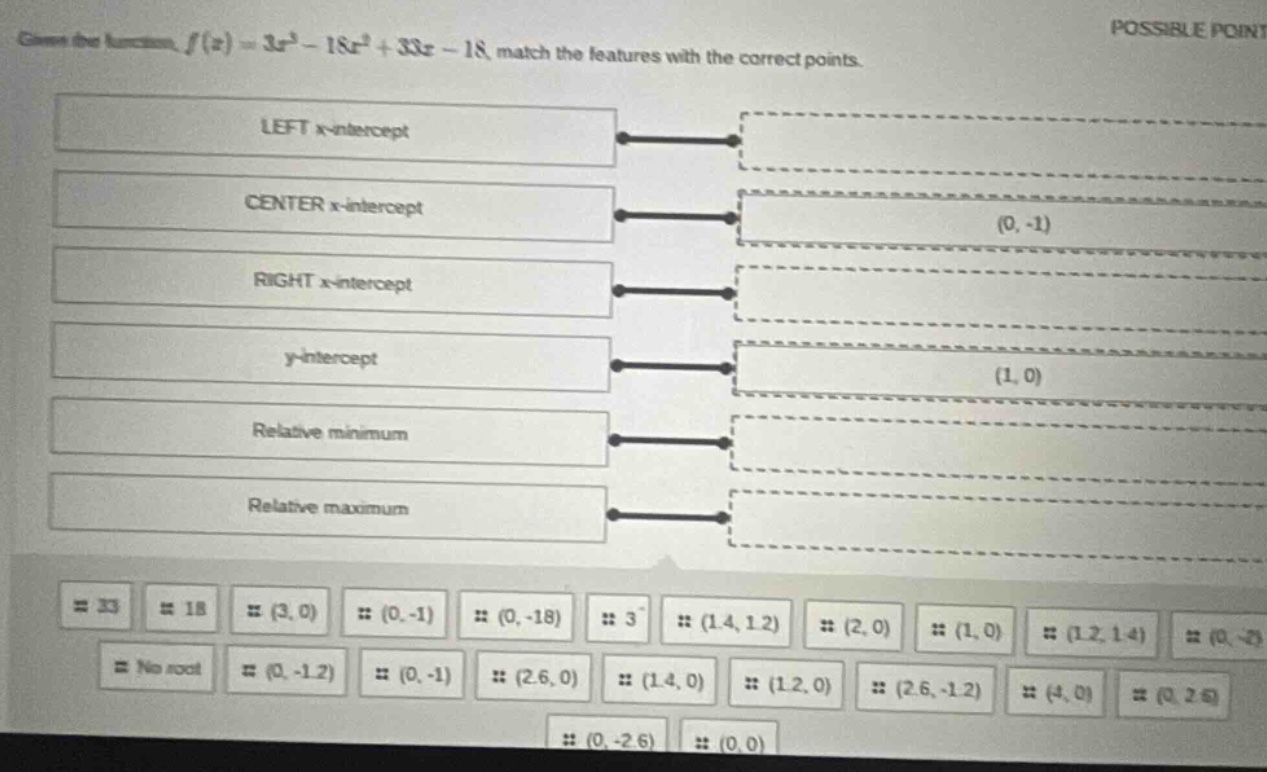
given the function, $f(x) = 3x^3 - 18x^2 + 33x - 18$, match the features with the correct points.
left x - intercept
center x - intercept
right x - intercept
y - intercept
relative minimum
relative maximum
possible points (some shown): (0, -1), (1, 0), (3, 0), (0, -18), (1.4, 1.2), (2, 0), (1.2, 1.4), (0, -1.2), (2.6, 0), (1.4, 0), (1.2, 0), (2.6, -1.2), (4, 0), (0, 2.6), (0, -2.6), (0, 0), etc.
Step 1: Find x - intercepts
To find the x - intercepts, we set \(y = f(x)=0\), so we solve the equation \(3x^{3}-18x^{2}+33x - 18=0\). First, we can factor out a 3: \(3(x^{3}-6x^{2}+11x - 6)=0\). Then we try to find the roots of \(x^{3}-6x^{2}+11x - 6\). We can use the Rational Root Theorem. The possible rational roots are factors of 6, i.e., \(\pm1,\pm2,\pm3,\pm6\).
- When \(x = 1\): \(1^{3}-6\times1^{2}+11\times1 - 6=1 - 6 + 11-6 = 0\). So \((x - 1)\) is a factor.
- We perform polynomial division or use synthetic division to divide \(x^{3}-6x^{2}+11x - 6\) by \((x - 1)\). Using synthetic division:
\[
\]
So \(x^{3}-6x^{2}+11x - 6=(x - 1)(x^{2}-5x + 6)\). Then we factor \(x^{2}-5x + 6=(x - 2)(x - 3)\). So the roots of \(f(x)=0\) are \(x = 1\), \(x = 2\), and \(x = 3\). So the x - intercepts are \((1,0)\), \((2,0)\), and \((3,0)\). Ordering them from left to right: LEFT x - intercept: \((1,0)\), CENTER x - intercept: \((2,0)\), RIGHT x - intercept: \((3,0)\).
Step 2: Find y - intercept
To find the y - intercept, we set \(x = 0\). Then \(f(0)=3\times0^{3}-18\times0^{2}+33\times0 - 18=- 18\). So the y - intercept is \((0,-18)\).
Step 3: Find relative minimum and maximum
First, find the derivative of \(f(x)\): \(f^\prime(x)=9x^{2}-36x + 33\). We can factor out a 3: \(f^\prime(x)=3(3x^{2}-12x + 11)\). To find the critical points, we set \(f^\prime(x)=0\), so \(3x^{2}-12x + 11 = 0\). Using the quadratic formula \(x=\frac{-b\pm\sqrt{b^{2}-4ac}}{2a}\) for \(ax^{2}+bx + c = 0\), here \(a = 3\), \(b=-12\), \(c = 11\). Then \(x=\frac{12\pm\sqrt{(-12)^{2}-4\times3\times11}}{2\times3}=\frac{12\pm\sqrt{144 - 132}}{6}=\frac{12\pm\sqrt{12}}{6}=\frac{12\pm2\sqrt{3}}{6}=2\pm\frac{\sqrt{3}}{3}\approx2\pm0.577\). So \(x_1\approx2 - 0.577 = 1.423\) and \(x_2\approx2 + 0.577 = 2.577\).
Now we find the second derivative \(f^{\prime\prime}(x)=18x-36\).
- For \(x = 1.423\): \(f^{\prime\prime}(1.423)=18\times1.423-36\approx25.614 - 36=- 10.386<0\), so the function has a relative maximum at \(x\approx1.423\). We find \(f(1.423)=3\times(1.423)^{3}-18\times(1.423)^{2}+33\times1.423-18\). Let's calculate:
\((1.423)^{3}\approx1.423\times1.423\times1.423\approx2.025\times1.423\approx2.882\)
\((1.423)^{2}\approx2.025\)
\(f(1.423)=3\times2.882-18\times2.025 + 33\times1.423-18\approx8.646-36.45+46.959 - 18\approx(8.646 + 46.959)-(36.45 + 18)\approx55.605 - 54.45 = 1.155\approx1.2\). So the relative maximum point is \((1.4,1.2)\) (approximate).
- For \(x = 2.577\): \(f^{\prime\prime}(2.577)=18\times2.577-36\approx46.386-36 = 10.386>0\), so the function has a relative minimum at \(x\approx2.577\). We find \(f(2.577)=3\times(2.577)^{3}-18\times(2.577)^{2}+33\times2.577-18\).
\((2.577)^{3}\approx2.577\times2.577\times2.577\approx6.641\times2.577\approx17.11\)
\((2.577)^{2}\approx6.641\)
\(f(2.577)=3\times17.11-18\times6.641+33\times2.577 - 18\approx51.33-119.538+85.041-18\approx(51.33 + 85.041)-(119.538 + 18)\approx136.371-137.538=-1.167\approx - 1.2\). So the relative minimum point is \((2.6,-1.2)\) (approximate).

Snap & solve any problem in the app
Get step-by-step solutions on Sovi AI
Photo-based solutions with guided steps
Explore more problems and detailed explanations
- LEFT x - intercept: \((1,0)\)
- CENTER x - intercept: \((2,0)\)
- RIGHT x - intercept: \((3,0)\)
- y - intercept: \((0,-18)\)
- Relative minimum: \((2.6,-1.2)\)
- Relative maximum: \((1.4,1.2)\)