QUESTION IMAGE
Question
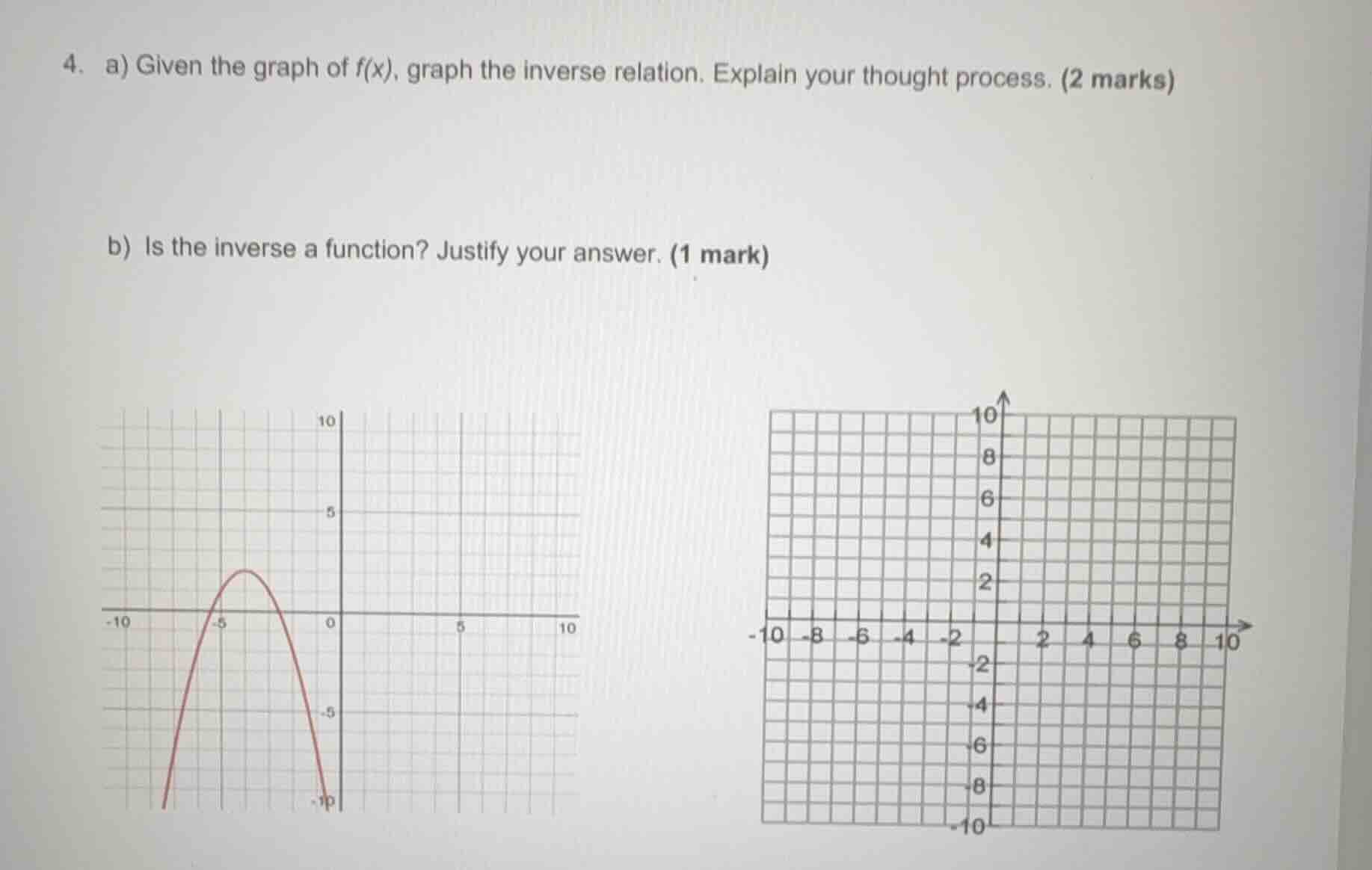
- a) given the graph of f(x), graph the inverse relation. explain your thought process. (2 marks)
b) is the inverse a function? justify your answer. (1 mark)
Part (a)
Step1: Recall Inverse Graph Rule
To graph the inverse of a relation \( y = f(x) \), we reflect the graph over the line \( y = x \). This means that for every point \( (a, b) \) on the graph of \( f(x) \), the corresponding point on the inverse relation will be \( (b, a) \).
Step2: Identify Key Points on \( f(x) \)
First, identify some key points on the graph of \( f(x) \). From the left graph, let's assume some visible points (e.g., the vertex, x - intercepts, y - intercept). The graph of \( f(x) \) is a parabola opening downward. Let's say the vertex is at \( (-3, 2) \) (approximate, based on the grid), the x - intercepts are at \( x=-5 \) (where \( y = 0 \)) and let's assume another x - intercept (but since it's a parabola, symmetric about \( x=-3 \)), and the y - intercept is at \( (0, - 10) \) (from the graph).
Step3: Find Corresponding Inverse Points
For the point \( (-5, 0) \) on \( f(x) \), the inverse point is \( (0, -5) \). For the vertex \( (-3, 2) \), the inverse point is \( (2, -3) \). For the y - intercept \( (0, - 10) \), the inverse point is \( (-10, 0) \).
Step4: Reflect Over \( y = x \)
Plot these inverse points on the right - hand grid and draw the curve connecting them. The shape of the inverse relation will be a reflection of the original parabola over the line \( y = x \). So, we take each point \( (x,y) \) on \( f(x) \), swap \( x \) and \( y \) to get \( (y,x) \), and then plot these new points to form the graph of the inverse relation.
Part (b)
Step1: Recall the Vertical Line Test
A relation is a function if and only if every vertical line intersects its graph at most once. So, we need to apply the vertical line test to the graph of the inverse relation.
Step2: Analyze the Inverse Graph
The original function \( f(x) \) is a parabola (a quadratic function), which is not one - to - one (since it fails the horizontal line test: a horizontal line will intersect the parabola at two points). When we find the inverse of a non - one - to - one function, the inverse relation will not be a function. To see this, consider the graph of the inverse relation (which is a reflection of the parabola over \( y = x \)). If we draw a vertical line on the graph of the inverse relation, we will find that there are vertical lines that intersect the graph of the inverse relation more than once. This is because the original function \( f(x) \) is not one - to - one (it has two different \( x \) - values that map to the same \( y \) - value), so when we swap \( x \) and \( y \) for the inverse, there will be two different \( y \) - values (in the inverse relation) that map to the same \( x \) - value, which means the inverse relation fails the vertical line test.

Snap & solve any problem in the app
Get step-by-step solutions on Sovi AI
Photo-based solutions with guided steps
Explore more problems and detailed explanations
s:
a) To graph the inverse relation, reflect each point \((x,y)\) on \(f(x)\) over \(y = x\) (swap \(x\) and \(y\) to get \((y,x)\)) and plot these points. For example, if \((x_1,y_1)\) is on \(f(x)\), \((y_1,x_1)\) is on the inverse. Then draw the curve through these reflected points.
b) The inverse is not a function. Justification: The original function \(f(x)\) is a parabola (quadratic function) and fails the horizontal line test (not one - to - one). When we find the inverse, the inverse relation will fail the vertical line test (a vertical line will intersect the inverse graph more than once), so it is not a function.