QUESTION IMAGE
Question
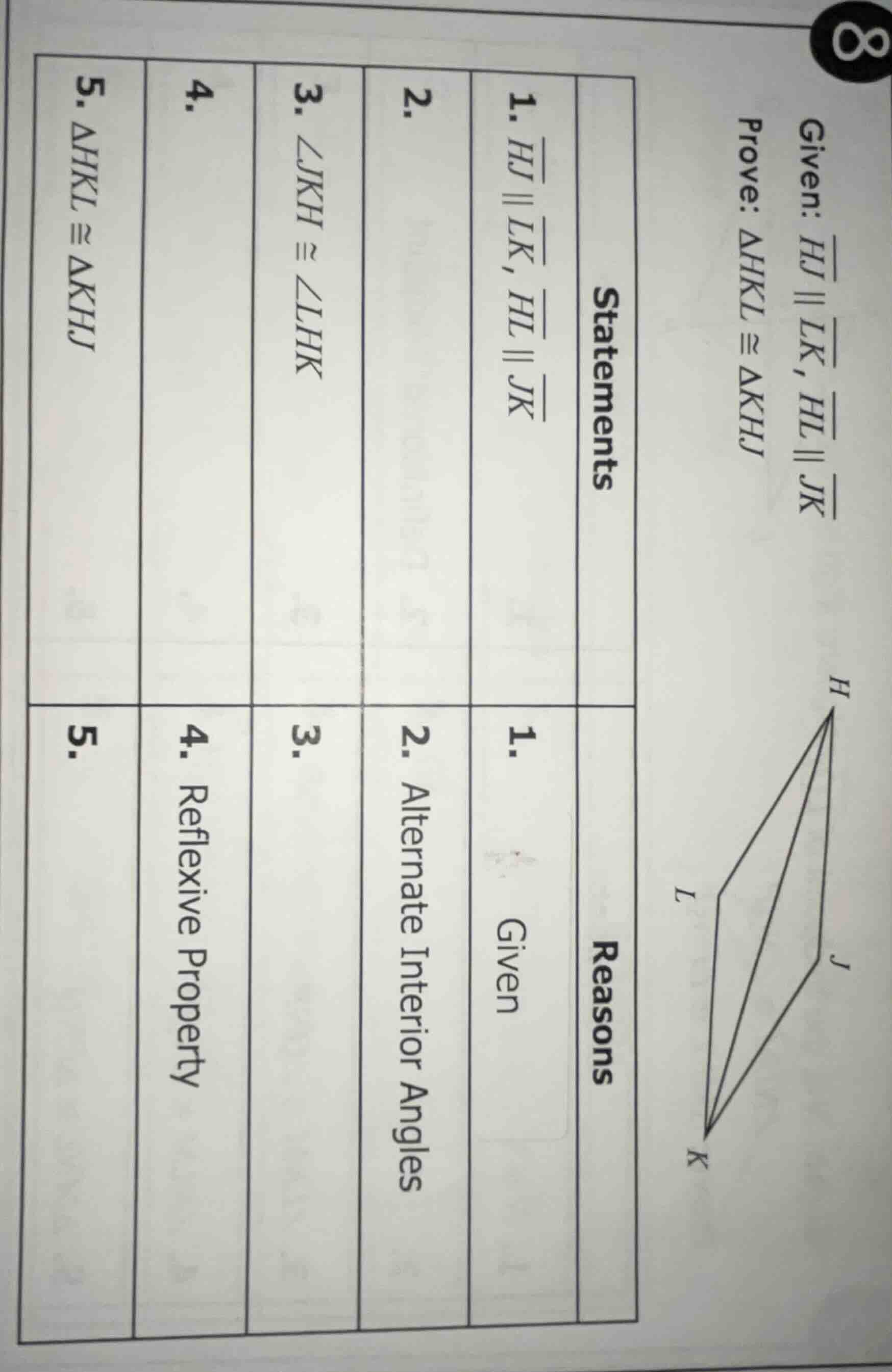
given: $overline{hj} parallel overline{lk}$, $overline{hl} parallel overline{jk}$
prove: $\triangle hkl cong \triangle khj$
| statements | reasons |
|---|---|
| 2. | 2. alternate interior angles |
| 3. $angle jkh cong angle lhk$ | 3. |
| 4. | 4. reflexive property |
| 5. $\triangle hkl cong \triangle khj$ | 5. |
Step 1: Fill in Statement 2
Since \( \overline{HJ} \parallel \overline{LK} \) and \( \overline{HL} \parallel \overline{JK} \), we use the Alternate Interior Angles Theorem. For \( \overline{HJ} \parallel \overline{LK} \) with transversal \( \overline{HK} \), \( \angle JKH \) and \( \angle LHK \) are alternate interior angles. Wait, actually, let's correct. For \( \overline{HL} \parallel \overline{JK} \) with transversal \( \overline{HK} \), the alternate interior angles would be \( \angle LKH \) and \( \angle JHK \)? Wait, no, the reason for statement 3 is \( \angle JKH \cong \angle LHK \), so the lines must be \( \overline{HJ} \parallel \overline{LK} \) with transversal \( \overline{HK} \), so alternate interior angles: \( \angle JKH \) (at \( K \) between \( JK \) and \( HK \)) and \( \angle LHK \) (at \( H \) between \( LH \) and \( HK \)) are congruent. So statement 2 should be the pair of parallel lines leading to that, but actually, the table has statement 2 empty, reason is Alternate Interior Angles. Wait, maybe statement 2 is \( \overline{HJ} \parallel \overline{LK} \) (wait, no, statement 1 is given as \( \overline{HJ} \parallel \overline{LK}, \overline{HL} \parallel \overline{JK} \)). Then statement 3 is \( \angle JKH \cong \angle LHK \), reason Alternate Interior Angles (from \( \overline{HJ} \parallel \overline{LK} \), transversal \( HK \)). Then statement 4: Reflexive Property, so \( \overline{HK} \cong \overline{HK} \) (since it's common side). Then statement 5: \( \triangle HKL \cong \triangle KHJ \) by ASA (Angle-Side-Angle): \( \angle LHK \cong \angle JKH \) (statement 3), \( \overline{HK} \cong \overline{HK} \) (statement 4), and then we need another angle. Wait, also from \( \overline{HL} \parallel \overline{JK} \), alternate interior angles \( \angle LKH \cong \angle JHK \)? Wait, maybe I messed up. Let's re-express:
- Statement 1: \( \overline{HJ} \parallel \overline{LK} \), \( \overline{HL} \parallel \overline{JK} \) (Given)
- Statement 2: Let's see, the reason for statement 3 is Alternate Interior Angles, so the lines must be \( \overline{HJ} \parallel \overline{LK} \), so the alternate interior angles are \( \angle JKH \) and \( \angle LHK \), so statement 2 should be the fact that those angles are alternate interior angles from the parallel lines. Wait, maybe statement 2 is \( \overline{HJ} \parallel \overline{LK} \) (but it's already in statement 1). Wait, no, the table has:
- Statements: 1. \( \overline{HJ} \parallel \overline{LK}, \overline{HL} \parallel \overline{JK} \); 2. (empty); 3. \( \angle JKH \cong \angle LHK \); 4. (empty, reason Reflexive Property); 5. \( \triangle HKL \cong \triangle KHJ \)
- Reasons: 1. Given; 2. Alternate Interior Angles; 3. (empty); 4. Reflexive Property; 5. (empty)
Wait, no, the columns are Statements (1-5) and Reasons (1-5). So:
- Reason 2: Alternate Interior Angles, so Statement 2 must be the pair of parallel lines and transversal that create the alternate interior angles for \( \angle JKH \cong \angle LHK \). So \( \overline{HJ} \parallel \overline{LK} \) (from statement 1) with transversal \( \overline{HK} \), so the alternate interior angles are \( \angle JKH \) (on \( \overline{JK} \) and \( \overline{HK} \)) and \( \angle LHK \) (on \( \overline{LH} \) and \( \overline{HK} \)), so Statement 2: \( \overline{HJ} \parallel \overline{LK} \) (but it's already in statement 1). Wait, maybe Statement 2 is \( \angle LKH \cong \angle JHK \) from \( \overline{HL} \parallel \overline{JK} \) with transversal \( \overline{HK} \), but no, statement 3 is \( \angle J…

Snap & solve any problem in the app
Get step-by-step solutions on Sovi AI
Photo-based solutions with guided steps
Explore more problems and detailed explanations
Filled table:
| Statements | Reasons |
|---|---|
| 2. \( \boldsymbol{\angle LKH \cong \angle JHK} \) | 2. Alternate Interior Angles |
| 3. \( \angle JKH \cong \angle LHK \) | 3. Alternate Interior Angles |
| 4. \( \boldsymbol{\overline{HK} \cong \overline{HK}} \) | 4. Reflexive Property |
| 5. \( \triangle HKL \cong \triangle KHJ \) | 5. ASA (Angle - Side - Angle) |
(Note: The key fills are Statement 2: \( \angle LKH \cong \angle JHK \), Statement 4: \( \overline{HK} \cong \overline{HK} \), and Reason 5: ASA. The congruence of triangles is proven by ASA using two pairs of congruent angles (from alternate interior angles) and a common side (reflexive property).)