QUESTION IMAGE
Question
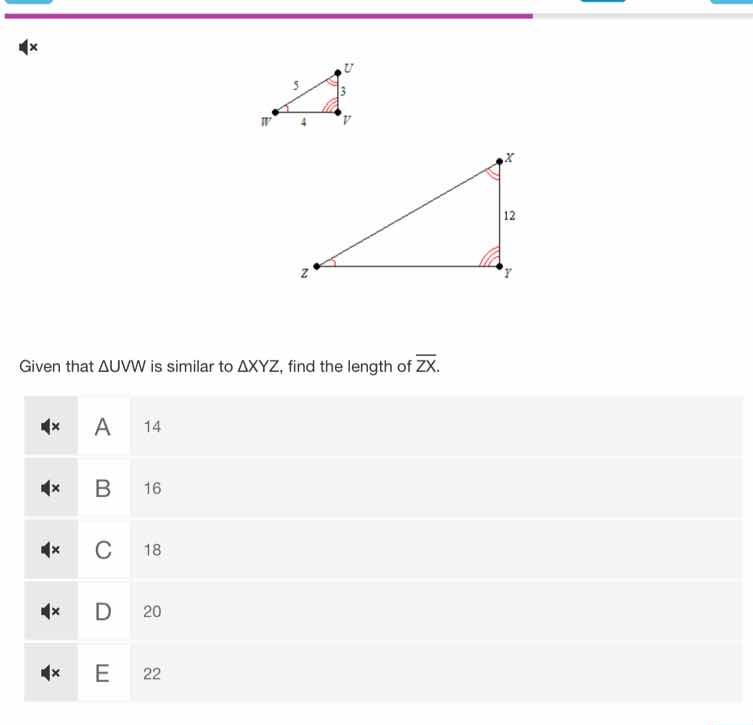
given that $\triangle uvw$ is similar to $\triangle xyz$, find the length of $\overline{zx}$.\
a 14\
b 16\
c 18\
d 20\
e 22
Step1: Identify corresponding sides
In similar triangles \( \triangle UVW \) and \( \triangle XYZ \), the sides are proportional. First, find the ratio of corresponding sides. In \( \triangle UVW \), the sides are \( UV = 3 \), \( VW = 4 \), \( UW = 5 \). In \( \triangle XYZ \), \( XY = 12 \), which corresponds to \( UV \).
Step2: Find the scale factor
The scale factor is \( \frac{XY}{UV}=\frac{12}{3} = 4 \).
Step3: Calculate \( ZX \)
\( ZX \) corresponds to \( UW \). So, \( ZX=UW\times\text{scale factor}=5\times4 = 20 \)? Wait, no, wait. Wait, let's check the triangles again. Wait, \( \triangle UVW \): right triangle? \( VW = 4 \), \( UV = 3 \), \( UW = 5 \) (3-4-5 triangle). \( \triangle XYZ \): right triangle with \( XY = 12 \), \( YZ \) is the base, \( ZX \) is the hypotenuse. Wait, maybe the correspondence is \( \triangle UVW \sim \triangle XYZ \), so \( UV \) corresponds to \( XY \), \( VW \) corresponds to \( YZ \), \( UW \) corresponds to \( ZX \). Wait, \( UV = 3 \), \( XY = 12 \), so ratio is \( 12/3 = 4 \). Then \( UW = 5 \), so \( ZX = 5\times4 = 20 \)? But wait, let's check again. Wait, maybe I mixed up the sides. Wait, \( \triangle UVW \): \( VW = 4 \), \( UV = 3 \), \( UW = 5 \). \( \triangle XYZ \): \( XY = 12 \) (vertical side), \( YZ \) (horizontal side), \( ZX \) (hypotenuse). So the ratio of similarity is \( XY/UV = 12/3 = 4 \). Then \( UW \) (hypotenuse of \( \triangle UVW \)) is 5, so hypotenuse of \( \triangle XYZ \) (ZX) is \( 5\times4 = 20 \)? But wait, the options have D as 20. Wait, but let's check again. Wait, maybe the correspondence is \( \triangle VWU \sim \triangle YZX \). Wait, no, the problem says \( \triangle UVW \) similar to \( \triangle XYZ \). So vertices U->X, V->Y, W->Z? Wait, no, the angles: the red angles. So \( \angle U \) and \( \angle X \) are equal, \( \angle V \) and \( \angle Y \) are right angles? Wait, \( \triangle UVW \): \( \angle V \) is right angle (since 3-4-5 triangle). \( \triangle XYZ \): \( \angle Y \) is right angle. So \( \triangle UVW \) (right-angled at V) and \( \triangle XYZ \) (right-angled at Y). So \( UV \) is vertical leg (3), \( VW \) is horizontal leg (4), \( UW \) is hypotenuse (5). \( XY \) is vertical leg (12), \( YZ \) is horizontal leg, \( ZX \) is hypotenuse. So vertical leg ratio: \( 12/3 = 4 \). So hypotenuse ratio is also 4. So \( ZX = 5\times4 = 20 \). Wait, but let's check the options. D is 20. So that's the answer.
Wait, but wait, maybe I made a mistake. Wait, 3-4-5 triangle, scaled by 4: 12-16-20. Oh! Wait, 34=12 (vertical leg), 44=16 (horizontal leg), 5*4=20 (hypotenuse). So \( YZ = 16 \), \( ZX = 20 \). So yes, ZX is 20. So the answer is D.

Snap & solve any problem in the app
Get step-by-step solutions on Sovi AI
Photo-based solutions with guided steps
Explore more problems and detailed explanations
D. 20