QUESTION IMAGE
Question
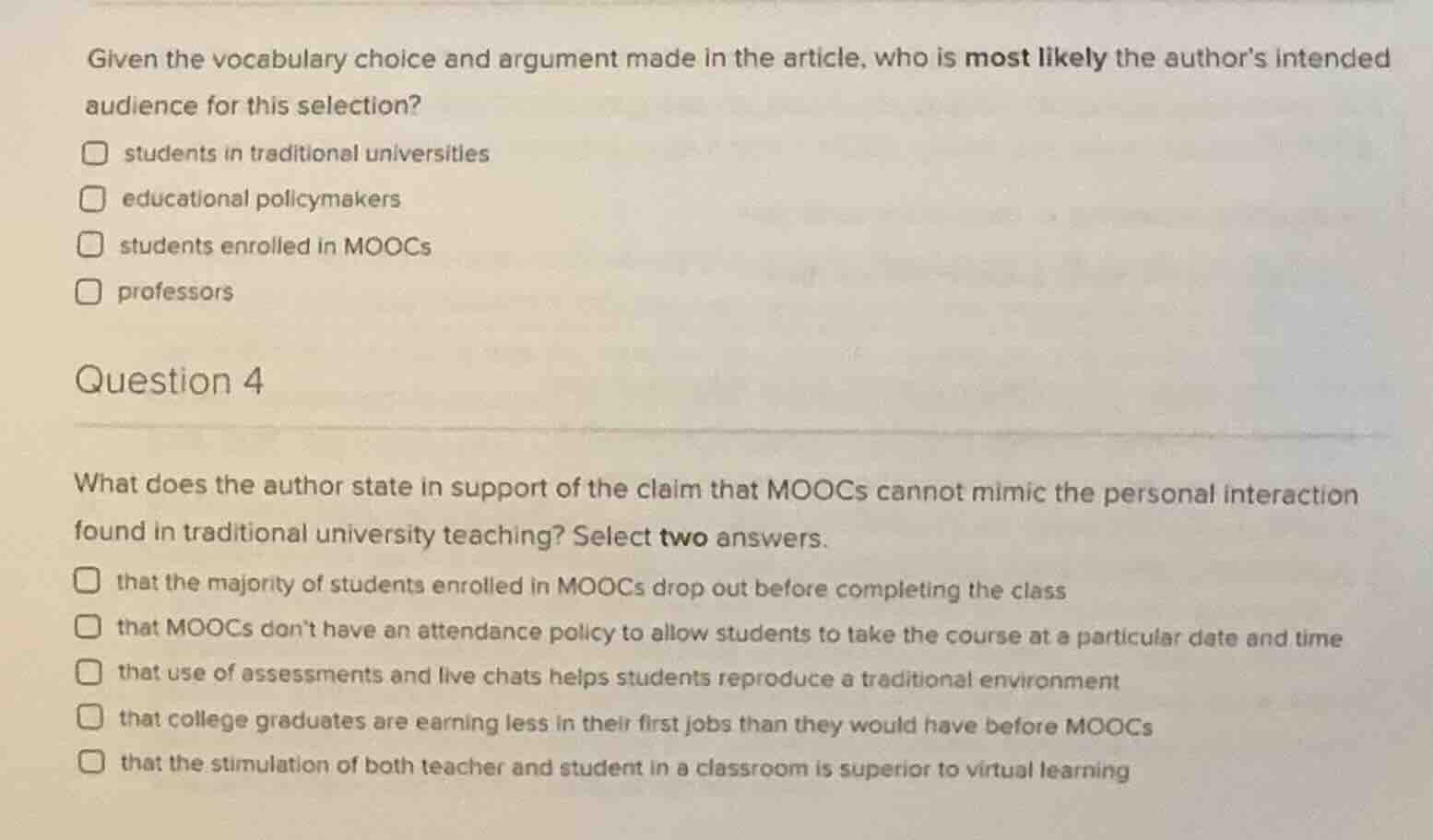
given the vocabulary choice and argument made in the article, who is most likely the authors intended audience for this selection?
□ students in traditional universities
□ educational policymakers
□ students enrolled in moocs
□ professors
question 4
what does the author state in support of the claim that moocs cannot mimic the personal interaction found in traditional university teaching? select two answers.
□ that the majority of students enrolled in moocs drop out before completing the class
□ that moocs dont have an attendance policy to allow students to take the course at a particular date and time
□ that use of assessments and live chats helps students reproduce a traditional environment
□ that college graduates are earning less in their first jobs than they would have before moocs
□ that the stimulation of both teacher and student in a classroom is superior to virtual learning
First Question (Intended Audience)
To determine the intended audience, we analyze the options. If the article discusses MOOCs and their comparison to traditional education, educational policymakers would be interested in such content for policy - making related to education. Students in traditional universities or MOOCs might not be the primary audience for an article that likely addresses broader educational issues. Professors' main focus is teaching rather than being the target for such a general - scope article about MOOCs and traditional education comparison. So educational policymakers are the most likely intended audience.
- Analyze option "that MOOCs don't have an attendance policy to allow students to take the course at a particular date and time": A fixed attendance policy in traditional classes promotes personal interaction (e.g., face - to - face discussions at a set time). MOOCs' lack of this means they can't replicate the personal interaction of traditional classes, so this supports the claim.
- Analyze option "that the stimulation of both teacher and student in a classroom is superior to virtual learning": This directly states that the classroom (traditional) interaction is better than virtual (MOOCs) learning, supporting the claim that MOOCs can't mimic traditional personal interaction.
- Option "that the majority of students enrolled in MOOCs drop out before completing the class" is about dropout rates, not personal interaction.
- Option "that use of assessments and live chats helps students reproduce a traditional environment" actually suggests MOOCs can mimic traditional interaction, so it doesn't support the claim.
- Option "that college graduates are earning less in their first jobs than they would have before MOOCs" is about earnings, not personal interaction.

Snap & solve any problem in the app
Get step-by-step solutions on Sovi AI
Photo-based solutions with guided steps
Explore more problems and detailed explanations
B. educational policymakers