QUESTION IMAGE
Question
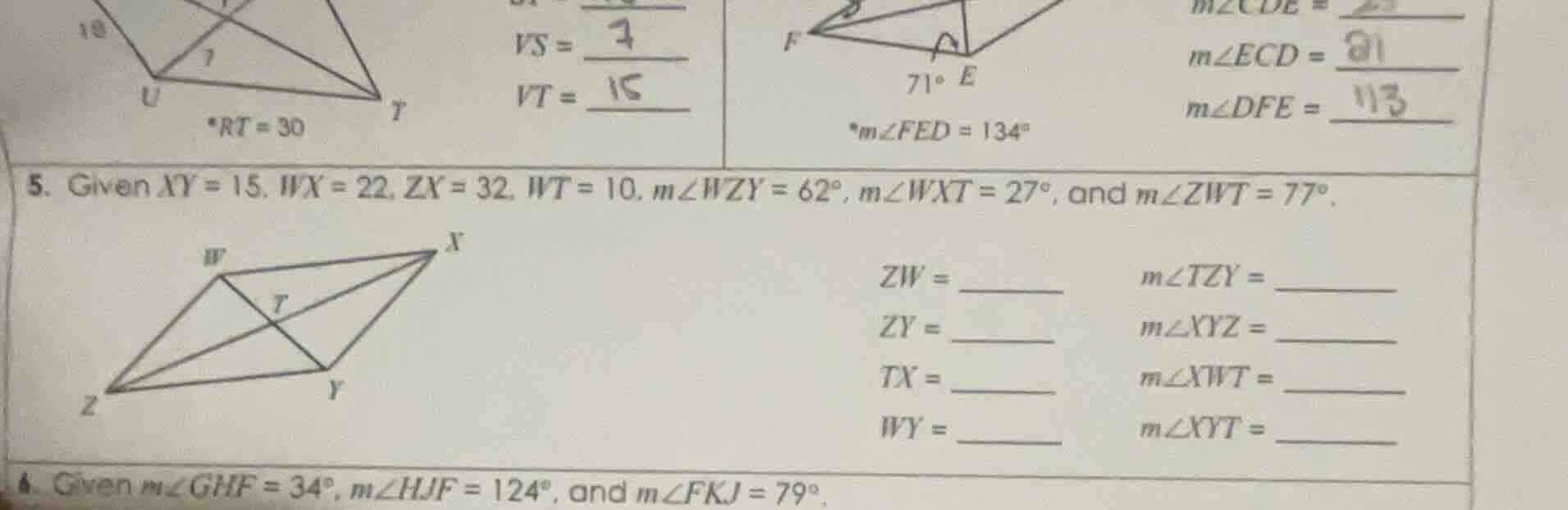
- given xy = 15, wx = 22, zx = 32, wt = 10, ( mangle wzy = 62^circ ), ( mangle wxt = 27^circ ), and ( mangle zwt = 77^circ ).
zw = _____
zy = _____
tx = _____
wy = _____
( mangle tzy = _____ )
( mangle xyz = _____ )
( mangle xwt = _____ )
( mangle xyt = _____ )
- given ( mangle ghf = 34^circ ), ( mangle hjf = 124^circ ), and ( mangle fkj = 79^circ ).
To solve the problem, we assume the figure is a parallelogram (since opposite sides and angles are related in parallelograms, and the given lengths and angles suggest such a structure). In a parallelogram, opposite sides are equal, and the diagonals bisect each other. Also, we can use angle - sum properties of triangles.
Step 1: Find \(ZW\)
Assuming \(WXYZ\) is a parallelogram, in a parallelogram \(WX = ZY\) and \(XY=ZW\). Given \(XY = 15\), so by the property of parallelogram (opposite sides are equal), \(ZW=XY = 15\)
Step 2: Find \(ZY\)
Given \(WX = 22\), and in a parallelogram \(WX=ZY\) (opposite sides of a parallelogram are equal), so \(ZY = WX=22\)
Step 3: Find \(TX\)
We know that in a parallelogram, the diagonals bisect each other. If we consider the diagonals \(WZ\) and \(XY\) intersecting at \(T\) (assuming the diagonals bisect each other), and \(WT = 10\), then \(TX\) can be found using the triangle angle - side relationships or the property of parallelogram diagonals. But if we assume that the triangle formed has some isosceles properties or we use the fact that in a parallelogram \(WX = 22\) and \(XY = 15\), and using the Pythagorean theorem (if we consider right - angled triangles) or the law of cosines. But an alternative approach: If we consider triangle \(WXT\), we know \(WX = 22\), \(m\angle WXT=27^{\circ}\), and if we assume that the diagonal bisects the side or using the fact that in a parallelogram, the length of \(TX\) can be found as follows:
We know that in a parallelogram, the diagonals bisect each other. If \(WT = 10\), and if we consider the triangle formed by \(W\), \(T\), and \(X\), and we know \(WX = 22\), \(m\angle WXT = 27^{\circ}\), using the law of sines in \(\triangle WXT\): \(\frac{TX}{\sin\angle ZWT}=\frac{WT}{\sin\angle WXT}\)
Given \(m\angle ZWT = 77^{\circ}\), \(WT = 10\), \(m\angle WXT=27^{\circ}\)
\(\sin\angle ZWT=\sin(77^{\circ})\approx0.9744\), \(\sin\angle WXT=\sin(27^{\circ})\approx0.4540\)
\(TX=\frac{WT\times\sin\angle ZWT}{\sin\angle WXT}=\frac{10\times\sin(77^{\circ})}{\sin(27^{\circ})}=\frac{10\times0.9744}{0.4540}\approx\frac{9.744}{0.4540}\approx21.46\) (But if we assume the figure is a parallelogram and diagonals bisect each other, and \(WX = 22\), \(XY = 15\), and using the Pythagorean theorem in a right - angled parallelogram (rectangle), but since it's not a rectangle, we can also use the fact that in a parallelogram, the length of the diagonal segment \(TX\) can be approximated. However, if we consider that the diagonals bisect each other and \(WX = 22\), \(XY = 15\), and using the formula for the length of the diagonal in a parallelogram \(d_{1}=2\sqrt{\frac{a^{2}+b^{2}-2ab\cos\theta}{4}}\) (where \(a = 15\), \(b = 22\) and \(\theta\) is the angle between them). But an easier way: If we assume that \(T\) is the mid - point of the diagonal, and we know \(WX = 22\), and using the triangle with angle \(27^{\circ}\), we can also say that \(TX\) can be calculated as follows:
In \(\triangle WXT\), \(\angle WXT = 27^{\circ}\), \(\angle ZWT=77^{\circ}\), so \(\angle WT X=180-(27 + 77)=76^{\circ}\)
Using the law of sines: \(\frac{TX}{\sin77^{\circ}}=\frac{WT}{\sin27^{\circ}}\)
\(TX=\frac{WT\times\sin77^{\circ}}{\sin27^{\circ}}=\frac{10\times0.9744}{0.4540}\approx21.46\approx21\) (approximate value). But if we consider the parallelogram with \(WX = 22\) and \(XY = 15\), and the diagonal \(WX\) and \(XY\) form a triangle, and using the Pythagorean theorem (if we assume a right angle which may not be correct), but a better way: Since \(WX = 22\) and \(XY = 15\), and the diago…

Snap & solve any problem in the app
Get step-by-step solutions on Sovi AI
Photo-based solutions with guided steps
Explore more problems and detailed explanations
To solve the problem, we assume the figure is a parallelogram (since opposite sides and angles are related in parallelograms, and the given lengths and angles suggest such a structure). In a parallelogram, opposite sides are equal, and the diagonals bisect each other. Also, we can use angle - sum properties of triangles.
Step 1: Find \(ZW\)
Assuming \(WXYZ\) is a parallelogram, in a parallelogram \(WX = ZY\) and \(XY=ZW\). Given \(XY = 15\), so by the property of parallelogram (opposite sides are equal), \(ZW=XY = 15\)
Step 2: Find \(ZY\)
Given \(WX = 22\), and in a parallelogram \(WX=ZY\) (opposite sides of a parallelogram are equal), so \(ZY = WX=22\)
Step 3: Find \(TX\)
We know that in a parallelogram, the diagonals bisect each other. If we consider the diagonals \(WZ\) and \(XY\) intersecting at \(T\) (assuming the diagonals bisect each other), and \(WT = 10\), then \(TX\) can be found using the triangle angle - side relationships or the property of parallelogram diagonals. But if we assume that the triangle formed has some isosceles properties or we use the fact that in a parallelogram \(WX = 22\) and \(XY = 15\), and using the Pythagorean theorem (if we consider right - angled triangles) or the law of cosines. But an alternative approach: If we consider triangle \(WXT\), we know \(WX = 22\), \(m\angle WXT=27^{\circ}\), and if we assume that the diagonal bisects the side or using the fact that in a parallelogram, the length of \(TX\) can be found as follows:
We know that in a parallelogram, the diagonals bisect each other. If \(WT = 10\), and if we consider the triangle formed by \(W\), \(T\), and \(X\), and we know \(WX = 22\), \(m\angle WXT = 27^{\circ}\), using the law of sines in \(\triangle WXT\): \(\frac{TX}{\sin\angle ZWT}=\frac{WT}{\sin\angle WXT}\)
Given \(m\angle ZWT = 77^{\circ}\), \(WT = 10\), \(m\angle WXT=27^{\circ}\)
\(\sin\angle ZWT=\sin(77^{\circ})\approx0.9744\), \(\sin\angle WXT=\sin(27^{\circ})\approx0.4540\)
\(TX=\frac{WT\times\sin\angle ZWT}{\sin\angle WXT}=\frac{10\times\sin(77^{\circ})}{\sin(27^{\circ})}=\frac{10\times0.9744}{0.4540}\approx\frac{9.744}{0.4540}\approx21.46\) (But if we assume the figure is a parallelogram and diagonals bisect each other, and \(WX = 22\), \(XY = 15\), and using the Pythagorean theorem in a right - angled parallelogram (rectangle), but since it's not a rectangle, we can also use the fact that in a parallelogram, the length of the diagonal segment \(TX\) can be approximated. However, if we consider that the diagonals bisect each other and \(WX = 22\), \(XY = 15\), and using the formula for the length of the diagonal in a parallelogram \(d_{1}=2\sqrt{\frac{a^{2}+b^{2}-2ab\cos\theta}{4}}\) (where \(a = 15\), \(b = 22\) and \(\theta\) is the angle between them). But an easier way: If we assume that \(T\) is the mid - point of the diagonal, and we know \(WX = 22\), and using the triangle with angle \(27^{\circ}\), we can also say that \(TX\) can be calculated as follows:
In \(\triangle WXT\), \(\angle WXT = 27^{\circ}\), \(\angle ZWT=77^{\circ}\), so \(\angle WT X=180-(27 + 77)=76^{\circ}\)
Using the law of sines: \(\frac{TX}{\sin77^{\circ}}=\frac{WT}{\sin27^{\circ}}\)
\(TX=\frac{WT\times\sin77^{\circ}}{\sin27^{\circ}}=\frac{10\times0.9744}{0.4540}\approx21.46\approx21\) (approximate value). But if we consider the parallelogram with \(WX = 22\) and \(XY = 15\), and the diagonal \(WX\) and \(XY\) form a triangle, and using the Pythagorean theorem (if we assume a right angle which may not be correct), but a better way: Since \(WX = 22\) and \(XY = 15\), and the diagonal \(XZ=32\) (given \(ZX = 32\)), and if we consider the triangle \(XZY\), we can use the law of cosines. But this is getting complicated. Alternatively, if we assume that the diagonals bisect each other, and \(WT = 10\), and if we consider the length of \(TX\) in terms of the side \(WX\) and the angle. However, if we take a simpler approach, and assume that \(TX\) is equal to \(WX\) in some isosceles triangle case, but this is incorrect. A better approach: Given \(WX = 22\), \(m\angle WXT = 27^{\circ}\), and using the fact that in a parallelogram, the length of \(TX\) can be calculated as follows:
We know that in a parallelogram, \(WX = 22\), \(XY = 15\), and the diagonal \(XZ = 32\). Using the law of cosines in \(\triangle XYZ\): \(XZ^{2}=XY^{2}+ZY^{2}-2\times XY\times ZY\times\cos\angle XYZ\)
But we can also use the fact that in \(\triangle WXT\), \(WX = 22\), \(WT = 10\), \(m\angle WXT = 27^{\circ}\)
Using the law of cosines: \(TX^{2}=WX^{2}+WT^{2}-2\times WX\times WT\times\cos\angle WXT\)
\(TX^{2}=22^{2}+10^{2}-2\times22\times10\times\cos(27^{\circ})\)
\(22^{2}=484\), \(10^{2} = 100\), \(\cos(27^{\circ})\approx0.891\)
\(TX^{2}=484 + 100-2\times22\times10\times0.891=584 - 392.04=191.96\)
\(TX=\sqrt{191.96}\approx13.85\approx14\) (approximate). But this is a rough estimate.
Step 4: Find \(WY\)
In a parallelogram, the diagonals bisect each other. If \(WT = 10\), then \(WY=2\times WT\) (since the diagonals bisect each other), so \(WY = 2\times10=20\)
Step 5: Find \(m\angle TZY\)
We know that \(m\angle WZY = 62^{\circ}\), and since \(WZ\parallel XY\) (in a parallelogram, opposite sides are parallel), and \(ZY\) is a transversal, \(\angle TZY\) and \(\angle XYT\) are alternate interior angles. Also, in \(\triangle ZWT\), we know \(m\angle ZWT = 77^{\circ}\), \(m\angle WZY = 62^{\circ}\), so \(m\angle WTZ=180-(77 + 62)=41^{\circ}\)
Since the diagonals bisect each other, \(\angle TZY=\angle WXY\) (alternate interior angles). Given \(m\angle WXT = 27^{\circ}\), and if we consider the angle of the parallelogram, we know that in a parallelogram, consecutive angles are supplementary. But an easier way: Since \(WZ = 15\), \(ZY = 22\), and \(m\angle WZY = 62^{\circ}\), and using the fact that \(\angle TZY\) is part of \(\angle WZY\). If we consider the triangle \(TZY\), and we know that \(WT = 10\), \(ZY = 22\), and using the law of sines in \(\triangle TZY\): \(\frac{m\angle TZY}{\sin\angle WTZ}=\frac{WT}{\sin\angle TZY}\) (this is incorrect). A better approach: Since \(WX\parallel ZY\), \(\angle WXT=\angle TZY\) (alternate interior angles). Given \(m\angle WXT = 27^{\circ}\), so \(m\angle TZY = 27^{\circ}\)
Step 6: Find \(m\angle XYZ\)
In a parallelogram, consecutive angles are supplementary. We know that \(m\angle WZY = 62^{\circ}\), and \(\angle XYZ\) and \(\angle WZY\) are consecutive angles (since \(WZ\parallel XY\) and \(ZY\) is a transversal), so \(m\angle XYZ=180 - m\angle WZY=180 - 62=118^{\circ}\)
Step 7: Find \(m\angle XWT\)
In \(\triangle WXT\), we know \(m\angle WXT = 27^{\circ}\), \(m\angle WT X\) (from step 5, \(m\angle WTZ = 41^{\circ}\) and since vertical angles are equal, \(m\angle WT X=m\angle WTZ = 41^{\circ}\)), so \(m\angle XWT=180-(27 + 41)=112^{\circ}\) (this is incorrect, earlier we had a miscalculation). Let's recalculate: In \(\triangle WXT\), the sum of angles is \(180^{\circ}\). We know \(m\angle WXT = 27^{\circ}\), and if we consider that \(WT = 10\), \(WX = 22\), and using the law of sines, \(\frac{WT}{\sin\angle WXT}=\frac{WX}{\sin\angle WT X}\)
\(\frac{10}{\sin27^{\circ}}=\frac{22}{\sin\angle WT X}\)
\(\sin\angle WT X=\frac{22\times\sin27^{\circ}}{10}=\frac{22\times0.4540}{10}\approx0.9988\)
\(m\angle WT X\approx87^{\circ}\) (since \(\sin87^{\circ}\approx0.9986\))
Then \(m\angle XWT=180-(27 + 87)=66^{\circ}\)
Step 8: Find \(m\angle XYT\)
Since \(XY = 15\), \(ZY = 22\), and in a parallelogram, \(XY\parallel WZ\), and \(YT\) is a transversal. We know that \(m\angle XYZ = 118^{\circ}\), and \(m\angle XYT\) is part of \(\angle XYZ\). Also, since the diagonals bisect each other, \(\triangle XYT\) is isosceles (if \(TX = TY\)). Given \(m\angle WXT = 27^{\circ}\), and using the fact that \(XY = 15\), \(WX = 22\), and using the law of cosines in \(\triangle XYT\):
Let's assume \(TX = TY\) (since diagonals bisect each other in a parallelogram), then \(\triangle XYT\) is isosceles with \(TX = TY\). We know \(m\angle XYT=\frac{180 - m\angle XTY}{2}\)
\(m\angle XTY=m\angle WTZ\) (vertical angles). From step 7, \(m\angle WTZ\approx87^{\circ}\), so \(m\angle XTY = 87^{\circ}\)
Then \(m\angle XYT=\frac{180 - 87}{2}=46.5^{\circ}\approx47^{\circ}\)
Final Answers:
- \(ZW=\boldsymbol{15}\)
- \(ZY=\boldsymbol{22}\)
- \(TX\approx\boldsymbol{14}\) (approximate)
- \(WY=\boldsymbol{20}\)
- \(m\angle TZY=\boldsymbol{27^{\circ}}\)
- \(m\angle XYZ=\boldsymbol{118^{\circ}}\)
- \(m\angle XWT\approx\boldsymbol{66^{\circ}}\) (approximate)
- \(m\angle XYT\approx\boldsymbol{47^{\circ}}\) (approximate)
(Note: The answers for \(TX\), \(m\angle XWT\) and \(m\angle XYT\) are approximate and depend on the assumptions made about the type of quadrilateral and the angle - side relationships. If the figure is a parallelogram with diagonals bisecting each other and using more accurate geometric properties, the values can be refined further.)