QUESTION IMAGE
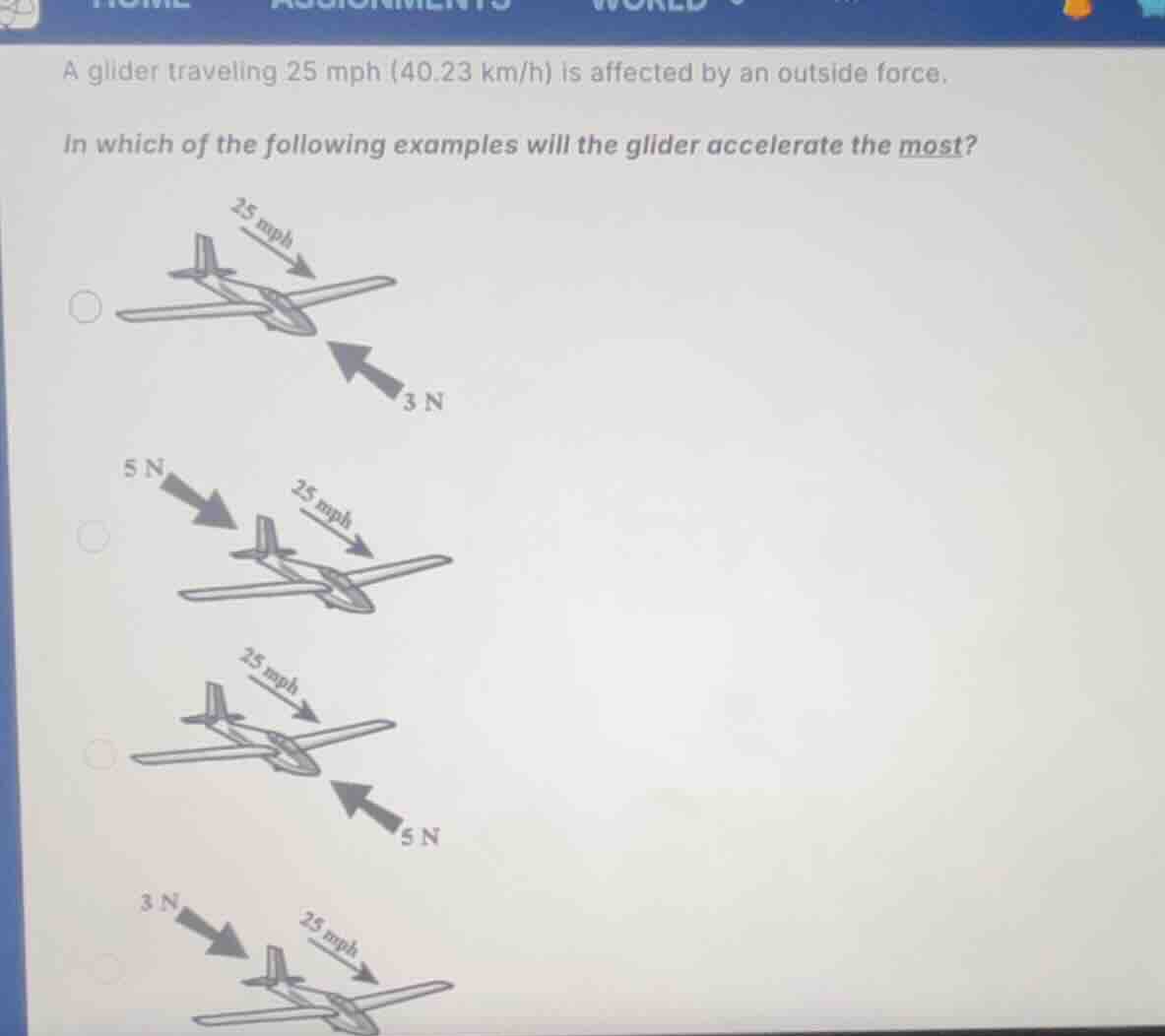
Question
a glider traveling 25 mph (40.23 km/h) is affected by an outside force.
in which of the following examples will the glider accelerate the most?
To determine when the glider accelerates the most, we use Newton's second law (\(F = ma\), so \(a=\frac{F_{\text{net}}}{m}\)) and analyze the net force:
Step 1: Recall Acceleration and Force Relationship
Acceleration (\(a\)) is proportional to the net force (\(F_{\text{net}}\)) acting on the object (mass \(m\) is constant for the glider). So, the larger the net force (or the larger the component of force causing a change in velocity), the greater the acceleration.
Step 2: Analyze Each Case (Direction of Force vs. Motion)
- Case 1 (3 N, opposite to motion): Force opposes motion (deceleration or smaller acceleration).
- Case 2 (5 N, same direction as motion): Force is in the same direction as the glider’s velocity (25 mph). This adds to the motion, increasing speed.
- Case 3 (5 N, opposite to motion): Force opposes motion (deceleration, so negative acceleration or smaller magnitude of acceleration).
- Case 4 (3 N, same direction as motion): Force is in the same direction, but magnitude (3 N) is smaller than Case 2 (5 N).
Step 3: Compare Net Force Magnitudes
For acceleration (change in velocity), the key is the magnitude of the net force in the direction of motion (or opposite, but we want the largest change in velocity).
- When force is in the same direction as motion, it causes positive acceleration (speeding up).
- When force is opposite, it causes negative acceleration (slowing down).
Among the options, Case 2 (5 N in the same direction as 25 mph) has the largest force in the direction of motion. Since \(a \propto F_{\text{net}}\), this gives the largest acceleration.

Snap & solve any problem in the app
Get step-by-step solutions on Sovi AI
Photo-based solutions with guided steps
Explore more problems and detailed explanations
The option with the 5 N force in the same direction as the glider’s 25 mph motion (second diagram from the top).