QUESTION IMAGE
Question
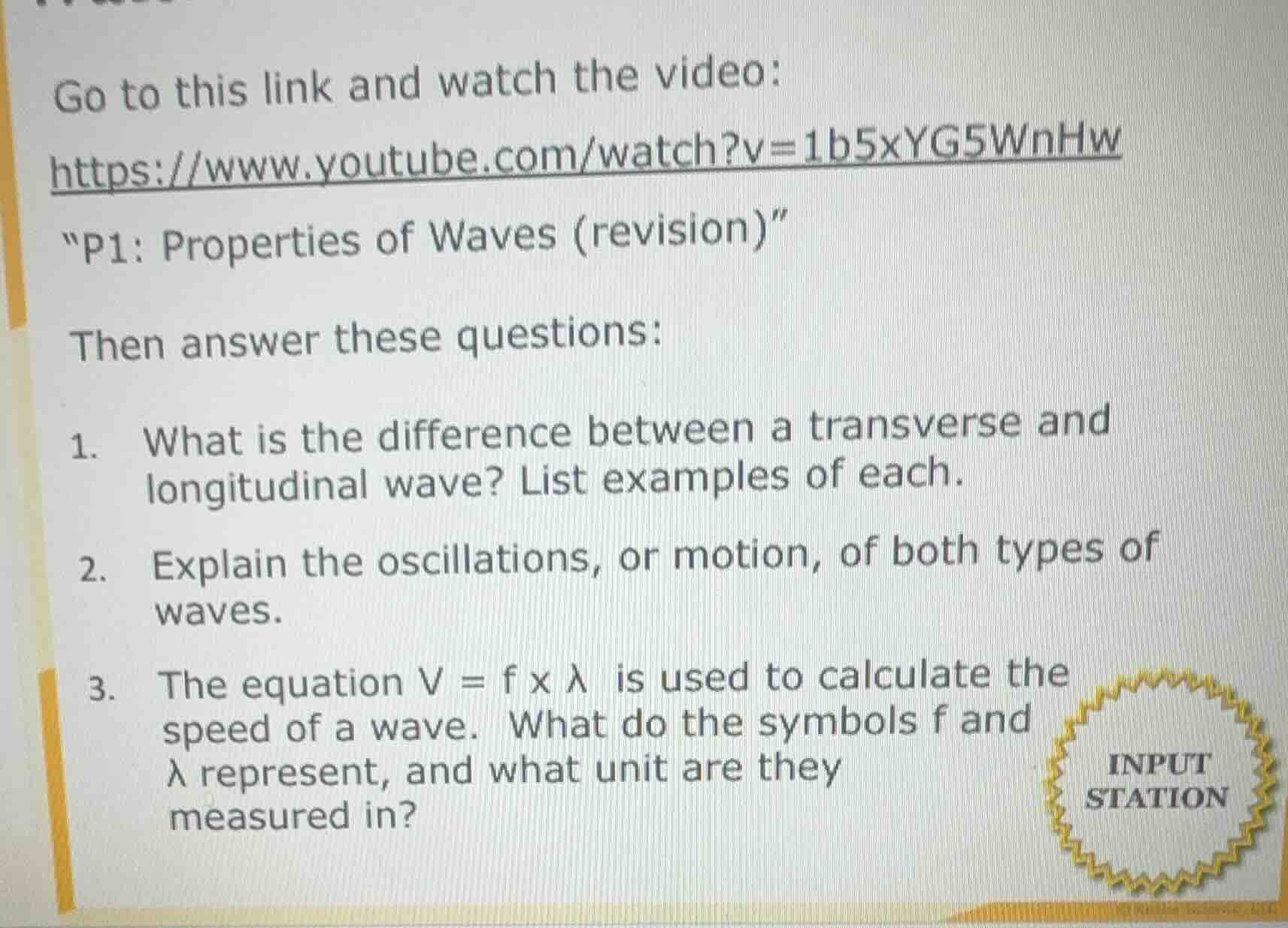
go to this link and watch the video:
https://www.youtube.com/watch?v=1b5xyg5wnhw
\p1: properties of waves (revision)\
then answer these questions:
- what is the difference between a transverse and longitudinal wave? list examples of each.
- explain the oscillations, or motion, of both types of waves.
- the equation $v = f \times \lambda$ is used to calculate the speed of a wave. what do the symbols $f$ and $\lambda$ represent, and what unit are they measured in?
Question 1
A transverse wave has oscillations perpendicular to the wave's direction of travel (e.g., light, water waves). A longitudinal wave has oscillations parallel to the wave's direction (e.g., sound, slinky compressions).
For transverse waves, particles move up - down (perpendicular to wave direction), like a rope wave. For longitudinal waves, particles move back - forth (parallel), like pushing a slinky (compressions/rarefactions).
In \( V = f\times\lambda \), \( f \) is frequency (number of cycles per second, unit: hertz, Hz), \( \lambda \) is wavelength (distance per cycle, unit: meter, m).

Snap & solve any problem in the app
Get step-by-step solutions on Sovi AI
Photo-based solutions with guided steps
Explore more problems and detailed explanations
- Difference: In a transverse wave, the particles oscillate perpendicular to the wave's direction of propagation. In a longitudinal wave, particles oscillate parallel to the wave's direction.
- Examples: Transverse - electromagnetic waves (light), water waves; Longitudinal - sound waves, waves in a slinky (compression - rarefaction waves).