QUESTION IMAGE
Question
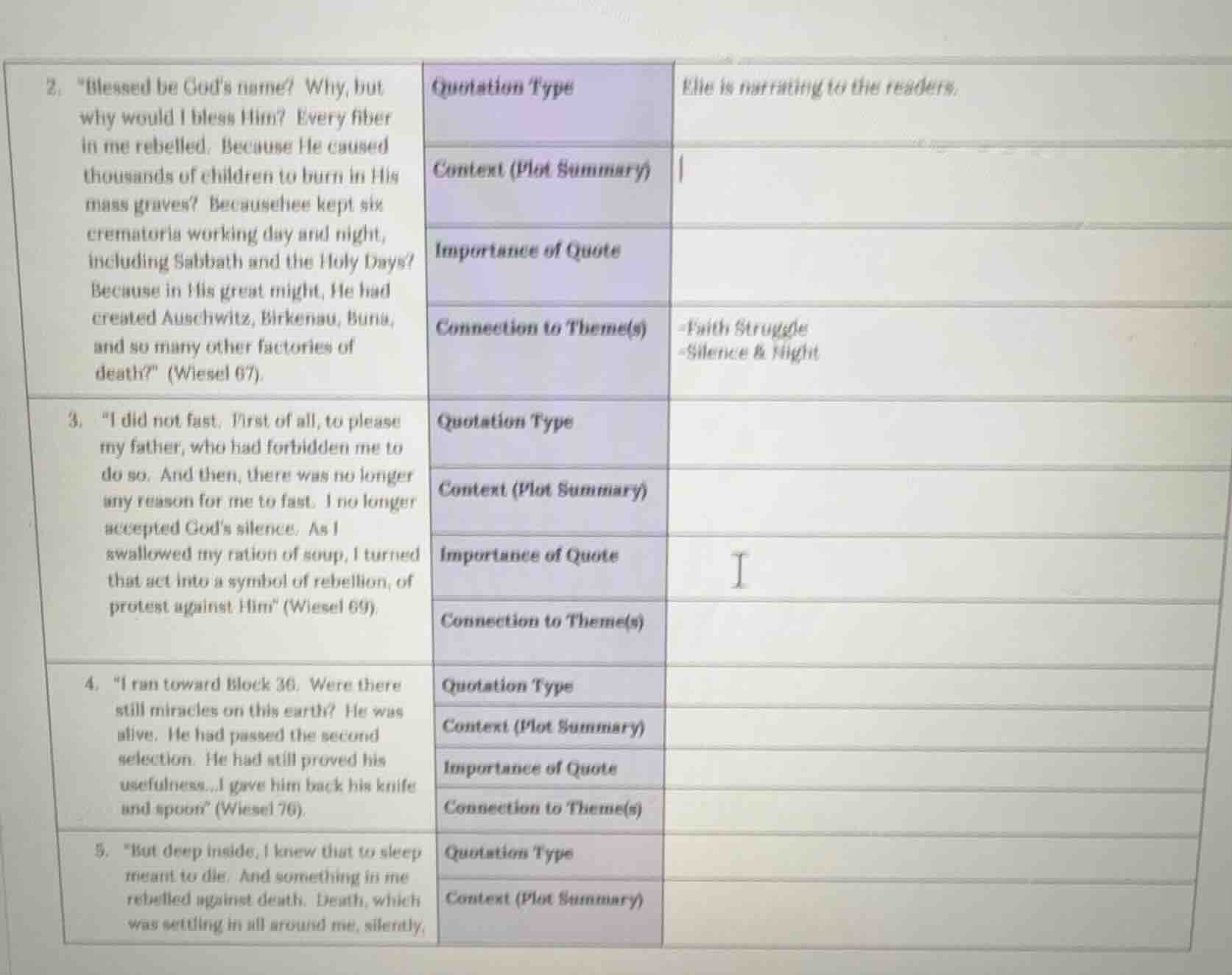
- \blessed be gods name? why, but why would i bless him? every fiber in me rebelled. because he caused thousands of children to burn in his mass graves? because he kept six crematoria working day and night, including sabbath and the holy days? because in his great might, he had created auschwitz, birkenau, buna, and so many other factories of death?\ (wiesel 67).
quotation type: elie is narrating to the readers.
context (plot summary):
importance of quote:
connection to theme(s): -faith struggle -silence & night
- \i did not fast. first of all, to please my father, who had forbidden me to do so. and then, there was no longer any reason for me to fast. i no longer accepted gods silence. as i swallowed my ration of soup, i turned that act into a symbol of rebellion, of protest against him\ (wiesel 69).
quotation type:
context (plot summary):
importance of quote:
connection to theme(s):
- \i ran toward block 36. were there still miracles on this earth? he was alive. he had passed the second selection. he had still proved his usefulness...i gave him back his knife and spoon\ (wiesel 70).
quotation type:
context (plot summary):
importance of quote:
connection to theme(s):
- \but deep inside, i knew that to sleep meant to die. and something in me rebelled against death. death, which was settling in all around me, silently,
Brief Explanations
For Quote 2:
- Quotation Type: Internal monologue (Elie's private, angry questioning of God, shared directly with readers as part of his narration).
- Context (Plot Summary): Elie is in Auschwitz during the Holocaust, witnessing constant mass murder of children and others, even on sacred Jewish days, and is furious at God for allowing this suffering.
- Importance of Quote: It marks a pivotal breaking point in Elie's faith, showing his shift from devout belief to bitter rebellion against a seemingly cruel, silent God.
- Connection to Theme(s): Ties to Faith Struggle (his rejection of God's goodness) and Silence & Night (God's silence in the face of the "night" of genocide).
For Quote 3:
- Quotation Type: First-person reflective narration (Elie explains his deliberate choice to break a religious practice).
- Context (Plot Summary): During Yom Kippur, the Jewish Day of Atonement, Elie chooses not to fast, defying both his father's initial request and religious tradition as an act of protest against God.
- Importance of Quote: It concretizes his rebellion against God, framing his act of eating as a symbolic rejection of God's silence and the suffering He allows.
- Connection to Theme(s): Faith Struggle (active rejection of religious practice due to lost faith) and Silence & Night (protesting God's silence amid the "night" of the camps).
For Quote 4:
- Quotation Type: First-person action and reflective narration (Elie describes his reaction to his father surviving a selection).
- Context (Plot Summary): After a selection where prisoners are chosen for death, Elie finds his father is still alive; he returns the knife and spoon (a precious inheritance his father gave him earlier, fearing he would die).
- Importance of Quote: It highlights the fragile bond between Elie and his father, and the small, hopeful moments amid constant death that keep them going.
- Connection to Theme(s): Family Bond (the value of their relationship in survival) and Survival (his father's "usefulness" as a means to avoid death).
For Quote 5:
- Quotation Type: Internal monologue (Elie's private resolve to resist death).
- Context (Plot Summary): In the brutal conditions of the camps, Elie recognizes that giving in to sleep (a temptation when exhausted) would lead to certain death, and he forces himself to stay awake.
- Importance of Quote: It shows the raw, instinctual will to survive that overrides physical exhaustion, capturing the dehumanizing fight to stay alive in the camps.
- Connection to Theme(s): Survival (the primal drive to resist death) and Night (the pervasive threat of death that defines camp life).

Snap & solve any problem in the app
Get step-by-step solutions on Sovi AI
Photo-based solutions with guided steps
Explore more problems and detailed explanations
Quote 2
| Category | Response |
|---|---|
| Context (Plot Summary) | Elie rages at God in Auschwitz, horrified by mass child murder on sacred days. |
| Importance of Quote | Marks Elie's bitter faith breaking point. |
| Connection to Theme(s) | -Faith Struggle<br>-Silence & Night |
Quote 3
| Category | Response |
|---|---|
| Context (Plot Summary) | Elie refuses to fast on Yom Kippur as protest against God. |
| Importance of Quote | Concretizes his active rebellion against God. |
| Connection to Theme(s) | -Faith Struggle<br>-Silence & Night |
Quote 4
| Category | Response |
|---|---|
| Context (Plot Summary) | Elie's father survives a selection; Elie returns his inherited knife/spoon. |
| Importance of Quote | Highlights their fragile, life-sustaining bond. |
| Connection to Theme(s) | -Family Bond<br>-Survival |
Quote 5
| Category | Response |
|---|---|
| Context (Plot Summary) | Elie fights sleep to avoid death in camp conditions. |
| Importance of Quote | Shows primal will to survive amid exhaustion. |
| Connection to Theme(s) | -Survival<br>-Night |