QUESTION IMAGE
Question
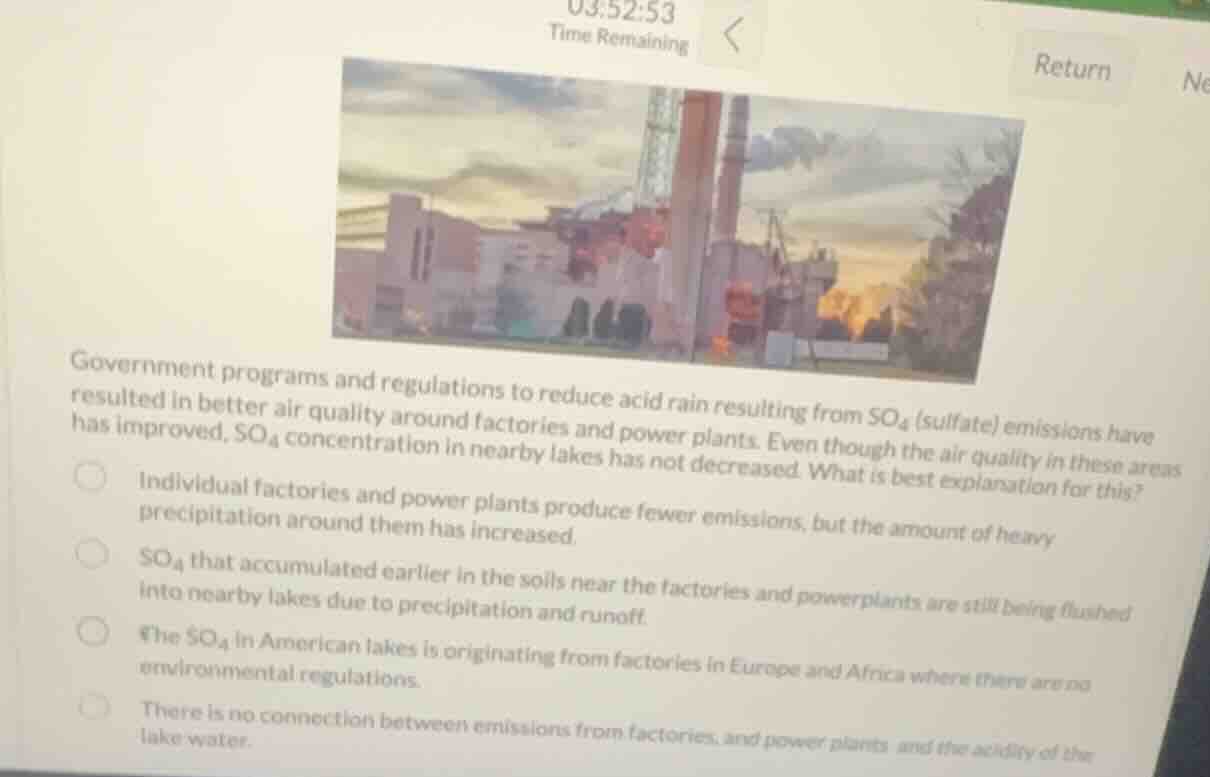
government programs and regulations to reduce acid rain resulting from so₄ (sulfate) emissions have resulted in better air quality around factories and power plants. even though the air quality in these areas has improved, so₄ concentration in nearby lakes has not decreased. what is best explanation for this?
- individual factories and power plants produce fewer emissions, but the amount of heavy precipitation around them has increased.
- so₄ that accumulated earlier in the soils near the factories and powerplants are still being flushed into nearby lakes due to precipitation and runoff.
- the so₄ in american lakes is originating from factories in europe and africa where there are no environmental regulations.
- there is no connection between emissions from factories, and power plants and the acidity of the lake water.
Brief Explanations
To solve this, we analyze each option:
- Option 1: Increasing heavy precipitation would likely flush more sulfate, but the question is why sulfate in lakes hasn't decreased despite reduced emissions. This doesn't explain the persistence of sulfate in lakes from past emissions.
- Option 2: Sulfate that accumulated earlier in the soil near factories and power plants can be flushed into lakes via precipitation and runoff. Even if current emissions are reduced, the stored sulfate in the soil can continue to enter the lakes, which explains why lake sulfate concentrations haven't decreased.
- Option 3: There's no strong evidence that European and African factories are the main source of sulfate in American lakes, and this is not a likely explanation compared to the soil accumulation factor.
- Option 4: There is a known connection between factory/power plant emissions (sulfate) and lake acidity (from acid rain), so this is incorrect.

Snap & solve any problem in the app
Get step-by-step solutions on Sovi AI
Photo-based solutions with guided steps
Explore more problems and detailed explanations
B. $\ce{SO_{4}}$ that accumulated earlier in the soils near the factories and powerplants are still being flushed into nearby lakes due to precipitation and runoff.