QUESTION IMAGE
Question
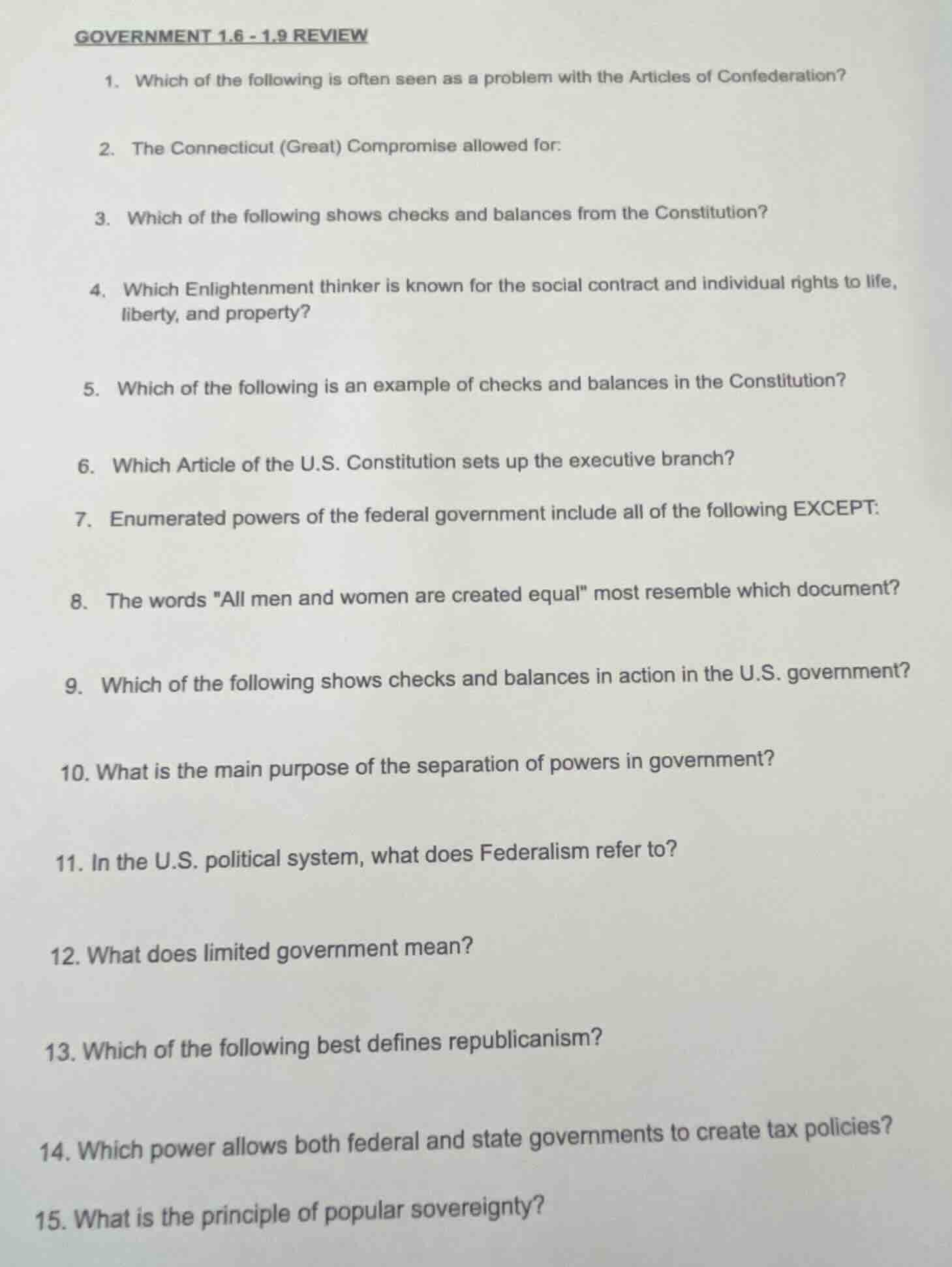
government 1.6 - 1.9 review
- which of the following is often seen as a problem with the articles of confederation?
- the connecticut (great) compromise allowed for:
- which of the following shows checks and balances from the constitution?
- which enlightenment thinker is known for the social contract and individual rights to life, liberty, and property?
- which of the following is an example of checks and balances in the constitution?
- which article of the u.s. constitution sets up the executive branch?
- enumerated powers of the federal government include all of the following except:
- the words \all men and women are created equal\ most resemble which document?
- which of the following shows checks and balances in action in the u.s. government?
- what is the main purpose of the separation of powers in government?
- in the u.s. political system, what does federalism refer to?
- what does limited government mean?
- which of the following best defines republicanism?
- which power allows both federal and state governments to create tax policies?
- what is the principle of popular sovereignty?
Brief Explanations
- Identifies a core flaw of the Articles of Confederation, which lacked a strong central government, most notably the inability to tax states or regulate interstate commerce.
- Describes the Great Compromise, which established a bicameral legislature: the Senate (equal representation per state) and the House of Representatives (representation based on state population).
- Defines checks and balances as the system where each branch of government can limit the power of the others (e.g., Congress can override a presidential veto, the Supreme Court can declare laws unconstitutional).
- Names John Locke, the Enlightenment philosopher whose work Two Treatises of Government outlined the social contract and natural rights to life, liberty, and property.
- Provides a specific example of checks and balances, such as the president vetoing a bill passed by Congress, or the Senate confirming presidential nominees.
- States that Article II of the U.S. Constitution establishes the executive branch, led by the president.
- Excludes a non-enumerated power; enumerated powers (listed in Article I, Section 8) include coining money, declaring war, and regulating interstate commerce, while powers like establishing public schools are reserved for states.
- Links the phrase to the Declaration of Sentiments (1848), which adapted the Declaration of Independence's language to advocate for women's rights.
- Gives a real-world example of checks and balances in action, such as the Supreme Court striking down a federal law as unconstitutional, or Congress impeaching a federal official.
- Explains that separation of powers divides government authority into legislative, executive, and judicial branches to prevent any single branch from gaining too much power.
- Defines U.S. federalism as the system of shared power between the national (federal) government and state governments, with each having distinct and overlapping authorities.
- Defines limited government as the principle that government power is restricted by law (like the Constitution) and cannot act arbitrarily, protecting individual rights.
- Defines republicanism as a system of government where power is held by the people, who exercise it through elected representatives, rather than a monarch.
- Identifies concurrent powers, which are powers shared by both the federal and state governments, including the ability to levy taxes.
- Defines popular sovereignty as the principle that the ultimate source of governmental power lies with the people, who express their will through elections and other democratic processes.

Snap & solve any problem in the app
Get step-by-step solutions on Sovi AI
Photo-based solutions with guided steps
Explore more problems and detailed explanations
- A common problem was the federal government's inability to levy taxes or regulate interstate commerce (it had no power to enforce laws on states).
- A bicameral legislature with equal representation in the Senate (2 per state) and population-based representation in the House of Representatives.
- Examples include: Congress can override a presidential veto; the Supreme Court can declare federal/state laws unconstitutional; the president nominates federal judges, who are confirmed by the Senate.
- John Locke
- Example: The president vetoes a bill passed by the U.S. Congress.
- Article II
- Example of a correct answer (non-enumerated power): The power to establish public schools (reserved for states).
- The Declaration of Sentiments (from the 1848 Seneca Falls Convention)
- Example: The U.S. Supreme Court strikes down a federal law as a violation of the Constitution.
- To prevent the concentration of power in any single branch of government, protecting against tyranny.
- A system of shared political power between the national (federal) government and state governments, each having their own areas of authority.
- A system where government power is restricted by a constitution or laws, ensuring it cannot act without limit and must respect individual rights.
- A form of government where power is held by the people and exercised through elected representatives, rather than a hereditary ruler.
- Concurrent powers
- The principle that the authority of the government is created and sustained by the consent of its people, who are the source of all political power.