QUESTION IMAGE
Question
grammar passage
cursive writing
recent articles have documented the slow death of a
traditional subject in the elementary school curriculum for
well over a century. since the 1970s, teaching penmanship,
usually in the second or third grades, declined. with 45 state
adopting common core standards in which there is no
mention of cursive writing has hammered the last nail into
the penmanship tradition. well, not quite.
efforts to prevent the extinction of an endangered school
subject in north carolina, indiana and a few other states hav
led to legislative mandates that penmanship be taught in
elementary school. that delaying action, however, will not
alter the eventual disappearance of handwriting from the
curriculum.
6 arguments for dropping cursive handwriting include
irrelevance—block printing is now acceptable in replacing
cursive, typing is far more efficient than handwriting,
standardized tests do not require handwriting—and its
difficulty for many students to learn who will not use it much
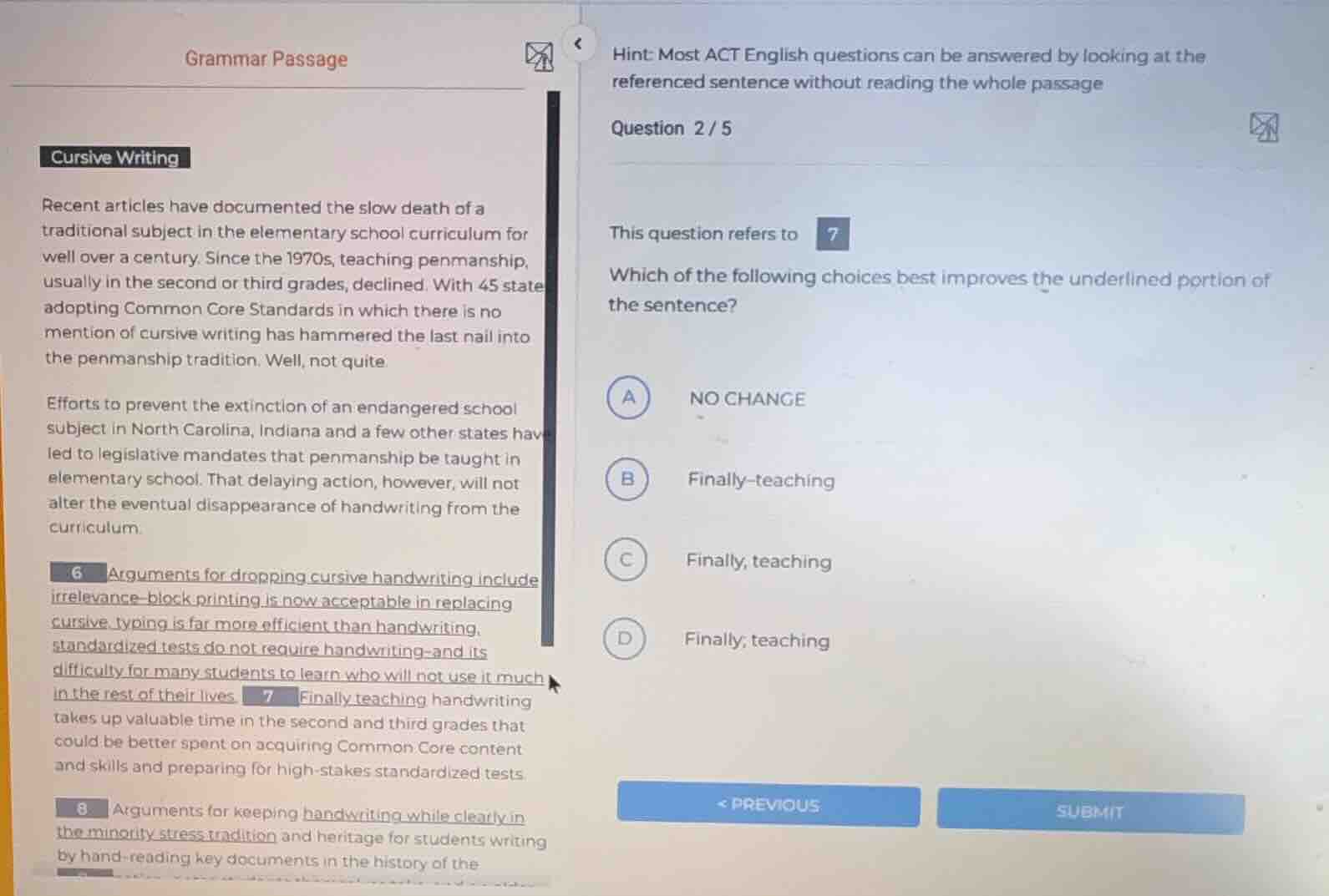
in the rest of their lives 7 finally teaching handwriting
takes up valuable time in the second and third grades that
could be better spent on acquiring common core content
and skills and preparing for high - stakes standardized tests.
8 arguments for keeping handwriting while clearly in
the minority stress tradition and heritage for students writing
by hand - reading key documents in the history of the
hint: most act english questions can be answered by looking at the
referenced sentence without reading the whole passage
question 2 / 5
this question refers to 7
which of the following choices best improves the underlined portion of
the sentence?
a no change
b finally—teaching
c finally, teaching
d finally, teaching
To determine the correct answer, we analyze the punctuation and context. The original underlined part is "Finally teaching" (assuming the original had no comma). We need a comma after "Finally" to separate the introductory adverb from the main clause. Option A is incorrect as the original likely has an error. Option B uses a hyphen, which is inappropriate here. Option C and D (assuming D is a typo and same as C) have "Finally, teaching" which correctly uses a comma to introduce the clause. So the correct choice is the one with "Finally, teaching".

Snap & solve any problem in the app
Get step-by-step solutions on Sovi AI
Photo-based solutions with guided steps
Explore more problems and detailed explanations
D. Finally, teaching (assuming option D is same as C in content with correct punctuation; if options C and D are same, then C/D. If original options have C as "Finally, teaching" then C. Finally, teaching)