QUESTION IMAGE
Question
graph the equation shown below by transforming the given graph of the parent function. \\( y = (x + 2)^3 + 2 \\)
Step1: Identify Parent Function
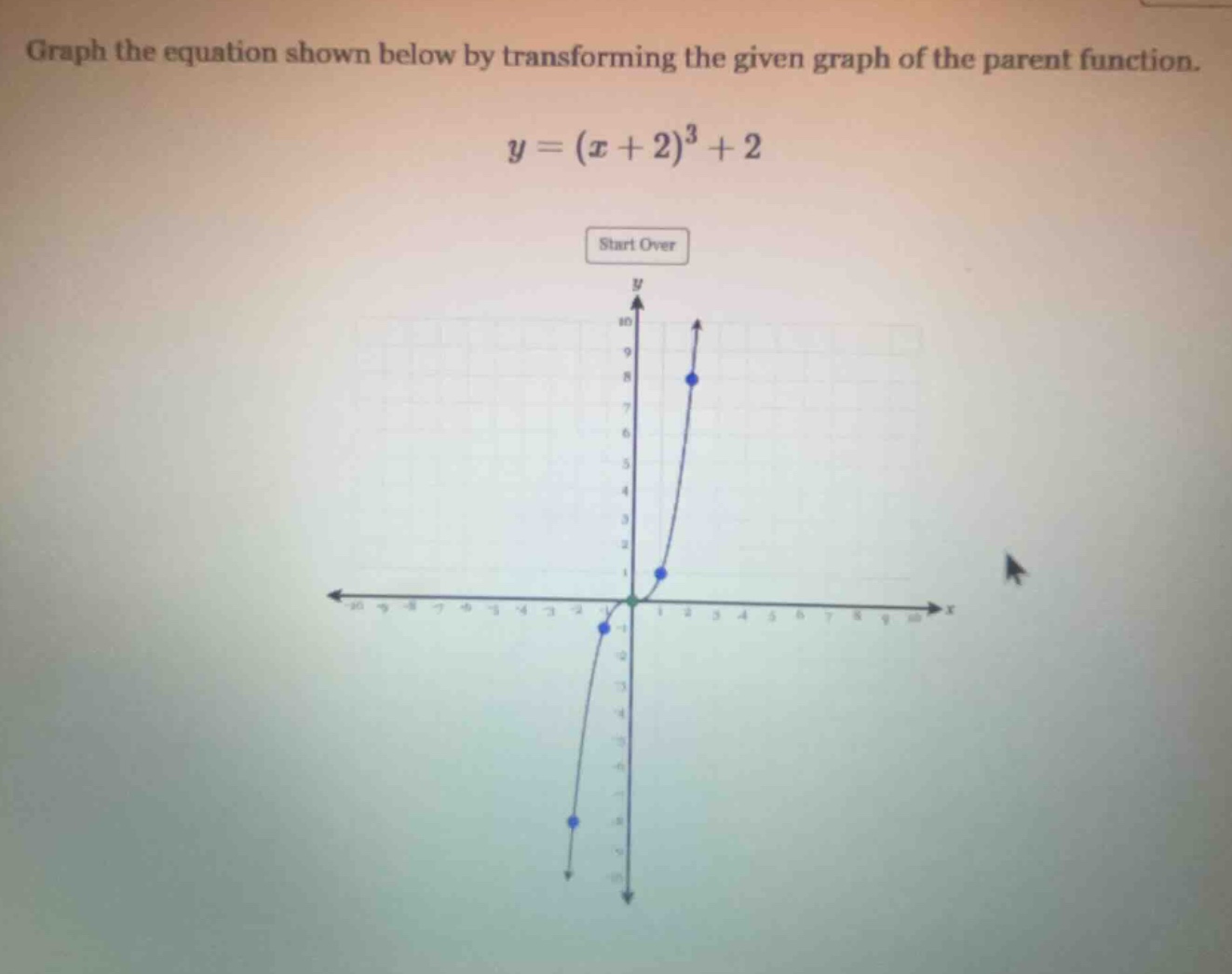
The parent function for \( y=(x + 2)^{3}+2 \) is \( y = x^{3} \). The graph of \( y=x^{3} \) passes through the origin \((0,0)\), is symmetric about the origin, and has a point - shape with a cubic curve.
Step2: Analyze Horizontal Shift
For a function of the form \( y=(x - h)^{3}+k \), the horizontal shift is determined by \( h \). In the equation \( y=(x + 2)^{3}+2 \), we can rewrite it as \( y=(x-(- 2))^{3}+2 \). So, the graph of \( y = x^{3} \) is shifted 2 units to the left. This is because when \( h=-2\), the transformation \( x
ightarrow x - h=x+2 \) causes a left shift (since for the same \( y \) - value, we need to decrease \( x \) by 2 to get the same output as the parent function).
Step3: Analyze Vertical Shift
The vertical shift is determined by \( k \). In the equation \( y=(x + 2)^{3}+2 \), \( k = 2 \). So, after the horizontal shift, the graph is shifted 2 units up.
Step4: Transform Key Points
- For the parent function \( y=x^{3} \), some key points are \((0,0)\), \((1,1)\), \((- 1,-1)\), \((2,8)\), \((-2,-8)\).
- After a horizontal shift of 2 units left (\( x
ightarrow x - 2 \)) and a vertical shift of 2 units up (\( y
ightarrow y + 2 \)):
- For the point \((0,0)\): New \( x=0 - 2=-2\), new \( y = 0+2 = 2\), so the point becomes \((-2,2)\).
- For the point \((1,1)\): New \( x=1 - 2=-1\), new \( y=1 + 2=3\), so the point becomes \((-1,3)\).
- For the point \((-1,-1)\): New \( x=-1 - 2=-3\), new \( y=-1 + 2 = 1\), so the point becomes \((-3,1)\).
- For the point \((2,8)\): New \( x=2 - 2=0\), new \( y=8 + 2=10\), so the point becomes \((0,10)\).
- For the point \((-2,-8)\): New \( x=-2 - 2=-4\), new \( y=-8 + 2=-6\), so the point becomes \((-4,-6)\).
- Then, we plot these new points and draw the cubic curve passing through them, which will be the graph of \( y=(x + 2)^{3}+2 \). The general shape of the cubic curve (with the characteristic S - shape of a cubic function) is maintained, but it is shifted 2 units left and 2 units up from the parent function \( y=x^{3} \).

Snap & solve any problem in the app
Get step-by-step solutions on Sovi AI
Photo-based solutions with guided steps
Explore more problems and detailed explanations
To graph \( y=(x + 2)^{3}+2 \):
- Start with the parent function \( y = x^{3} \) (cubic curve through \((0,0)\), \((1,1)\), \((-1,-1)\) etc.).
- Shift the graph of \( y=x^{3} \) 2 units to the left (replace \( x \) with \( x + 2 \)) and 2 units up (add 2 to the function value).
- Plot the transformed key points (e.g., \((-2,2)\), \((-1,3)\), \((-3,1)\), \((0,10)\), \((-4,-6)\)) and draw the cubic curve through them. The final graph is a cubic curve shifted 2 units left and 2 units up from \( y=x^{3} \).