QUESTION IMAGE
Question
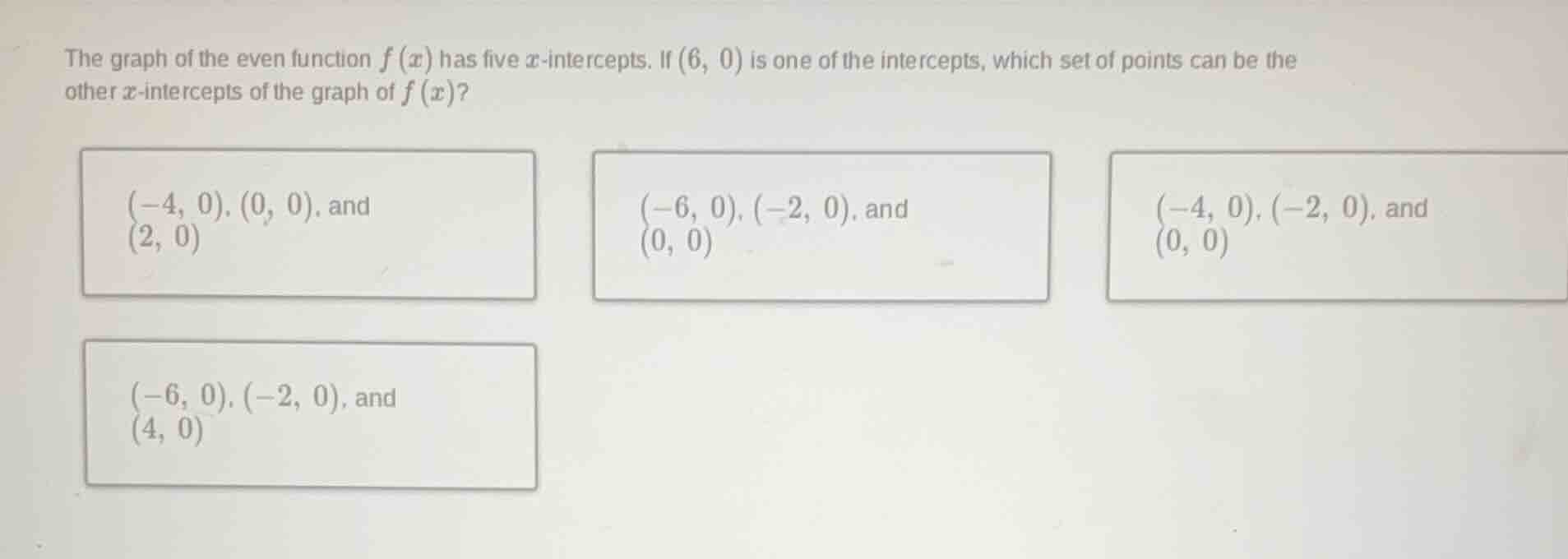
the graph of the even function $f(x)$ has five $x$-intercepts. if $(6, 0)$ is one of the intercepts, which set of points can be the other $x$-intercepts of the graph of $f(x)$?
$(-4, 0)$, $(0, 0)$, and $(2, 0)$
$(-6, 0)$, $(-2, 0)$, and $(0, 0)$
$(-4, 0)$, $(-2, 0)$, and $(0, 0)$
$(-6, 0)$, $(-2, 0)$, and $(4, 0)$
Step1: Recall the property of even functions
For an even function \( f(x) \), we have \( f(x)=f(-x) \) for all \( x \) in the domain. This implies that if \( (a, 0) \) is an \( x \)-intercept (i.e., \( f(a) = 0 \)), then \( (-a, 0) \) must also be an \( x \)-intercept because \( f(-a)=f(a) = 0 \). Also, the graph of an even function is symmetric about the \( y \)-axis.
Given that \( (6, 0) \) is an \( x \)-intercept, by the property of even functions, \( (-6, 0) \) must also be an \( x \)-intercept.
Step2: Analyze the number of intercepts
The function has five \( x \)-intercepts. We already have \( (6, 0) \) and \( (-6, 0) \) (from the even function property). Now we need three more intercepts. Among the options, we need to check which set includes \( (-6, 0) \) and has a total of three other intercepts (along with \( (6,0) \) and \( (-6,0) \) to make five).
Let's check each option:
- Option 1: \( (-4, 0),(0, 0),(2, 0) \): Does not include \( (-6, 0) \), so eliminate.
- Option 2: \( (-6, 0),(-2, 0),(0, 0) \): Includes \( (-6, 0) \). Now, the intercepts would be \( (6, 0), (-6, 0), (-2, 0), (0, 0) \) and we need one more? Wait, no, the set given is three points, so total intercepts: \( (6,0) \) (given), \( (-6,0), (-2,0), (0,0) \) from the set. Wait, no, the problem says "the other \( x \)-intercepts" besides \( (6,0) \). So total intercepts: \( (6,0) \) plus the three in the set. So total \( 1 + 3=4 \)? Wait, no, maybe I misread. Wait, the function has five \( x \)-intercepts. One is \( (6,0) \), so we need four more? Wait, no, the options are sets of "the other \( x \)-intercepts", so the number of intercepts in the set plus 1 (the \( (6,0) \)) should be five. So the set should have four intercepts? Wait, no, let's re - examine.
Wait, the even function: if \( (a,0) \) is an intercept, \( (-a,0) \) is also an intercept, unless \( a = 0 \). The \( y \)-intercept (when \( x = 0 \)) is its own mirror image (since \( f(0)=f(-0)=f(0) \)). So for non - zero \( a \), intercepts come in pairs \( (a,0) \) and \( (-a,0) \), and \( (0,0) \) is a single intercept.
So, let's consider the structure of the intercepts:
Case 1: If there is a non - zero intercept \( a
eq0 \), then \( -a \) is also an intercept.
We have \( (6,0) \), so \( (-6,0) \) is also an intercept (pair). Now, we need three more intercepts. If one of them is \( (0,0) \) (single), and two other non - zero intercepts which are their own pairs? No, non - zero intercepts must come in pairs. Wait, no, if we have \( (-2,0) \), then \( (2,0) \) should also be an intercept. But in option 2, the set is \( (-6,0), (-2,0),(0,0) \). Wait, but if \( (-2,0) \) is an intercept, \( (2,0) \) should also be an intercept (because of even function). But the option does not include \( (2,0) \). Wait, maybe the \( (-2,0) \) is such that \( 2 = - 2 \)? No, \( 2
eq - 2 \) unless we consider \( x = 0 \). Wait, no, the mistake is in my earlier reasoning. Wait, the \( x \)-intercept at \( x = 0 \) is symmetric about the \( y \)-axis (since \( f(0)=f(-0) \)). For non - zero \( x \), \( (a,0) \) and \( (-a,0) \) are both intercepts.
So, let's count the number of intercepts correctly:
- If we have \( (6,0) \), then \( (-6,0) \) (1 pair, 2 intercepts)
- If we have \( (-2,0) \), then \( (2,0) \) should be an intercept (another pair, 2 intercepts)
- And \( (0,0) \) (1 intercept)
But the function has five intercepts. So \( 2+2 + 1=5 \). But in option 2, the set is \( (-6,0), (-2,0),(0,0) \). So the intercepts would be \( (6,0), (-6,0), (-2,0), (2,0), (0,0) \). Wait, but the set given in option 2 does not…

Snap & solve any problem in the app
Get step-by-step solutions on Sovi AI
Photo-based solutions with guided steps
Explore more problems and detailed explanations
The set of points is \(\boldsymbol{(-6, 0), (-2, 0), \text{and } (0, 0)}\) (the second option in the given choices)