QUESTION IMAGE
Question
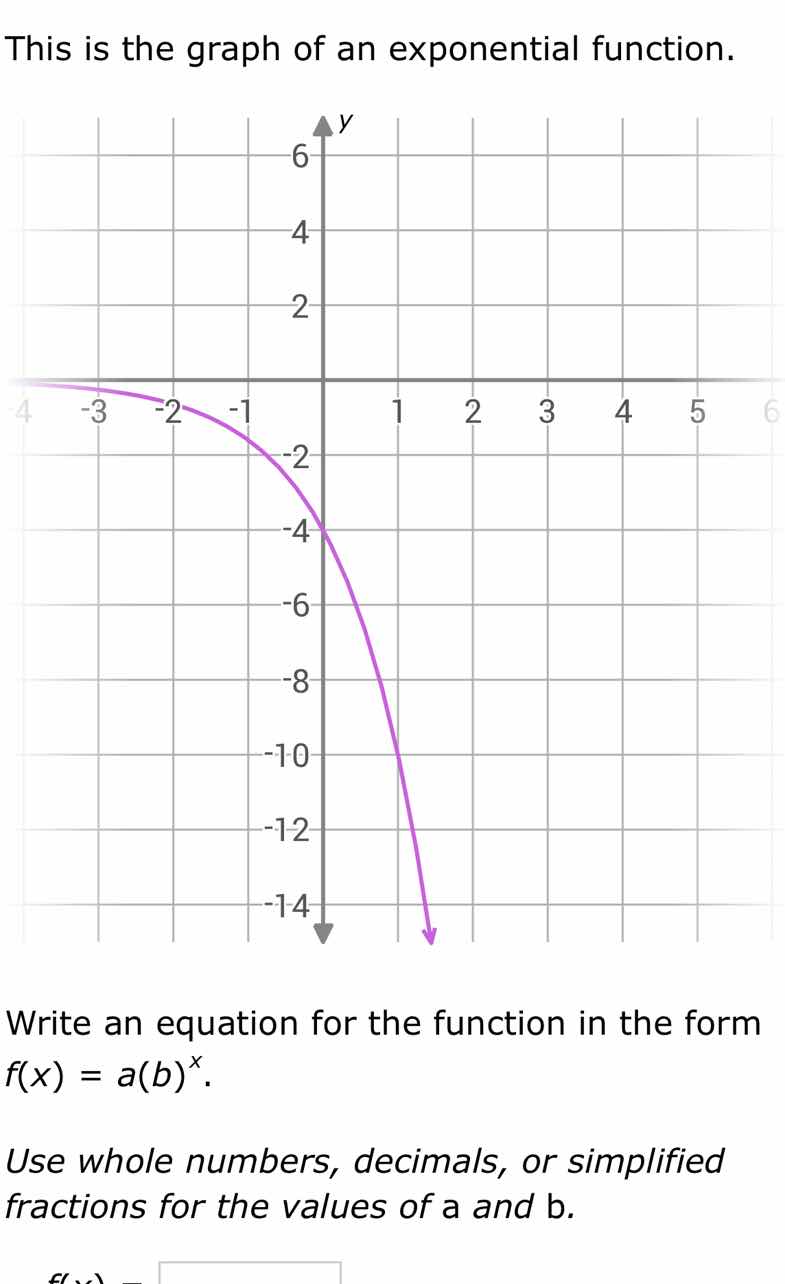
this is the graph of an exponential function.
write an equation for the function in the form f(x) = a(b)^x.
use whole numbers, decimals, or simplified fractions for the values of a and b.
Step1: Find the value of \( a \)
The general form of an exponential function is \( f(x) = a(b)^x \). When \( x = 0 \), we know that \( b^0 = 1 \), so \( f(0)=a(1)=a \). From the graph, when \( x = 0 \), the \( y \)-intercept is \( - 4 \). So, \( a=-4 \).
Step2: Find the value of \( b \)
We can use another point on the graph. Let's pick a point, for example, when \( x = 1 \), let's assume the function passes through a point. Wait, actually, let's check the behavior. The function is decreasing, so \( b>0 \) and \( b
eq1 \). Let's use the fact that we know \( a = - 4 \), so the function is \( f(x)=-4(b)^x \). Let's find a point on the graph. Let's see, when \( x = 1 \), what's the \( y \)-value? From the graph, when \( x = 1 \), the \( y \)-value seems to be \( - 12 \)? Wait, no, maybe I made a mistake. Wait, let's check the grid. Wait, the \( y \)-axis has values like -4, -6, -8, -10, -12. Wait, when \( x = 0 \), \( y=-4 \), when \( x = 1 \), let's see the graph. The line goes from \( (0, - 4) \) down to, say, when \( x = 1 \), \( y=-12 \)? Wait, no, let's calculate. If \( f(x)=-4(b)^x \), and when \( x = 1 \), \( f(1)=-12 \) (assuming from the graph), then:
\( - 12=-4(b)^1 \)
Divide both sides by -4: \( \frac{-12}{-4}=b \), so \( b = 3 \). Wait, let's verify. If \( a=-4 \) and \( b = 3 \), then \( f(x)=-4(3)^x \). Let's check \( x = 0 \): \( f(0)=-4(3)^0=-4(1)=-4 \), which matches the \( y \)-intercept. Let's check \( x = 1 \): \( f(1)=-4(3)^1=-12 \), which seems to match the graph (since the graph at \( x = 1 \) is at \( y=-12 \)). So \( b = 3 \).

Snap & solve any problem in the app
Get step-by-step solutions on Sovi AI
Photo-based solutions with guided steps
Explore more problems and detailed explanations
\( f(x)=-4(3)^x \)