QUESTION IMAGE
Question
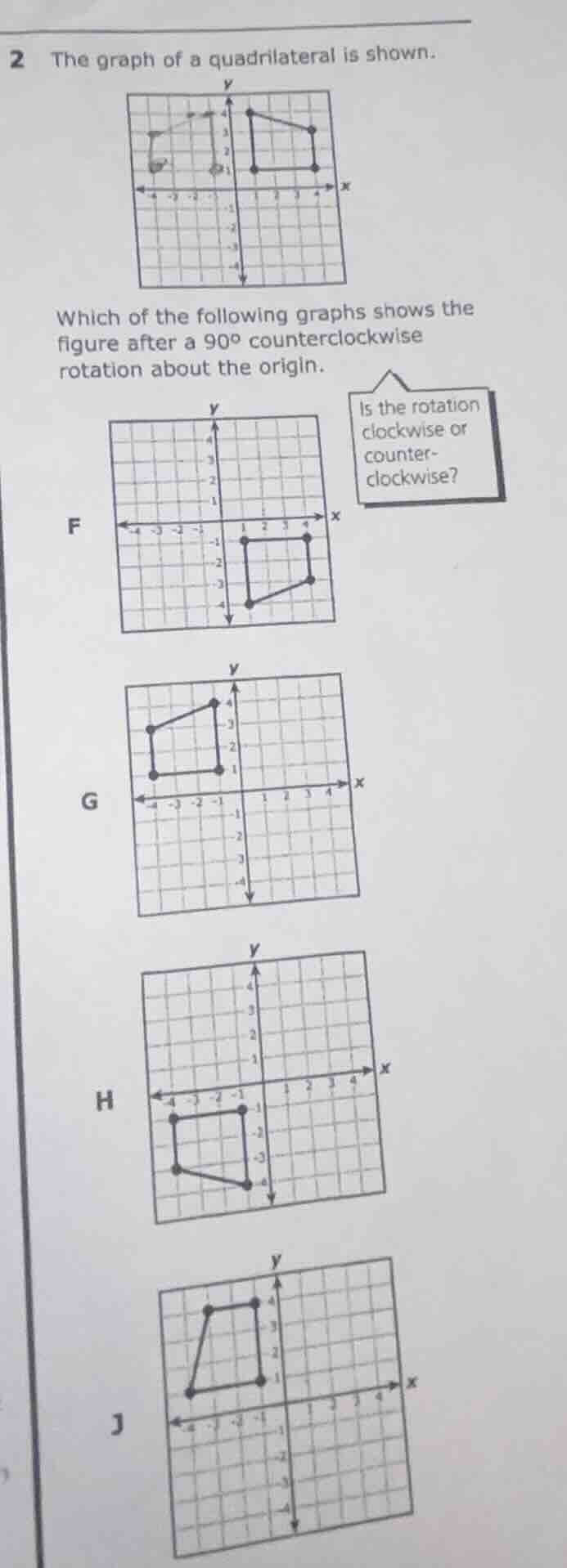
2 the graph of a quadrilateral is shown.
which of the following graphs shows the figure after a 90° counterclockwise rotation about the origin.
f
g
h
j
Step1: Recall Rotation Rule
For a \(90^\circ\) counterclockwise rotation about the origin, the rule is \((x,y)\to(-y,x)\). Let's identify the vertices of the original quadrilateral. From the graph, assume the vertices are (1,1), (3,1), (3,3), (1,3) (estimating from the grid).
Step2: Apply Rotation Rule
- For (1,1): \((1,1)\to(-1,1)\)
- For (3,1): \((3,1)\to(-1,3)\)
- For (3,3): \((3,3)\to(-3,3)\)
- For (1,3): \((1,3)\to(-3,1)\)
Now check the options:
- Option G: Let's see the vertices. The vertices here seem to match the rotated coordinates (negative y becomes x, x becomes -y). Wait, rechecking: Original quadrilateral (let's get correct coordinates). Wait, original quadrilateral (from the first graph) has vertices at (1,1), (3,1), (3,3), (1,3)? Wait no, looking at the first graph, the right quadrilateral: (1,1), (3,1), (3,3), (1,3)? Wait no, the first quadrilateral (right one) has bottom vertices at (1,1), (3,1), top at (1,3), (3,3)? Wait no, the first graph: the right quadrilateral: (1,1), (3,1), (3,3), (1,3)? Wait, no, looking at the grid, the right quadrilateral: x from 1 to 3, y from 1 to 3. So vertices (1,1), (3,1), (3,3), (1,3).
Applying \(90^\circ\) counterclockwise: \((x,y)\to(-y,x)\)
- (1,1) → (-1,1)
- (3,1) → (-1,3)
- (3,3) → (-3,3)
- (1,3) → (-3,1)
Now check option G: The vertices in G are at (-3,1), (-3,3), (-1,3), (-1,1)? Wait, no, let's look at the graph of G: x from -4 to 0, y from 1 to 4. The vertices seem to be (-3,1), (-1,1), (-1,3), (-3,3)? Wait, no, maybe I misidentified original vertices. Wait, original quadrilateral (right one) has vertices: (1,1), (3,1), (3,3), (1,3). Wait, no, the first graph: the right quadrilateral: bottom two points at (1,1) and (3,1), top two at (1,3) and (3,3)? Wait, no, the first graph's right quadrilateral: (1,1), (3,1), (3,3), (1,3). Wait, no, looking at the grid, the right quadrilateral: x=1, y=1; x=3, y=1; x=3, y=3; x=1, y=3. So a rectangle.
After \(90^\circ\) counterclockwise rotation: (x,y)→(-y,x). So (1,1)→(-1,1); (3,1)→(-1,3); (3,3)→(-3,3); (1,3)→(-3,1). Now, plotting these points: x=-1, y=1; x=-1, y=3; x=-3, y=3; x=-3, y=1. So the figure should be in the second quadrant (x negative, y positive), with vertices at (-3,1), (-3,3), (-1,3), (-1,1). Looking at the options, option G has vertices in the second quadrant, matching this. Let's check other options:
- F: In fourth quadrant (x positive, y negative) – no, counterclockwise 90 should be second quadrant.
- H: In third quadrant (x negative, y negative) – no.
- J: Not matching. So G is correct.

Snap & solve any problem in the app
Get step-by-step solutions on Sovi AI
Photo-based solutions with guided steps
Explore more problems and detailed explanations
G