QUESTION IMAGE
Question
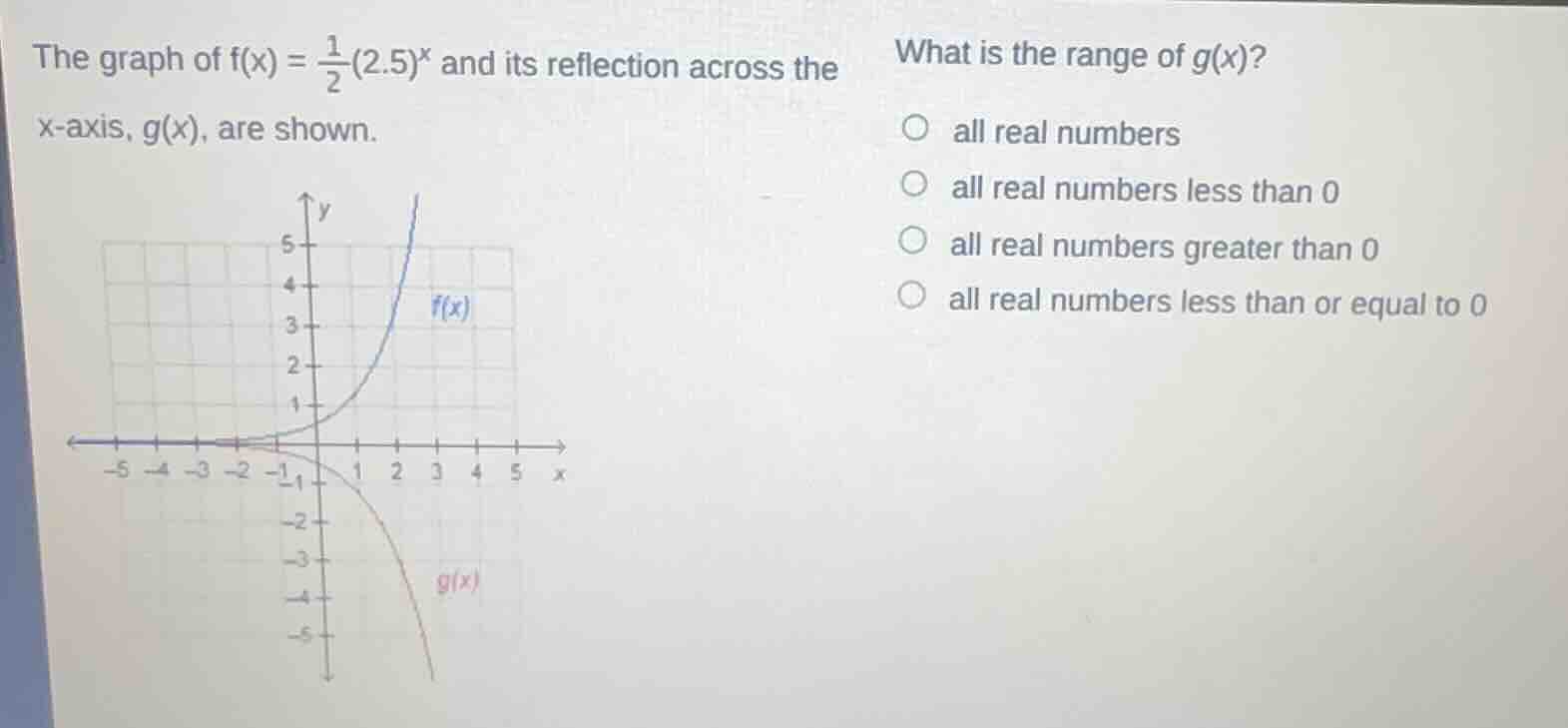
the graph of $f(x) = \frac{1}{2}(2.5)^x$ and its reflection across the x-axis, $g(x)$, are shown. what is the range of $g(x)$? \bigcirc all real numbers \bigcirc all real numbers less than 0 \bigcirc all real numbers greater than 0 \bigcirc all real numbers less than or equal to 0
- First, recall the range of the original function \( f(x)=\frac{1}{2}(2.5)^{x} \). For an exponential function of the form \( a\cdot b^{x} \) where \( a>0 \) and \( b > 1 \), the range is \( y>0 \) (all real numbers greater than 0). This is because as \( x
ightarrow-\infty \), \( (2.5)^{x}
ightarrow0 \), so \( f(x)=\frac{1}{2}(2.5)^{x}
ightarrow0 \), and as \( x
ightarrow\infty \), \( (2.5)^{x}
ightarrow\infty \), so \( f(x)
ightarrow\infty \), and the function is always positive.
- Now, \( g(x) \) is the reflection of \( f(x) \) across the \( x \)-axis. The rule for reflecting a function \( y = f(x) \) across the \( x \)-axis is \( y=-f(x) \). So if \( f(x)>0 \) for all \( x \), then \( g(x)=-f(x)<0 \) for all \( x \).
- Looking at the graph of \( g(x) \), it is below the \( x \)-axis (where \( y < 0 \)) and never touches or crosses above the \( x \)-axis (since the original function \( f(x) \) never touches \( y = 0 \), just approaches it, so the reflection \( g(x) \) will never touch \( y = 0 \) either, it will just approach \( y = 0 \) as \( x
ightarrow-\infty \)). So the range of \( g(x) \) is all real numbers less than 0.

Snap & solve any problem in the app
Get step-by-step solutions on Sovi AI
Photo-based solutions with guided steps
Explore more problems and detailed explanations
all real numbers less than 0