QUESTION IMAGE
Question
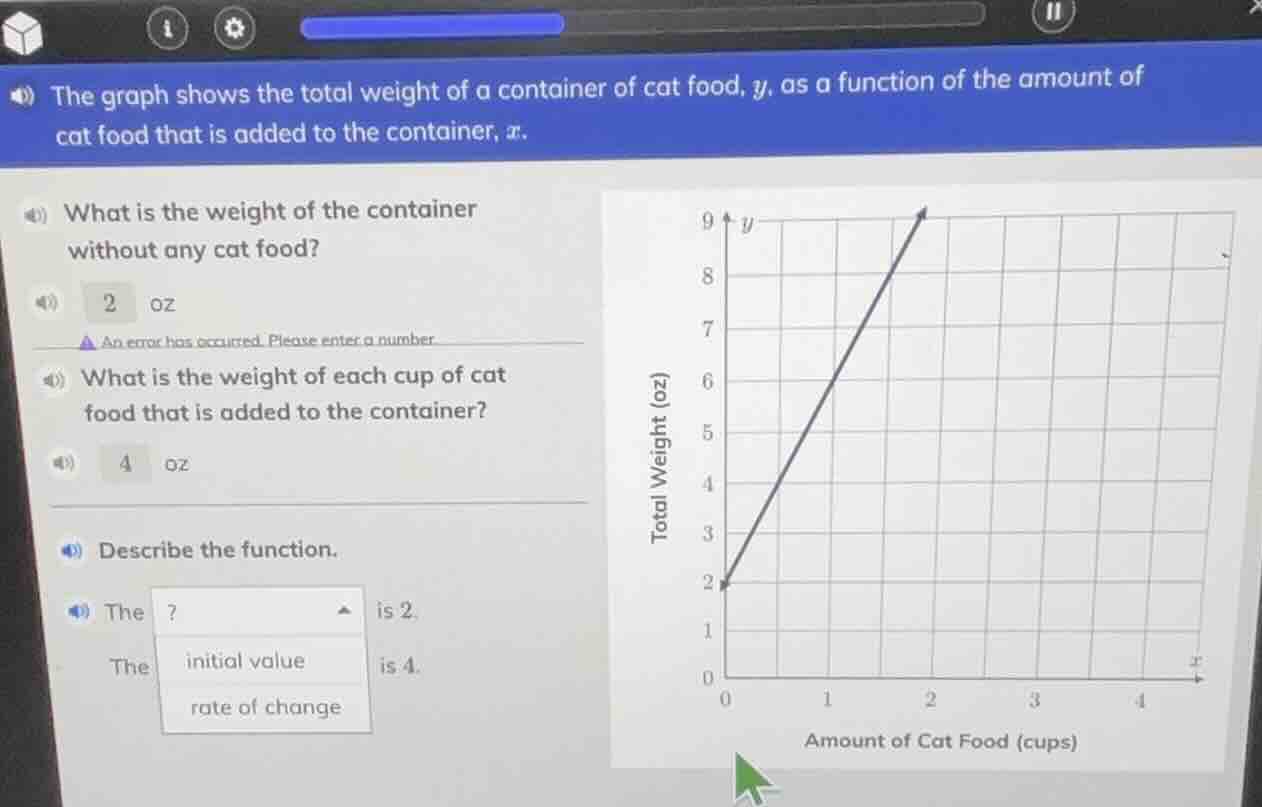
the graph shows the total weight of a container of cat food, y, as a function of the amount of cat food that is added to the container, x. what is the weight of the container without any cat food? 2 oz an error has occurred. please enter a number what is the weight of each cup of cat food that is added to the container? 4 oz describe the function. the? is 2. the initial value is 4. rate of change
First Sub - Question: Weight of the container without any cat food
Step1: Understand the graph's y - intercept
The weight of the container without any cat food is the value of \(y\) when \(x = 0\) (since \(x\) is the amount of cat food added, \(x=0\) means no cat food is added). From the graph, when \(x = 0\), \(y=2\).
Step1: Recall the formula for slope (rate of change)
The slope \(m\) of a line (which represents the rate of change here) is given by \(m=\frac{y_2 - y_1}{x_2 - x_1}\). Let's take two points from the graph. When \(x_1 = 0,y_1 = 2\) and when \(x_2=1,y_2 = 6\) (we can also use other points).
Step2: Calculate the slope
\(m=\frac{6 - 2}{1-0}=\frac{4}{1} = 4\). This slope represents the weight of each cup of cat food (since for each unit increase in \(x\) (1 cup of cat food), \(y\) (total weight) increases by 4).
The initial value of a linear function (which this is, as the graph is a straight line) is the value of the function when the independent variable (\(x\), amount of cat food) is 0. We found this to be 2. The rate of change of a linear function is the slope, which we calculated as 4 (weight per cup of cat food). So the first blank (with value 2) corresponds to "initial value" and the second blank (with value 4) corresponds to "rate of change".

Snap & solve any problem in the app
Get step-by-step solutions on Sovi AI
Photo-based solutions with guided steps
Explore more problems and detailed explanations
2