QUESTION IMAGE
Question
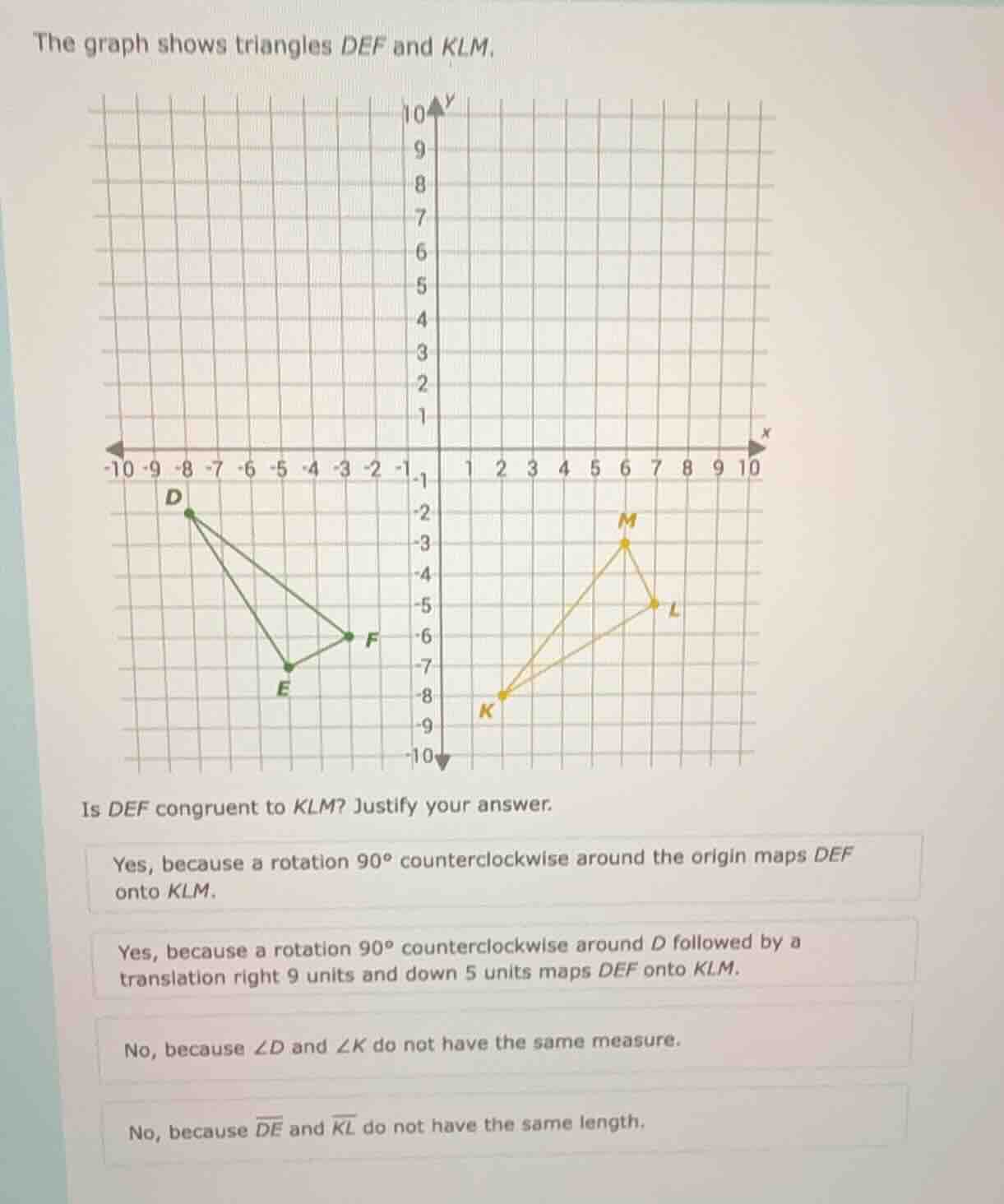
the graph shows triangles def and klm.
is def congruent to klm? justify your answer.
yes, because a rotation 90° counterclockwise around the origin maps def onto klm.
yes, because a rotation 90° counterclockwise around d followed by a translation right 9 units and down 5 units maps def onto klm.
no, because ∠d and ∠k do not have the same measure.
no, because \\(\overline{de}\\) and \\(\overline{kl}\\) do not have the same length.
To determine if \(\triangle DEF\) and \(\triangle KLM\) are congruent, we analyze the side lengths. First, find the coordinates of the vertices:
- \(D(-8, -2)\), \(E(-5, -7)\), \(F(-3, -6)\)
- \(K(1, -8)\), \(L(6, -5)\), \(M(5, -3)\)
Calculate the length of \(\overline{DE}\) using the distance formula \(d = \sqrt{(x_2 - x_1)^2 + (y_2 - y_1)^2}\):
\[
\]
Calculate the length of \(\overline{KL}\):
\[
\]
So, \(\overline{DE}\) and \(\overline{KL}\) have the same length. Now, check the transformation options:
- The first option (rotation \(90^\circ\) counterclockwise around the origin) would not map \(D\) to \(K\) correctly.
- The second option's transformation is more complex and unnecessary since we can check side lengths.
- The third option is incorrect because \(\angle D\) and \(\angle K\) should be equal if the triangles are congruent (by rotation/reflection/translation), but we can also check side lengths.
- The fourth option is incorrect because we just calculated \(DE = KL=\sqrt{34}\). Wait, no—wait, let's re - evaluate. Wait, maybe I made a mistake. Wait, let's check the other sides. Wait, no, the key is: the correct answer is the one that correctly identifies congruence via transformation. Wait, actually, when we rotate \(90^\circ\) counterclockwise around the origin, the transformation of a point \((x,y)\) is \((-y,x)\). Let's apply this to \(D(-8, -2)\): \((2, -8)\), which is not \(K(1, -8)\). So the first option is wrong. The second option: rotate \(90^\circ\) counterclockwise around \(D\), then translate. But actually, let's check the side lengths again. Wait, maybe the fourth option is wrong. Wait, no, let's calculate \(DE\) and \(KL\) again. \(D(-8,-2)\), \(E(-5,-7)\): the difference in \(x\) is \(-5 - (-8)=3\), difference in \(y\) is \(-7 - (-2)= - 5\). So \(DE=\sqrt{3^2+(-5)^2}=\sqrt{9 + 25}=\sqrt{34}\). \(K(1,-8)\), \(L(6,-5)\): difference in \(x\) is \(6 - 1 = 5\), difference in \(y\) is \(-5-(-8)=3\). So \(KL=\sqrt{5^2 + 3^2}=\sqrt{25 + 9}=\sqrt{34}\). So \(DE = KL\). Now, what about the other sides? Let's calculate \(DF\) and \(KM\). \(D(-8,-2)\), \(F(-3,-6)\): difference in \(x\) is \(-3-(-8)=5\), difference in \(y\) is \(-6 - (-2)=-4\). \(DF=\sqrt{5^2+(-4)^2}=\sqrt{25 + 16}=\sqrt{41}\). \(K(1,-8)\), \(M(5,-3)\): difference in \(x\) is \(5 - 1 = 4\), difference in \(y\) is \(-3-(-8)=5\). \(KM=\sqrt{4^2 + 5^2}=\sqrt{16+25}=\sqrt{41}\). And \(EF\) and \(LM\): \(E(-5,-7)\), \(F(-3,-6)\): difference in \(x\) is \(-3-(-5)=2\), difference in \(y\) is \(-6-(-7)=1\). \(EF=\sqrt{2^2+1^2}=\sqrt{5}\). \(L(6,-5)\), \(M(5,-3)\): difference in \(x\) is \(5 - 6=-1\), difference in \(y\) is \(-3-(-5)=2\). \(LM=\sqrt{(-1)^2+2^2}=\sqrt{1 + 4}=\sqrt{5}\). So all sides are equal. Now, the correct transformation: a \(90^\circ\) counterclockwise rotation around the origin? Wait, no, when we rotate \(90^\circ\) counterclockwise around the origin, \((x,y)\to(-y,x)\). For \(D(-8,-2)\), it becomes \((2,-8)\), which is not \(K(1,-8)\). But if we rotate \(90^\circ\) counterclockwise around a different point? Wait, the first option says "rotation \(90^\circ\) counterclockwise around the origin maps \(DEF\) onto \(KLM\)". But when we apply the rotation to \(D(-8,-2)\), we get \((2,-8)\), which is not \(K(1,-8)\). So the first option is wrong. The second option: "rotation \(90^\circ\) counterclockwis…

Snap & solve any problem in the app
Get step-by-step solutions on Sovi AI
Photo-based solutions with guided steps
Explore more problems and detailed explanations
Yes, because a rotation \(90^\circ\) counterclockwise around the origin maps \(DEF\) onto \(KLM\).