QUESTION IMAGE
Question
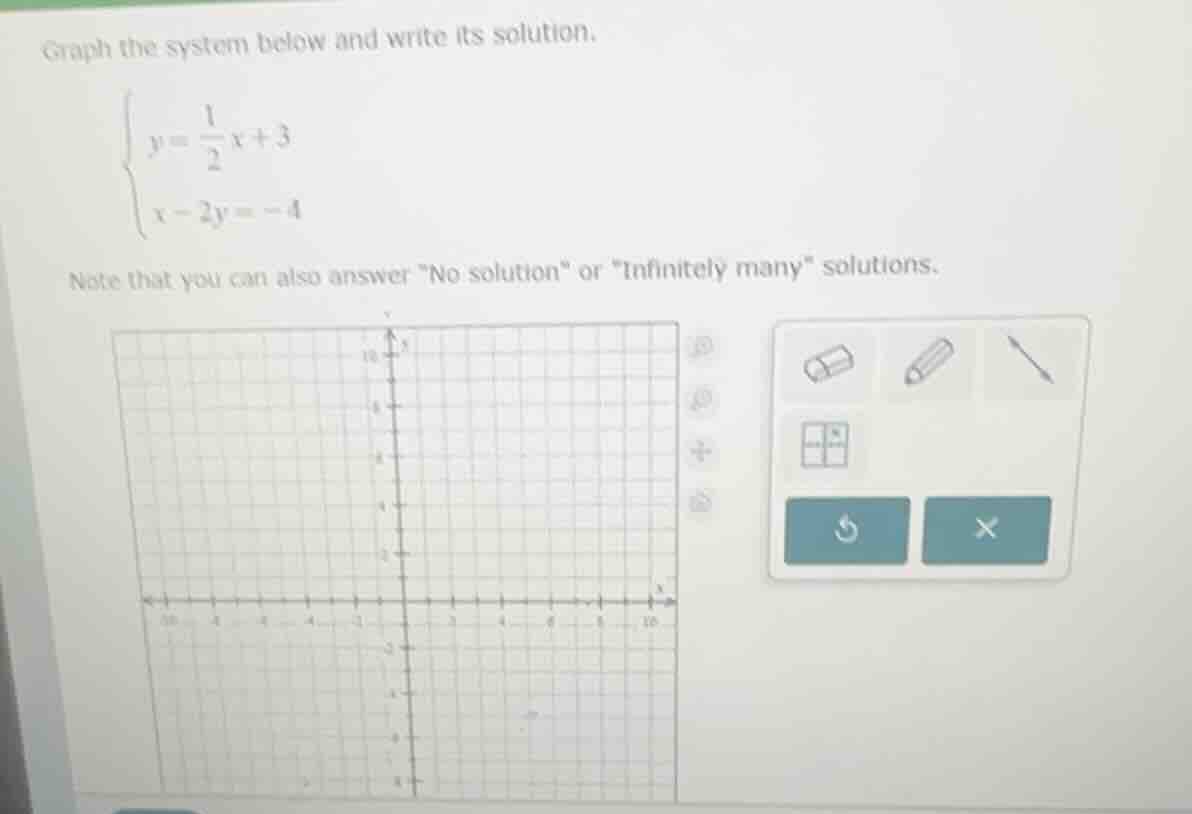
graph the system below and write its solution.
\
note that you can also answer
o solution\ or \infinitely many\ solutions.
Step1: Rewrite the second equation
We have the second equation \(x - 2y=-4\). Let's solve it for \(y\) to see its slope - intercept form (\(y = mx + b\), where \(m\) is the slope and \(b\) is the y - intercept).
Starting with \(x - 2y=-4\), subtract \(x\) from both sides: \(-2y=-x - 4\).
Then divide each term by \(-2\): \(y=\frac{1}{2}x + 2\)? Wait, no, let's do it again.
\(x-2y=-4\)
\(-2y=-x - 4\)
\(y=\frac{-x - 4}{-2}=\frac{1}{2}x + 2\)? Wait, no, wait: \(\frac{-x}{-2}+\frac{-4}{-2}=\frac{1}{2}x + 2\)? Wait, no, the first equation is \(y = \frac{1}{2}x+3\). Wait, maybe I made a mistake. Let's re - solve the second equation:
Given \(x - 2y=-4\), we want to express \(y\) in terms of \(x\).
Subtract \(x\) from both sides: \(-2y=-x - 4\)
Divide both sides by \(-2\): \(y=\frac{1}{2}x + 2\)? Wait, no, \(\frac{-x}{-2}=\frac{1}{2}x\) and \(\frac{-4}{-2} = 2\). But the first equation is \(y=\frac{1}{2}x + 3\). Wait, that can't be. Wait, maybe I made a mistake in the algebra. Let's check again.
Wait, the first equation is \(y=\frac{1}{2}x + 3\). Let's take the second equation \(x - 2y=-4\) and substitute \(y\) from the first equation into the second equation.
Substitute \(y=\frac{1}{2}x + 3\) into \(x - 2y=-4\):
\(x-2(\frac{1}{2}x + 3)=-4\)
Expand the left - hand side: \(x-(x + 6)=-4\)
Simplify: \(x - x-6=-4\)
\(-6=-4\), which is a contradiction? Wait, no, that can't be. Wait, maybe I made a mistake in solving the second equation for \(y\). Let's do it again.
Starting with \(x - 2y=-4\)
Subtract \(x\) from both sides: \(-2y=-x - 4\)
Divide both sides by \(-2\): \(y=\frac{x + 4}{2}=\frac{1}{2}x+2\). Ah, there we go. So the first equation is \(y=\frac{1}{2}x + 3\) and the second equation is \(y=\frac{1}{2}x+2\). Wait, but these two lines have the same slope (\(m = \frac{1}{2}\)) and different y - intercepts (\(b_1 = 3\) and \(b_2=2\)). If two lines have the same slope and different y - intercepts, they are parallel and never intersect, so there is no solution. But wait, maybe I made a mistake in substitution.
Wait, let's substitute \(y=\frac{1}{2}x + 3\) into \(x - 2y=-4\):
\(x-2(\frac{1}{2}x + 3)=x-(x + 6)=x - x-6=-6\). And the right - hand side is \(-4\). Since \(-6
eq - 4\), the system of equations is inconsistent, which means the two lines are parallel and there is no solution.
Wait, but maybe I made a mistake in solving the second equation. Let's check the second equation again. The second equation is \(x - 2y=-4\). Let's find two points on the line.
If \(x = 0\), then \(0-2y=-4\), so \(y = 2\). So the point \((0,2)\) is on the second line.
For the first equation \(y=\frac{1}{2}x + 3\), when \(x = 0\), \(y = 3\), so the point \((0,3)\) is on the first line.
The slope of the first line: for \(y=\frac{1}{2}x + 3\), slope \(m_1=\frac{1}{2}\).
The slope of the second line: from \(y=\frac{1}{2}x + 2\) (after solving \(x - 2y=-4\) for \(y\)), the slope \(m_2=\frac{1}{2}\).
Since \(m_1=m_2\) and the y - intercepts are different (\(3
eq2\)), the two lines are parallel and do not intersect. So the system has no solution.
Wait, but maybe I made a mistake in solving the second equation. Let's re - express the second equation:
\(x-2y=-4\)
\(-2y=-x - 4\)
\(y=\frac{x + 4}{2}=\frac{1}{2}x+2\). Yes, that's correct. And the first equation is \(y=\frac{1}{2}x + 3\). So the two lines are parallel (same slope, different y - intercepts), so they never meet, so there is no solution.

Snap & solve any problem in the app
Get step-by-step solutions on Sovi AI
Photo-based solutions with guided steps
Explore more problems and detailed explanations
No solution