QUESTION IMAGE
Question
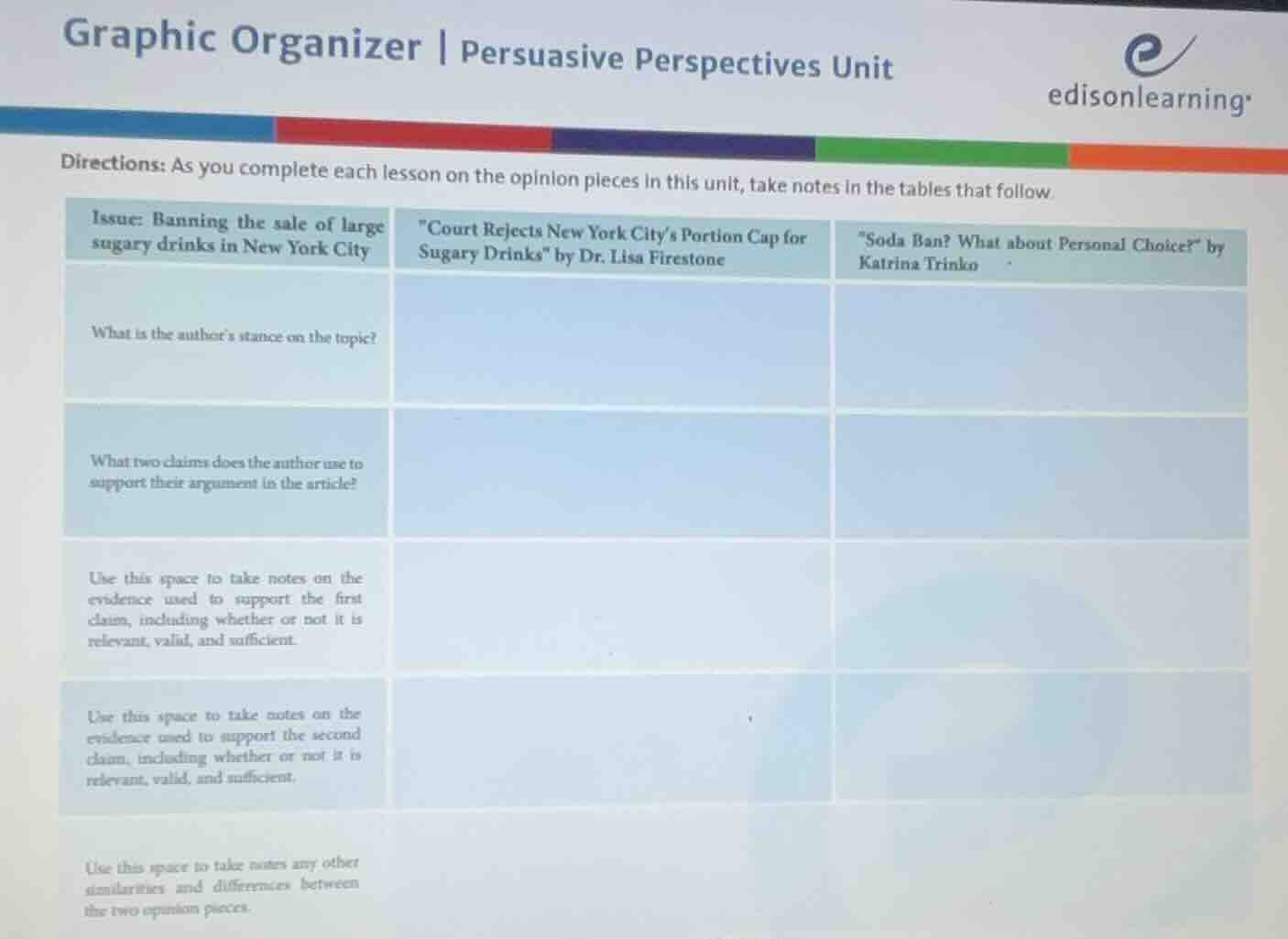
graphic organizer | persuasive perspectives unit
edisonlearning
directions: as you complete each lesson on the opinion pieces in this unit, take notes in the tables that follow
issue: banning the sale of large sugary drinks in new york city
\court rejects new york city’s portion cap for sugary drinks\ by dr. lisa firestone
\soda ban? what about personal choice?\ by katrina trinko
what is the author’s stance on the topic?
what two claims does the author use to support their argument in the article?
use this space to take notes on the evidence used to support the first claim, including whether or not it is relevant, valid, and sufficient.
use this space to take notes on the evidence used to support the second claim, including whether or not it is relevant, valid, and sufficient.
use this space to take notes any other similarities and differences between the two opinion pieces.
To complete this graphic organizer, we analyze each article:
1. Article: "Court Rejects New York City’s Portion Cap for Sugary Drinks" by Dr. Lisa Firestone
- Author’s Stance: Likely supports the court’s rejection (opposes the soda ban), arguing it is an overreach or ineffective.
- Two Claims:
- The ban infringes on personal freedom/government overreach.
- The ban is not an effective solution to public health issues.
- Evidence for First Claim: Legal reasoning (court ruling) showing the ban violates legal standards (e.g., overstepping regulatory authority). Relevant (relates to legality), valid (court decision is authoritative), sufficient (legal precedent).
- Evidence for Second Claim: Data on ineffective bans (e.g., people will find workarounds, or it targets the wrong issue). Relevant (public health efficacy), valid (if using research), sufficient (if multiple examples).
2. Article: "Soda Ban? What about Personal Choice?" by Katrina Trinko
- Author’s Stance: Opposes the soda ban, prioritizing personal choice.
- Two Claims:
- Bans violate individual autonomy (personal choice in diet).
- Individuals should be responsible for their health, not the government.
- Evidence for First Claim: Appeals to liberty (e.g., "adults can make their own choices"). Relevant (personal choice), valid (philosophical argument for autonomy), sufficient (if citing ethical principles).
- Evidence for Second Claim: Examples of personal responsibility (e.g., other unhealthy choices not banned). Relevant (comparison to other behaviors), valid (logical parallel), sufficient (if multiple examples).
Similarities/Differences
- Similarities: Both oppose the ban, cite personal choice/government overreach.
- Differences: Firestone focuses on legal aspects; Trinko emphasizes ethical autonomy.
To fill the table, summarize these points in each row (stance, claims, evidence, similarities/differences) for both articles.
For example, in the "Author’s Stance" row:
- First column (issue): Banning large sugary drinks in NYC
- Second column (Firestone): Opposes the ban (supports court rejection, sees it as overreach/ineffective)
- Third column (Trinko): Opposes the ban, prioritizes personal choice over government regulation
Repeat this process for claims, evidence, and similarities/differences, using specific details from the articles (if you have access to the full text, include direct quotes/evidence).

Snap & solve any problem in the app
Get step-by-step solutions on Sovi AI
Photo-based solutions with guided steps
Explore more problems and detailed explanations
To complete this graphic organizer, we analyze each article:
1. Article: "Court Rejects New York City’s Portion Cap for Sugary Drinks" by Dr. Lisa Firestone
- Author’s Stance: Likely supports the court’s rejection (opposes the soda ban), arguing it is an overreach or ineffective.
- Two Claims:
- The ban infringes on personal freedom/government overreach.
- The ban is not an effective solution to public health issues.
- Evidence for First Claim: Legal reasoning (court ruling) showing the ban violates legal standards (e.g., overstepping regulatory authority). Relevant (relates to legality), valid (court decision is authoritative), sufficient (legal precedent).
- Evidence for Second Claim: Data on ineffective bans (e.g., people will find workarounds, or it targets the wrong issue). Relevant (public health efficacy), valid (if using research), sufficient (if multiple examples).
2. Article: "Soda Ban? What about Personal Choice?" by Katrina Trinko
- Author’s Stance: Opposes the soda ban, prioritizing personal choice.
- Two Claims:
- Bans violate individual autonomy (personal choice in diet).
- Individuals should be responsible for their health, not the government.
- Evidence for First Claim: Appeals to liberty (e.g., "adults can make their own choices"). Relevant (personal choice), valid (philosophical argument for autonomy), sufficient (if citing ethical principles).
- Evidence for Second Claim: Examples of personal responsibility (e.g., other unhealthy choices not banned). Relevant (comparison to other behaviors), valid (logical parallel), sufficient (if multiple examples).
Similarities/Differences
- Similarities: Both oppose the ban, cite personal choice/government overreach.
- Differences: Firestone focuses on legal aspects; Trinko emphasizes ethical autonomy.
To fill the table, summarize these points in each row (stance, claims, evidence, similarities/differences) for both articles.
For example, in the "Author’s Stance" row:
- First column (issue): Banning large sugary drinks in NYC
- Second column (Firestone): Opposes the ban (supports court rejection, sees it as overreach/ineffective)
- Third column (Trinko): Opposes the ban, prioritizes personal choice over government regulation
Repeat this process for claims, evidence, and similarities/differences, using specific details from the articles (if you have access to the full text, include direct quotes/evidence).