QUESTION IMAGE
Question
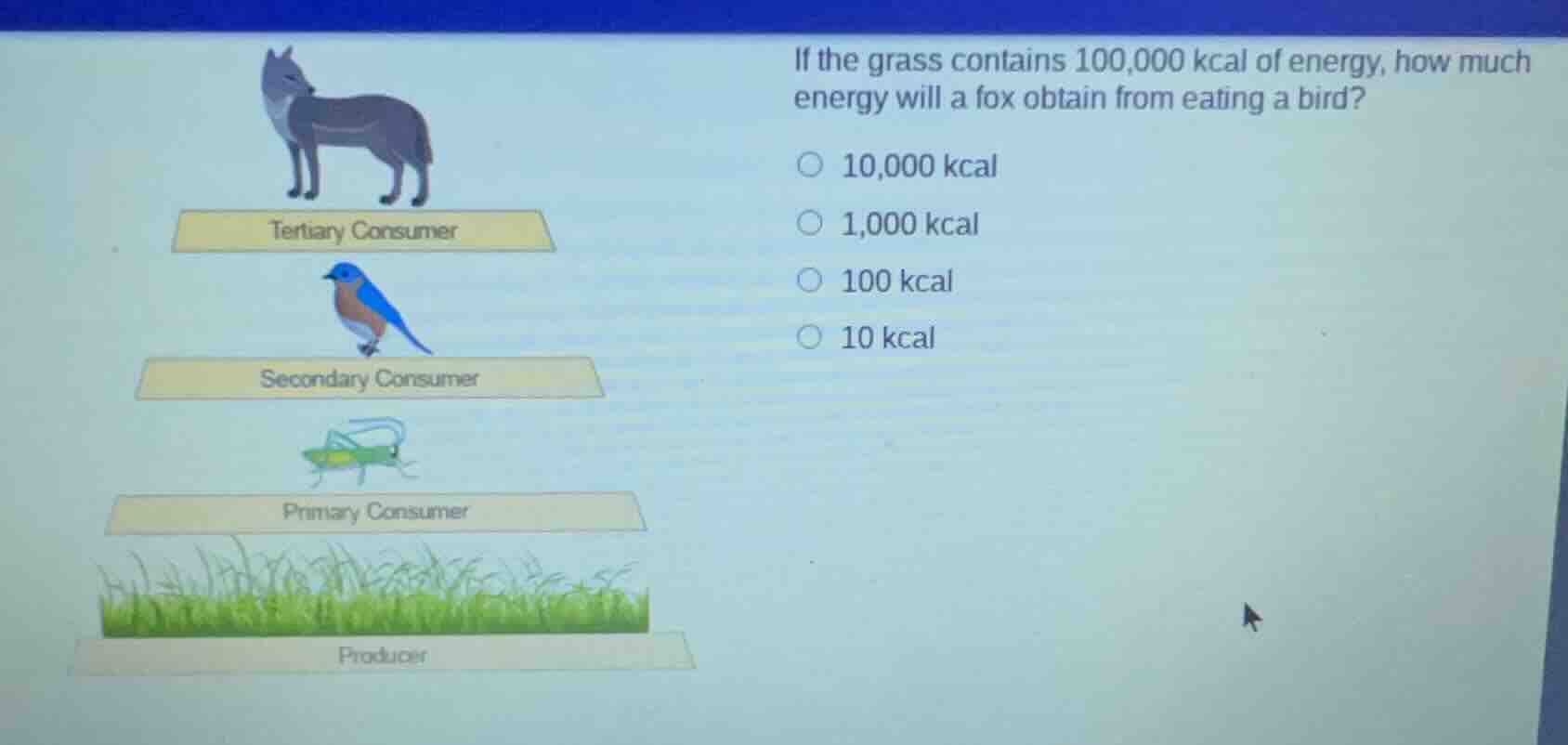
if the grass contains 100,000 kcal of energy, how much energy will a fox obtain from eating a bird? 10,000 kcal 1,000 kcal 100 kcal 10 kcal
Step1: Recall energy transfer rule
In a food chain, only about 10% of energy is transferred between trophic levels. Grass (producer) has 100,000 kcal.
Step2: Energy for primary consumer
Primary consumer (grasshopper) gets \(100,000\times0.1 = 10,000\) kcal.
Step3: Energy for secondary consumer
Secondary consumer (bird) gets \(10,000\times0.1 = 1,000\) kcal.
Step4: Energy for fox (tertiary consumer eating bird)
Fox gets \(1,000\times0.1 = 100\) kcal? Wait, no—wait, the question is fox eating a bird (secondary consumer). Wait, grass (producer) → primary (grasshopper) → secondary (bird) → tertiary (wolf). Wait, the question is fox obtaining energy from eating a bird. Wait, maybe the trophic levels: grass (producer, level 1), primary (level 2), secondary (level 3), tertiary (level 4). Wait, no—producer is level 1, primary consumer (herbivore) level 2, secondary (carnivore eating primary) level 3, tertiary (carnivore eating secondary) level 4. So grass (level 1: 100,000 kcal) → primary (level 2: 10% of 100,000 = 10,000 kcal) → secondary (level 3: 10% of 10,000 = 1,000 kcal) → tertiary (level 4: 10% of 1,000 = 100 kcal). But the question is fox eating a bird (secondary consumer, level 3). Wait, maybe the fox is tertiary, but when eating a bird (secondary), the energy the fox gets from the bird is 10% of the bird's energy? Wait, no—when an organism eats another, it gets the energy that the prey has, but the prey's energy is 10% of its prey. Wait, the bird (secondary consumer) has 1,000 kcal (from eating primary consumer with 10,000 kcal). Then the fox (tertiary) eating the bird would get 10% of the bird's energy? Wait, no—maybe I messed up. Wait, the energy transfer is 10% per trophic level. So grass (level 1: 100,000) → primary (level 2: 10% of 100,000 = 10,000) → secondary (level 3: 10% of 10,000 = 1,000) → tertiary (level 4: 10% of 1,000 = 100). But the question is "how much energy will a fox obtain from eating a bird?" So the bird is secondary consumer (level 3) with 1,000 kcal? Wait, no—wait, maybe the bird is secondary, so its energy is 10% of primary, which is 10% of producer. So producer (grass) 100,000 → primary (10,000) → secondary (1,000) → tertiary (100). But the fox is eating the bird (secondary), so the energy the fox gets from the bird is 10% of the bird's energy? Wait, no—when the fox eats the bird, the bird has 1,000 kcal, so the fox gets 10% of that? Wait, no—actually, when an organism consumes another, it assimilates about 10% of the prey's biomass energy. So the bird (secondary consumer) has 1,000 kcal (from its trophic level). Then the fox (tertiary) eating the bird would get 10% of 1,000 kcal? Wait, that would be 100 kcal. But let's check the options. The options are 10,000; 1,000; 100; 10. Wait, maybe the fox is a secondary consumer? No, the diagram shows wolf as tertiary, bird as secondary, grasshopper as primary, grass as producer. So fox—wait, maybe the fox is tertiary, but the question is fox eating a bird (secondary). So the bird's energy is 1,000 kcal (secondary), so fox gets 10% of that, which is 100 kcal? But wait, maybe I made a mistake. Wait, let's re-express:
- Producer (grass): 100,000 kcal (level 1)
- Primary consumer (grasshopper): 10% of 100,000 = 10,000 kcal (level 2)
- Secondary consumer (bird): 10% of 10,000 = 1,000 kcal (level 3)
- Tertiary consumer (wolf): 10% of 1,000 = 100 kcal (level 4)
But the question is "how much energy will a fox obtain from eating a bird?" So the bird is a secondary consumer with 1,000 kcal. When the fox (tertiary) eats the bird, it gets 10% of the bird's ener…

Snap & solve any problem in the app
Get step-by-step solutions on Sovi AI
Photo-based solutions with guided steps
Explore more problems and detailed explanations
100 kcal (Option: 100 kcal)