QUESTION IMAGE
Question
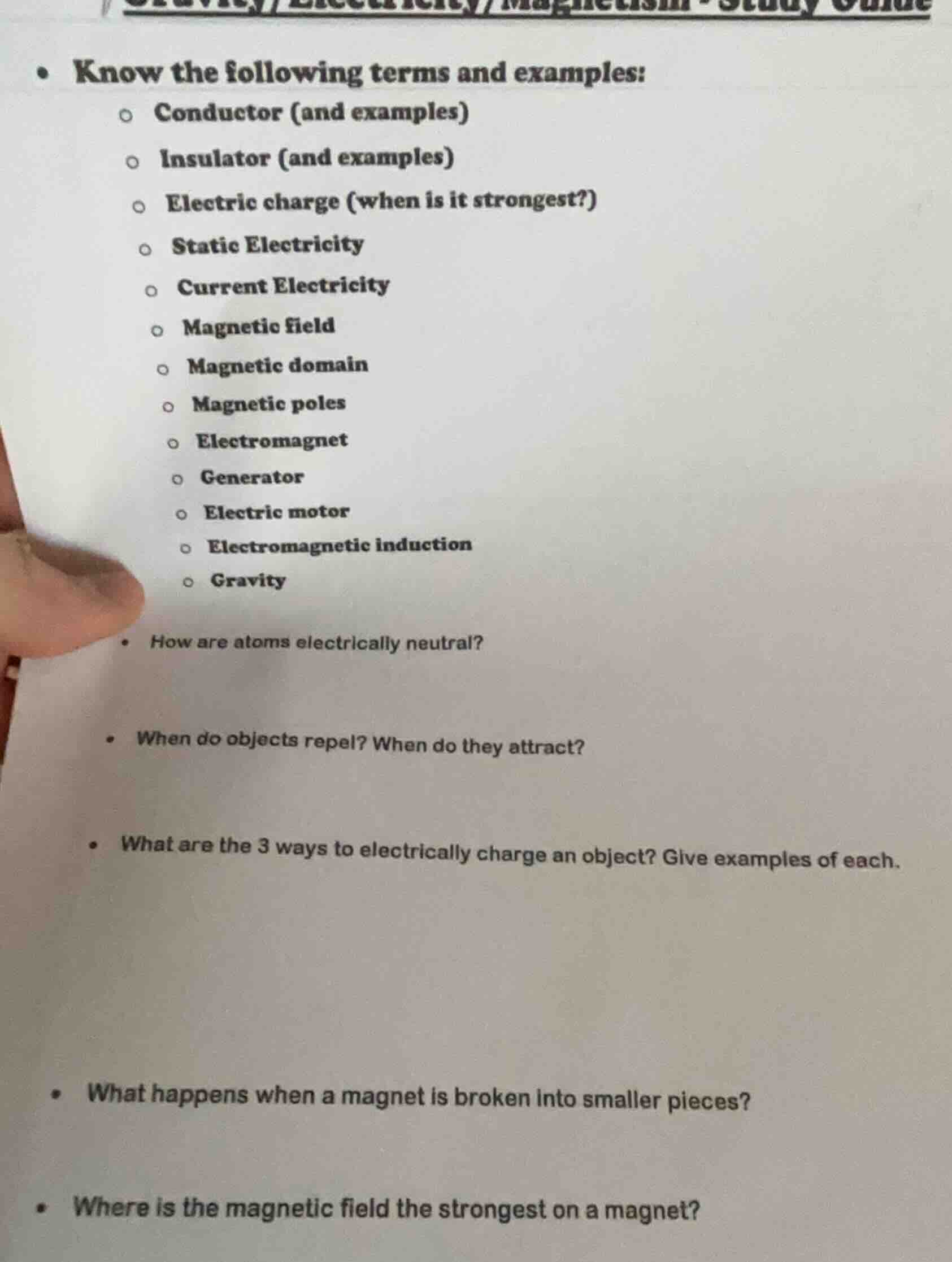
gravity/electricity/magnetism - study guide• know the following terms and examples:○ conductor (and examples)○ insulator (and examples)○ electric charge (when is it strongest?)○ static electricity○ current electricity○ magnetic field○ magnetic domain○ magnetic poles○ electromagnet○ generator○ electric motor○ electromagnetic induction○ gravity• how are atoms electrically neutral?• when do objects repel? when do they attract?• what are the 3 ways to electrically charge an object? give examples of each.• what happens when a magnet is broken into smaller pieces?• where is the magnetic field the strongest on a magnet?
Key Terms & Examples
- Conductor: Material that allows electric current flow easily; outer electrons are loosely held.
- Insulator: Material that blocks electric current flow; outer electrons are tightly held.
- Electric charge: A property of matter that causes electrostatic force; strength depends on distance (Coulomb's law: force is inversely proportional to the square of distance between charges).
- Static Electricity: Buildup of stationary electric charge on an object, from electron transfer.
- Current Electricity: Flow of electric charge (usually electrons) through a conductor.
- Magnetic field: Invisible region around a magnet where magnetic force acts on magnetic materials or moving charges.
- Magnetic domain: Tiny regions in ferromagnetic materials where atomic magnets align uniformly.
- Magnetic poles: The two ends of a magnet (north and south) where magnetic force is strongest; poles always exist in pairs.
- Electromagnet: A temporary magnet made by running electric current through a coil of wire around a ferromagnetic core; strength depends on current and coil turns.
- Generator: Device that converts mechanical energy to electrical energy using electromagnetic induction.
- Electric motor: Device that converts electrical energy to mechanical energy using magnetic forces on current-carrying wires.
- Electromagnetic induction: The process of generating an electric current by moving a conductor through a magnetic field (or changing the magnetic field around a conductor).
- Gravity: A fundamental force of attraction between all objects with mass; weakest of the fundamental forces, but acts over infinite distance.
Specific Questions
- Atomic electrical neutrality: Atoms have equal numbers of positively charged protons (in the nucleus) and negatively charged electrons (in electron clouds), so their total charge cancels out.
- Object attraction/repulsion: Charged objects repel when they have identical electric charges (positive-positive or negative-negative); they attract when they have opposite electric charges (positive-negative). Neutral and charged objects also attract due to charge induction.
- 3 ways to charge an object:
- Friction: Transfer electrons by rubbing two different materials together.
- Conduction: Transfer electrons by touching a charged object to a neutral conductor.
- Induction: Redistribute electrons in a neutral object by bringing a charged object near it (no direct contact).
- Broken magnet: Each smaller piece becomes a complete, smaller magnet with its own north and south magnetic pole; magnetic domains reorient to form new pole pairs in each fragment.
- Strongest magnetic field: The magnetic field is strongest at the magnetic poles (the north and south ends) of the magnet, where magnetic field lines are most densely packed.

Snap & solve any problem in the app
Get step-by-step solutions on Sovi AI
Photo-based solutions with guided steps
Explore more problems and detailed explanations
Key Terms & Examples
- Conductor: Examples include copper, aluminum, silver, and saltwater.
- Insulator: Examples include rubber, plastic, glass, and dry wood.
- Electric charge: It is strongest when the distance between two charged objects is smallest.
- Static Electricity: Example: A balloon sticking to a wall after being rubbed on hair.
- Current Electricity: Example: The flow of electricity through the wiring in a home to power lights.
- Magnetic field: Represented by lines that run from the north pole to the south pole outside a magnet.
- Magnetic domain: In an unmagnetized nail, domains are randomly oriented; in a magnetized nail, domains align.
- Magnetic poles: All magnets have a north-seeking pole and a south-seeking pole; opposite poles attract, like poles repel.
- Electromagnet: Example: The magnets used in scrap yards to lift metal objects, which turn off when current stops.
- Generator: Example: The generators in a power plant that use steam to spin turbines and create electricity.
- Electric motor: Example: The motor in a household fan that spins the blades when powered.
- Electromagnetic induction: This is how a bicycle dynamo generates electricity to power the bike's light when the wheel spins.
- Gravity: Example: The force that keeps planets in orbit around the Sun and pulls objects toward Earth's surface.
Specific Questions
- Atoms are electrically neutral because they have an equal number of positively charged protons and negatively charged electrons, so their charges balance out.
- Objects repel when they have the same type of electric charge (positive-positive or negative-negative). Objects attract when they have opposite electric charges (positive-negative), or when a charged object interacts with a neutral object (via charge induction).
- The 3 ways to charge an object are:
- Friction: Rubbing a glass rod with a silk cloth (the glass loses electrons and becomes positively charged, the silk gains electrons and becomes negatively charged).
- Conduction: Touching a neutral metal spoon to a positively charged metal plate (electrons from the spoon move to the plate, making the spoon positively charged).
- Induction: Bringing a negatively charged balloon near a neutral metal can (electrons in the can are repelled to the far side, making the near side of the can positively charged; the can can be grounded to trap the charge).
- When a magnet is broken into smaller pieces, each piece becomes a fully functional, smaller magnet with its own distinct north and south pole.
- The magnetic field is the strongest at the north and south poles (the ends) of the magnet.