QUESTION IMAGE
Question
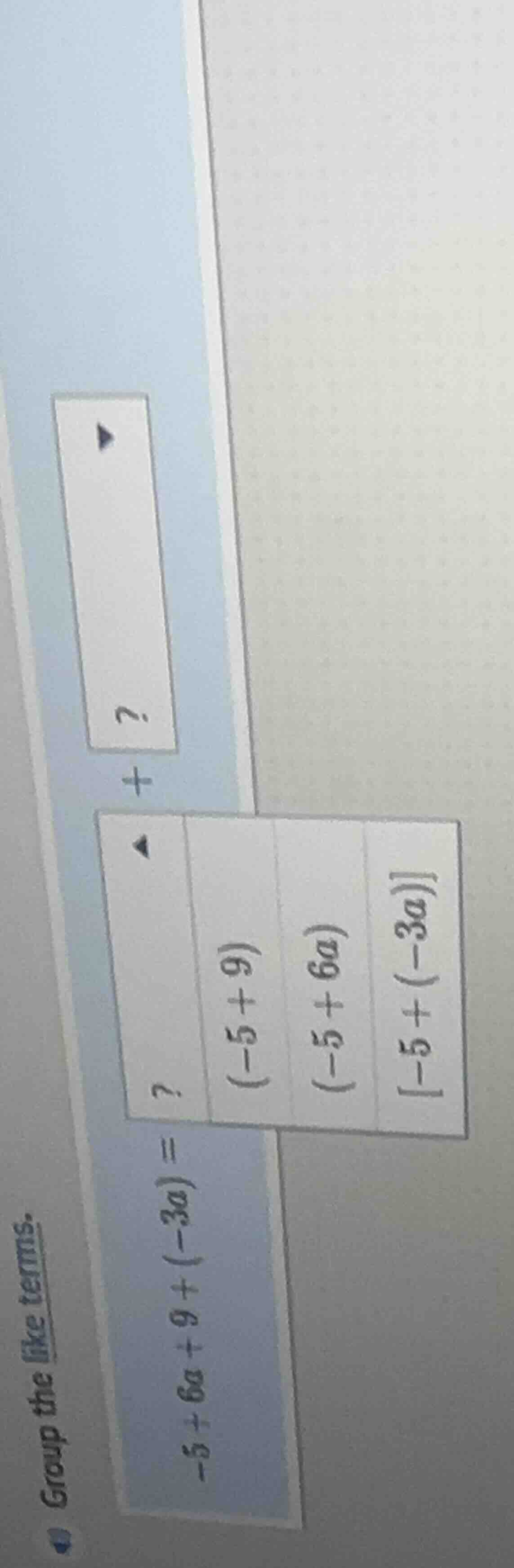
group the like terms.
-5 + 6a + 9 + (-3a) =
+ ?
?
options: (-5 + 9), (-5 + 6a), -5 + (-3a)
Step1: Identify like terms
In the expression \(-5 + 6a + 9 + (-3a)\), the like terms are the constant terms (\(-5\) and \(9\)) and the variable terms (\(6a\) and \(-3a\)). To group like terms, we can use the associative property of addition.
Step2: Group constant terms and variable terms
We group the constant terms \(-5\) and \(9\) together, and the variable terms \(6a\) and \(-3a\) together. So, we can rewrite the expression as \((-5 + 9)+(6a - 3a)\) or in the form of grouping the constant terms first and then the variable terms. Looking at the options, we need to group \(-5\) with \(9\) and \(6a\) with \(-3a\). The first box should be the group of variable terms or constant terms? Wait, the original expression is \(-5 + 6a + 9 + (-3a)\), and we want to group like terms. So, grouping \(-5\) and \(9\) (constants) and \(6a\) and \(-3a\) (variables). So the first group (the lower box) should be \((-5 + 9)\) and the upper box should be \((6a - 3a)\) or \((6a + (-3a))\). Wait, looking at the options, the lower box options are \((-5 + 9)\), \((-5 + 6a)\), \([-5 + (-3a)]\). So we need to group \(-5\) with \(9\) (since they are constants) and \(6a\) with \(-3a\) (variables). So the lower box should be \((-5 + 9)\) and the upper box should be \((6a + (-3a))\) or simplified. Wait, let's check the original equation: \(-5 + 6a + 9 + (-3a)= (-5 + 9)+(6a + (-3a))\). So the lower box (the first group) is \((-5 + 9)\) and the upper box is \((6a + (-3a))\) or \((6a - 3a)\). But looking at the options, the lower box options include \((-5 + 9)\), so we choose \((-5 + 9)\) for the lower box and then the upper box would be \((6a - 3a)\) or \((6a + (-3a))\). Wait, maybe the problem is to fill in the blanks. Let's re-express:
Original expression: \(-5 + 6a + 9 + (-3a)\)
Group like terms: \((-5 + 9)+(6a + (-3a))\)
So the lower box (the first group) is \((-5 + 9)\) and the upper box is \((6a + (-3a))\) or \((6a - 3a)\). But looking at the options, the lower box has \((-5 + 9)\) as an option, so we select that for the lower box, and then the upper box would be \((6a - 3a)\) or \((6a + (-3a))\). But maybe the first (lower) box is the constant group: \((-5 + 9)\) and the upper box is the variable group: \((6a - 3a)\) or \((6a + (-3a))\). So the answer for the lower box is \((-5 + 9)\) and the upper box would be \((6a - 3a)\) or similar. But let's confirm:
Like terms are terms with the same variable (or constant). So \(-5\) and \(9\) are constants (like terms), \(6a\) and \(-3a\) are like terms (same variable \(a\)). So we group \(-5\) and \(9\) together, and \(6a\) and \(-3a\) together. So the lower box (the first group) is \((-5 + 9)\) and the upper box is \((6a + (-3a))\) or \((6a - 3a)\).

Snap & solve any problem in the app
Get step-by-step solutions on Sovi AI
Photo-based solutions with guided steps
Explore more problems and detailed explanations
Lower box: \((-5 + 9)\)
Upper box: \((6a + (-3a))\) (or simplified as \(3a\), but based on the options, we match the grouping)
Wait, maybe the problem is to fill in the two boxes. The lower box (the first group) is \((-5 + 9)\) and the upper box is \((6a + (-3a))\) or \((6a - 3a)\). But looking at the options, the lower box options are \((-5 + 9)\), so we choose \((-5 + 9)\) for the lower box, and then the upper box would be \((6a - 3a)\) or \((6a + (-3a))\). So the final answer for the lower box is \((-5 + 9)\) and the upper box is \((6a - 3a)\) (or \((6a + (-3a))\)). But since the problem is about grouping like terms, the correct grouping for the lower box (the first group) is \((-5 + 9)\) (grouping constants) and the upper box (the second group) is \((6a + (-3a))\) (grouping variables).