QUESTION IMAGE
Question
#2 – growing yams (ch 3)
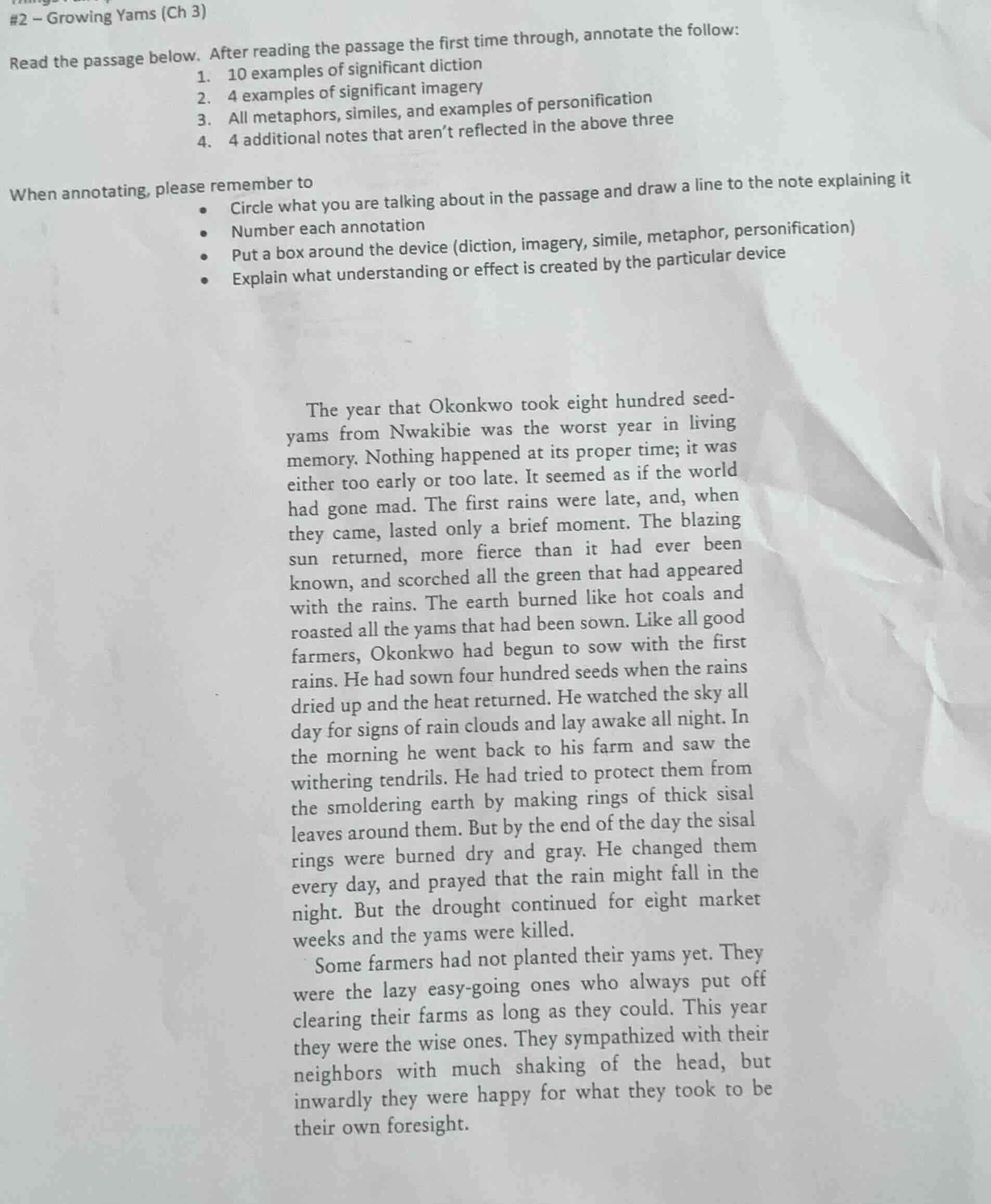
read the passage below. after reading the passage the first time through, annotate the follow:
- 10 examples of significant diction
- 4 examples of significant imagery
- all metaphors, similes, and examples of personification
- 4 additional notes that arent reflected in the above three
when annotating, please remember to
- circle what you are talking about in the passage and draw a line to the note explaining it
- number each annotation
- put a box around the device (diction, imagery, simile, metaphor, personification)
- explain what understanding or effect is created by the particular device
the year that okonkwo took eight hundred seed-yams from nwakibie was the worst year in living memory. nothing happened at its proper time; it was either too early or too late. it seemed as if the world had gone mad. the first rains were late, and, when they came, lasted only a brief moment. the blazing sun returned, more fierce than it had ever been known, and scorched all the green that had appeared with the rains. the earth burned like hot coals and roasted all the yams that had been sown. like all good farmers, okonkwo had begun to sow with the first rains. he had sown four hundred seeds when the rains dried up and the heat returned. he watched the sky all day for signs of rain clouds and lay awake all night. in the morning he went back to his farm and saw the withering tendrils. he had tried to protect them from the smoldering earth by making rings of thick sisal leaves around them. but by the end of the day the sisal rings were burned dry and gray. he changed them every day, and prayed that the rain might fall in the night. but the drought continued for eight market weeks and the yams were killed.
some farmers had not planted their yams yet. they were the lazy easy-going ones who always put off clearing their farms as long as they could. this year they were the wise ones. they sympathized with their neighbors with much shaking of the head, but inwardly they were happy for what they took to be their own foresight.
Below are annotated elements from the passage, following the requirements, with each entry linked to the text, labeled, and explained:
- Diction (1): "worst year in living memory" - This phrase emphasizes the extreme, unprecedented severity of the drought, framing it as a catastrophic event for the community.
- Diction (2): "gone mad" - Reinforces the chaotic, unnatural nature of the disrupted weather patterns, making the crisis feel unmanageable.
- Diction (3): "blazing sun" - Conveys the intense, unrelenting heat that overwhelms the land and crops.
- Diction (4): "smoldering earth" - Highlights the lingering, oppressive heat of the parched soil, showing it remains a threat even without direct harsh sun.
- Diction (5): "killed" - Frames the yams' destruction as a violent, irreversible loss, emphasizing the personal and economic devastation for farmers.
- Diction (6): "lazy easy-going" - Establishes the initial, judgmental perception of the delayed farmers, setting up the ironic twist later.
- Diction (7): "wise ones" - Creates irony by reversing the earlier judgment, showing how circumstance redefines "good farming."
- Diction (8): "sympathized with much shaking of the head" - Reveals the farmers' performative pity, masking their secret relief.
- Diction (9): "inwardly they were happy" - Exposes the gap between public decorum and private feeling, adding complexity to the community's dynamics.
- Diction (10): "foresight" - The farmers' self-congratulatory term underscores their misplaced belief that their laziness was intentional wisdom.
- Imagery (1): "scorched all the green that had appeared with the rains" - Visualizes the sudden, total destruction of new growth, showing the drought's swift cruelty.
- Imagery (2): "earth burned like hot coals" - Evokes the searing, tangible heat of the parched soil, making the land feel like an active threat.
- Imagery (3): "withered tendrils" - Shows the slow, visible death of the yams, making Okonkwo's loss feel intimate and gradual.
- Imagery (4): "sisal rings were burned dry and gray" - Visualizes the failure of Okonkwo's protective efforts, emphasizing his powerlessness.
- Simile (1): "earth burned like hot coals" - Compares the parched soil to hot coals, amplifying the intensity of the heat and its destructive effect on the yams.
- Personification (1): "the world had gone mad" - Gives the natural world human-like madness, framing the chaotic weather as an irrational, ungovernable force beyond human control.
- Additional Note (1): The passage uses irony to contrast Okonkwo's careful, timely farming (which leads to total loss) with the lazy farmers' inaction (which saves them), subverting ideas of "good farming."
- Additional Note (2): Okonkwo's daily replacement of sisal rings and night prayers show his desperate, persistent efforts to save his crop, highlighting his dedication to his work.
- Additional Note (3): The focus on "eight hundred seed-yams" and "four hundred seeds" grounds the story in specific, tangible stakes, making the loss feel more real and impactful.
- Additional Note (4): The passage connects agricultural fate to social reputation: Okonkwo's hard work leads to ruin, while the lazy farmers gain unearned status, showing how circumstance shapes social standing.

Snap & solve any problem in the app
Get step-by-step solutions on Sovi AI
Photo-based solutions with guided steps
Explore more problems and detailed explanations
- 10 Significant Diction Examples:
- "worst year in living memory"
- "gone mad"
- "blazing sun"
- "smoldering earth"
- "killed"
- "lazy easy-going"
- "wise ones"
- "sympathized with much shaking of the head"
- "inwardly they were happy"
- "foresight"
- 4 Significant Imagery Examples:
- "scorched all the green that had appeared with the rains"
- "earth burned like hot coals"
- "withered tendrils"
- "sisal rings were burned dry and gray"
- Figurative Language:
- Simile: "earth burned like hot coals"
- Personification: "the world had gone mad"
- 4 Additional Notes:
- Irony subverts ideas of "good farming" (timely work fails, laziness succeeds).
- Okonkwo's daily efforts show his desperate dedication.
- Specific numbers (800, 400) make the loss tangible.
- Circumstance redefines the farmers' social reputations.