QUESTION IMAGE
Question
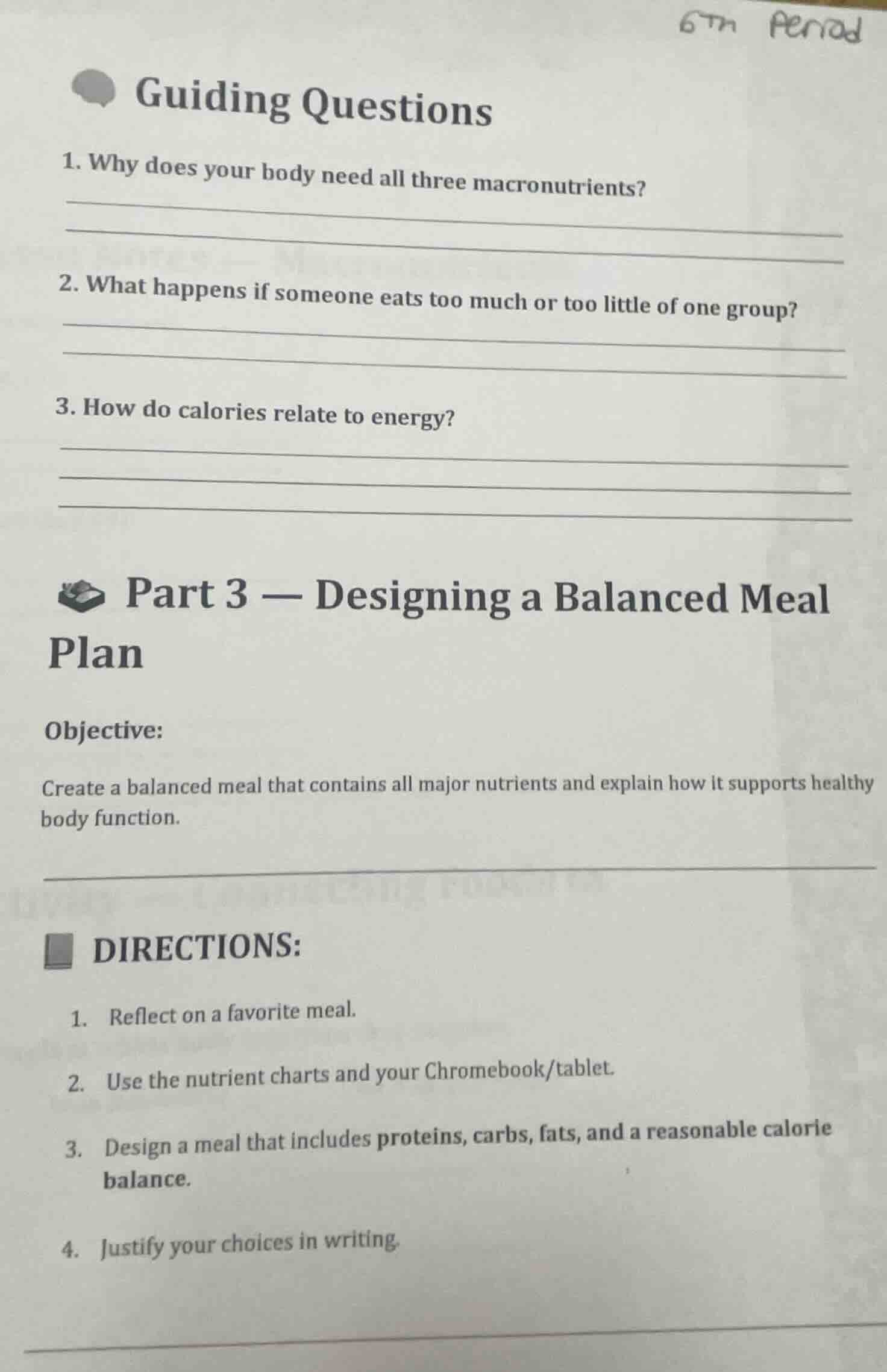
guiding questions
- why does your body need all three macronutrients?
- what happens if someone eats too much or too little of one group?
- how do calories relate to energy?
part 3 — designing a balanced meal plan
objective:
create a balanced meal that contains all major nutrients and explain how it supports healthy body function.
directions:
- reflect on a favorite meal.
- use the nutrient charts and your chromebook/tablet.
- design a meal that includes proteins, carbs, fats, and a reasonable calorie balance.
- justify your choices in writing.
1. Why does your body need all three macronutrients?
Macronutrients (carbohydrates, proteins, fats) each have unique roles. Carbohydrates provide energy (e.g., glucose for cells), proteins build/repair tissues (e.g., muscle, enzymes), and fats store energy, insulate, and aid nutrient absorption. A balance ensures energy, growth, and proper organ function.
- Too much: Excess carbs can lead to weight gain (converted to fat), excess protein may stress kidneys, excess fat (especially unhealthy fats) raises cholesterol/heart disease risk.
- Too little: Insufficient carbs cause fatigue (low energy), insufficient protein hinders tissue repair/growth (muscle loss, weak immunity), insufficient fat causes vitamin deficiency (fat - soluble vitamins) and hormonal imbalances.
A calorie is a unit of energy (specifically, the amount of energy needed to raise 1g of water by 1°C). Food calories (kilocalories, kcal) represent the energy stored in macronutrients. When we eat, our body breaks down food, releasing this energy (calories) to power bodily functions (e.g., breathing, movement) or store it (as fat/glycogen).

Snap & solve any problem in the app
Get step-by-step solutions on Sovi AI
Photo-based solutions with guided steps
Explore more problems and detailed explanations
The body needs all three macronutrients (carbohydrates, proteins, fats) because they serve distinct, essential roles: Carbohydrates supply energy for daily activities and bodily functions; proteins build, repair, and maintain tissues (like muscles, enzymes, hormones); fats store energy, insulate organs, facilitate nutrient absorption (e.g., fat - soluble vitamins), and support cell structure. Together, they ensure energy balance, growth, and proper physiological function.