QUESTION IMAGE
Question
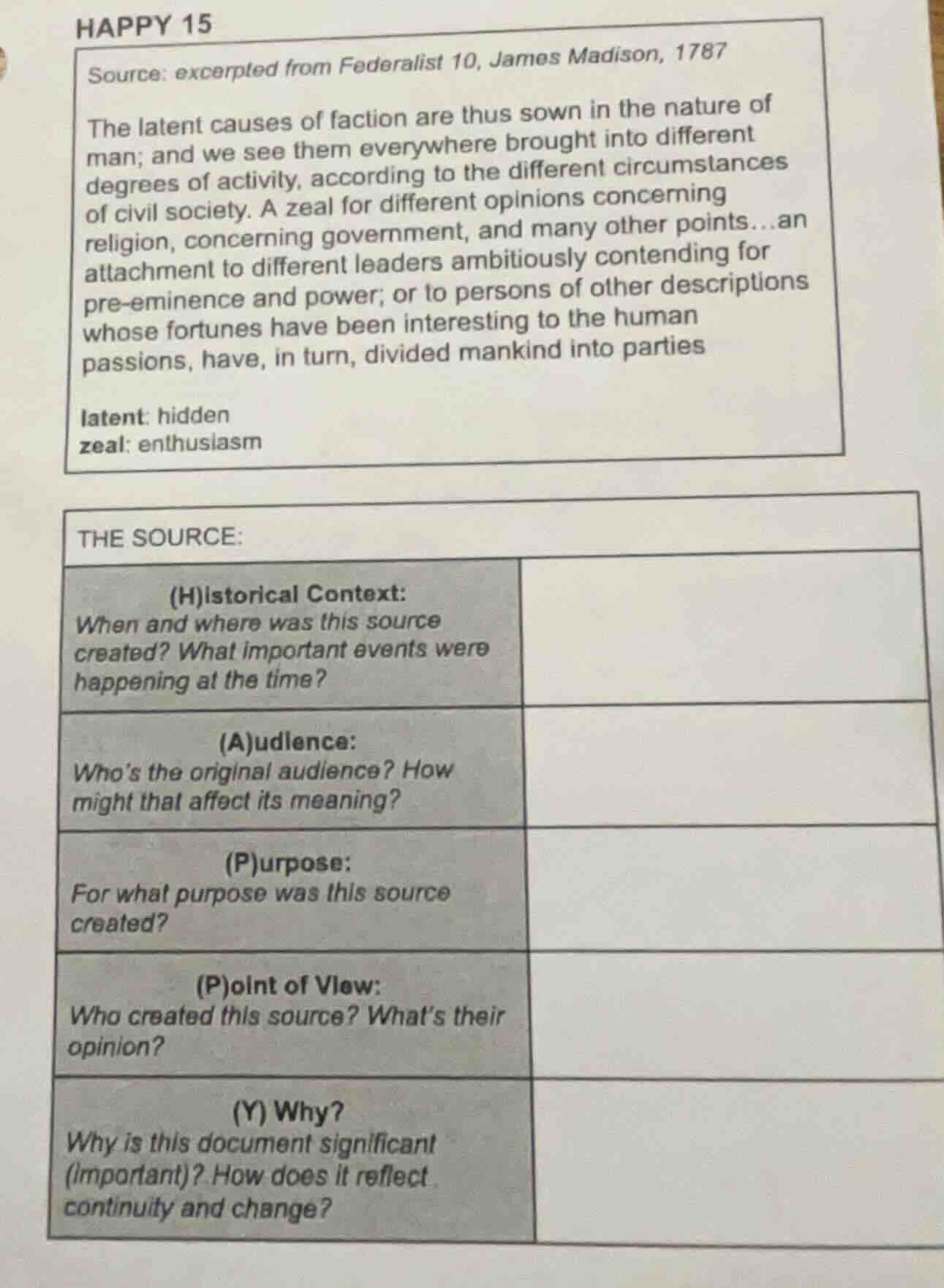
happy 15
source: excerpted from federalist 10, james madison, 1787
the latent causes of faction are thus sown in the nature of man; and we see them everywhere brought into different degrees of activity, according to the different circumstances of civil society. a zeal for different opinions concerning religion, concerning government, and many other points...an attachment to different leaders ambitiously contending for pre-eminence and power; or to persons of other descriptions whose fortunes have been interesting to the human passions, have, in turn, divided mankind into parties
latent: hidden
zeal: enthusiasm
the source:
(h)istorical context:
when and where was this source created? what important events were happening at the time?
(a)udience:
whos the original audience? how might that affect its meaning?
(p)urpose:
for what purpose was this source created?
(p)oint of view:
who created this source? whats their opinion?
(y) why?
why is this document significant (important)? how does it reflect continuity and change?
Historical Context:
This text was written in 1787 in the United States, during the period of debate over the proposed U.S. Constitution. The young nation had experienced instability under the Articles of Confederation, and there were intense arguments between federalists (who supported a strong central government) and anti-federalists (who favored more state power).
Audience:
The original audience was the citizens of New York (and broadly, all American colonists), specifically those who were undecided or opposed to the new Constitution. Madison aimed to persuade them by addressing fears of political division, so the text was framed to reassure readers that factionalism could be managed under the proposed system.
Purpose:
The source was created to defend the proposed U.S. Constitution by explaining the inevitability of political factions, arguing that a large, representative republic (as outlined in the Constitution) was the best way to control their harmful effects rather than eliminate them.
Point of View:
The source was written by James Madison, a Federalist. His opinion is that factionalism is rooted in human nature, and attempts to eliminate factions would violate individual liberties; instead, the structure of a large republic would balance and contain these competing groups.
Why?
This document is significant because it laid out a foundational theory of representative democracy, justifying the structure of the U.S. government as a way to mitigate political division. It reflects continuity in the tension between individual liberty and collective stability, and a change from the weak, decentralized system of the Articles of Confederation to a stronger, more structured federal government designed to manage societal divisions.

Snap & solve any problem in the app
Get step-by-step solutions on Sovi AI
Photo-based solutions with guided steps
Explore more problems and detailed explanations
Historical Context:
Created in 1787, U.S.A. during debates over the proposed U.S. Constitution, amid instability under the Articles of Confederation and federalist-anti-federalist tensions.
Audience:
American citizens (especially undecided/anti-federalist New Yorkers); the audience shaped the text to address fears of division and persuade readers to support the Constitution.
Purpose:
To defend the U.S. Constitution by arguing that a large republic can control the harms of inevitable political factions.
Point of View:
Written by Federalist James Madison, who viewed factions as natural to human nature, and believed a large republic was the best check on them without violating liberties.
Why?
It is a foundational work of U.S. political theory, justifying the federal system's structure to balance liberty and stability. It reflects continuity in debates over political division, and a change from weak decentralized governance to a structured federal government.