QUESTION IMAGE
Question
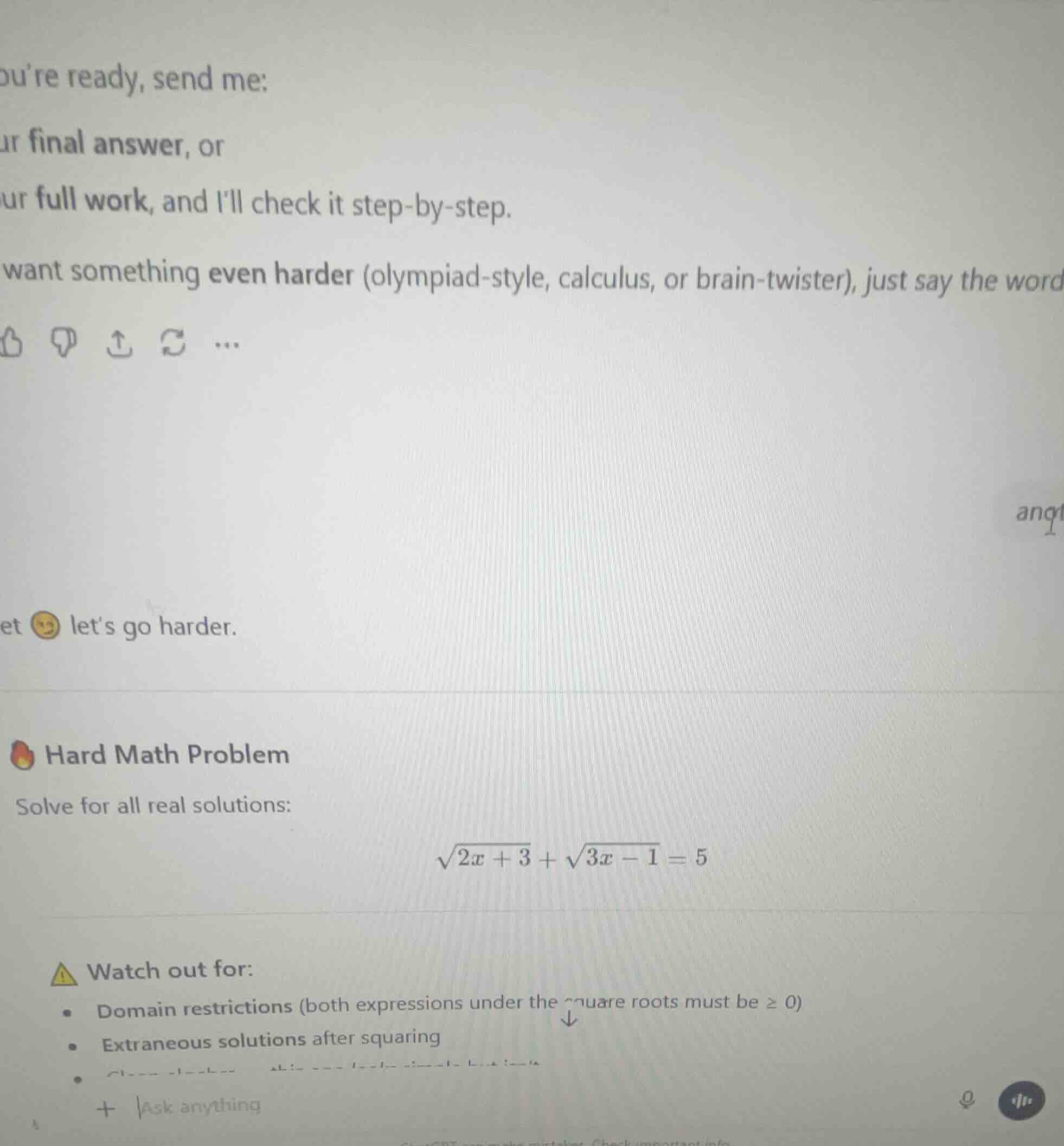
hard math problem
solve for all real solutions:
\\(\sqrt{2x + 3} + \sqrt{3x - 1} = 5\\)
watch out for:
- domain restrictions (both expressions under the square roots must be \\(\geq 0\\))
- extraneous solutions after squaring
Step1: Isolate one square root
We start with the equation \(\sqrt{2x + 3}+\sqrt{3x - 1}=5\). Let's isolate \(\sqrt{2x + 3}\) by subtracting \(\sqrt{3x - 1}\) from both sides:
\(\sqrt{2x + 3}=5 - \sqrt{3x - 1}\)
Step2: Square both sides
Now, square both sides to eliminate the square root on the left. Remember that \((a - b)^2=a^2-2ab + b^2\). So:
\((\sqrt{2x + 3})^2=(5 - \sqrt{3x - 1})^2\)
\(2x + 3 = 25-10\sqrt{3x - 1}+3x - 1\)
Step3: Simplify the equation
Simplify the right - hand side:
\(2x + 3=3x + 24-10\sqrt{3x - 1}\)
Now, let's isolate the square root term. Subtract \(3x + 24\) from both sides:
\(2x+3-(3x + 24)=- 10\sqrt{3x - 1}\)
\(2x + 3-3x - 24=-10\sqrt{3x - 1}\)
\(-x - 21=-10\sqrt{3x - 1}\)
Multiply both sides by - 1 to make it simpler:
\(x + 21 = 10\sqrt{3x - 1}\)
Step4: Square both sides again
Square both sides to eliminate the remaining square root:
\((x + 21)^2=(10\sqrt{3x - 1})^2\)
\(x^{2}+42x + 441 = 100(3x - 1)\)
\(x^{2}+42x + 441=300x - 100\)
Step5: Rearrange into quadratic form
Subtract \(300x-100\) from both sides to get a quadratic equation:
\(x^{2}+42x + 441-300x + 100 = 0\)
\(x^{2}-258x + 541 = 0\)? Wait, no, let's recalculate:
\(x^{2}+42x-300x + 441 + 100 = 0\)
\(x^{2}-258x+541 = 0\)? Wait, that can't be right. Wait, \((x + 21)^2=x^{2}+42x + 441\) and \(100(3x - 1)=300x-100\). So[SSE onError error]

Snap & solve any problem in the app
Get step-by-step solutions on Sovi AI
Photo-based solutions with guided steps
Explore more problems and detailed explanations
Step1: Isolate one square root
We start with the equation \(\sqrt{2x + 3}+\sqrt{3x - 1}=5\). Let's isolate \(\sqrt{2x + 3}\) by subtracting \(\sqrt{3x - 1}\) from both sides:
\(\sqrt{2x + 3}=5 - \sqrt{3x - 1}\)
Step2: Square both sides
Now, square both sides to eliminate the square root on the left. Remember that \((a - b)^2=a^2-2ab + b^2\). So:
\((\sqrt{2x + 3})^2=(5 - \sqrt{3x - 1})^2\)
\(2x + 3 = 25-10\sqrt{3x - 1}+3x - 1\)
Step3: Simplify the equation
Simplify the right - hand side:
\(2x + 3=3x + 24-10\sqrt{3x - 1}\)
Now, let's isolate the square root term. Subtract \(3x + 24\) from both sides:
\(2x+3-(3x + 24)=- 10\sqrt{3x - 1}\)
\(2x + 3-3x - 24=-10\sqrt{3x - 1}\)
\(-x - 21=-10\sqrt{3x - 1}\)
Multiply both sides by - 1 to make it simpler:
\(x + 21 = 10\sqrt{3x - 1}\)
Step4: Square both sides again
Square both sides to eliminate the remaining square root:
\((x + 21)^2=(10\sqrt{3x - 1})^2\)
\(x^{2}+42x + 441 = 100(3x - 1)\)
\(x^{2}+42x + 441=300x - 100\)
Step5: Rearrange into quadratic form
Subtract \(300x-100\) from both sides to get a quadratic equation:
\(x^{2}+42x + 441-300x + 100 = 0\)
\(x^{2}-258x + 541 = 0\)? Wait, no, let's recalculate:
\(x^{2}+42x-300x + 441 + 100 = 0\)
\(x^{2}-258x+541 = 0\)? Wait, that can't be right. Wait, \((x + 21)^2=x^{2}+42x + 441\) and \(100(3x - 1)=300x-100\). So[SSE onError error]