QUESTION IMAGE
Question
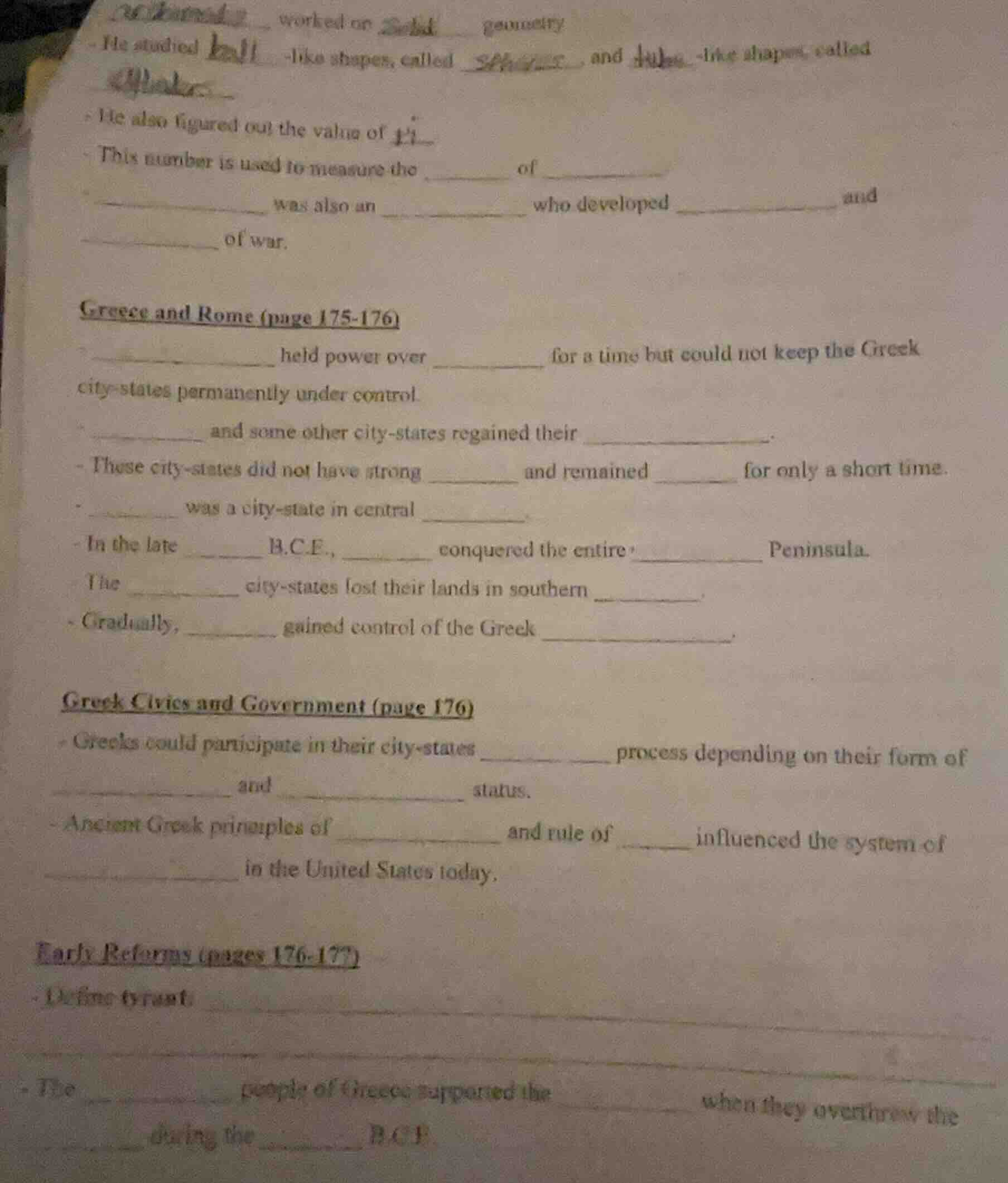
- he studied __ -like shapes, called , and -like shapes, called __.
- he also figured out the value of ____.
- this number is used to measure the __ of __.
- __ was also an who developed and __ of war.
greece and rome (page 175 - 176)
- __ held power over __ for a time but could not keep the greek city - states permanently under control.
- __ and some other city - states regained their __.
- these city - states did not have strong __ and remained __ for only a short time.
- __ was a city - state in central __.
- in the late __ b.c.e., conquered the entire __ peninsula.
- the __ city - states lost their lands in southern __.
- gradually, __ gained control of the greek __.
greek civics and government (page 176)
- greeks could participate in their city - states __ process depending on their form of and __ status.
- ancient greek principles of __ and rule of influenced the system of __ in the united states today.
early reforms (pages 176 - 177)
- define tyrant: ____
- the __ people of greece supported the when they overthrew the during the __ b.c.e.
Brief Explanations
These fill-in-the-blank questions cover ancient Greek and Roman history, government, and key figures. Answers are based on standard ancient Mediterranean history content:
- The first section refers to Archimedes, a Greek mathematician who studied solid geometry, calculated pi, and was also an engineer with war inventions.
- The Greece and Rome section covers Macedonian control of Greece, the rise of Rome, and Roman conquest of the Greek world.
- The Greek Civics section links ancient Greek democratic ideas to modern U.S. government.
- The Early Reforms section defines a tyrant and covers early Greek political upheaval.

Snap & solve any problem in the app
Get step-by-step solutions on Sovi AI
Photo-based solutions with guided steps
Explore more problems and detailed explanations
First Section (Archimedes):
- Archimedes worked on solid geometry
- He studied ball-like shapes, called spheres and tube-like shapes, called cylinders
- He also figured out the value of $\pi$ (pi)
- This number is used to measure the circumference of circles
- Archimedes was also an engineer who developed catapults and machines of war.
Greece and Rome:
- Macedonia held power over Greece for a time but could not keep the Greek city-states permanently under control.
- Athens and some other city-states regained their independence.
- These city-states did not have strong unity and remained free for only a short time.
- Rome was a city-state in central Italy.
- In the late 200s B.C.E., Rome conquered the entire Italian Peninsula.
- The Greek city-states lost their lands in southern Italy.
- Gradually, Rome gained control of the Greek world.
Greek Civics and Government:
- Greeks could participate in their city-states' governing process depending on their form of government and citizenship status.
- Ancient Greek principles of democracy and rule of law influenced the system of government in the United States today.
Early Reforms:
- Define tyrant: A ruler who seizes power illegally, often with support of the common people, and rules with absolute authority.
- The common people of Greece supported the tyrants when they overthrew the aristocracy during the 600s B.C.E.