QUESTION IMAGE
Question
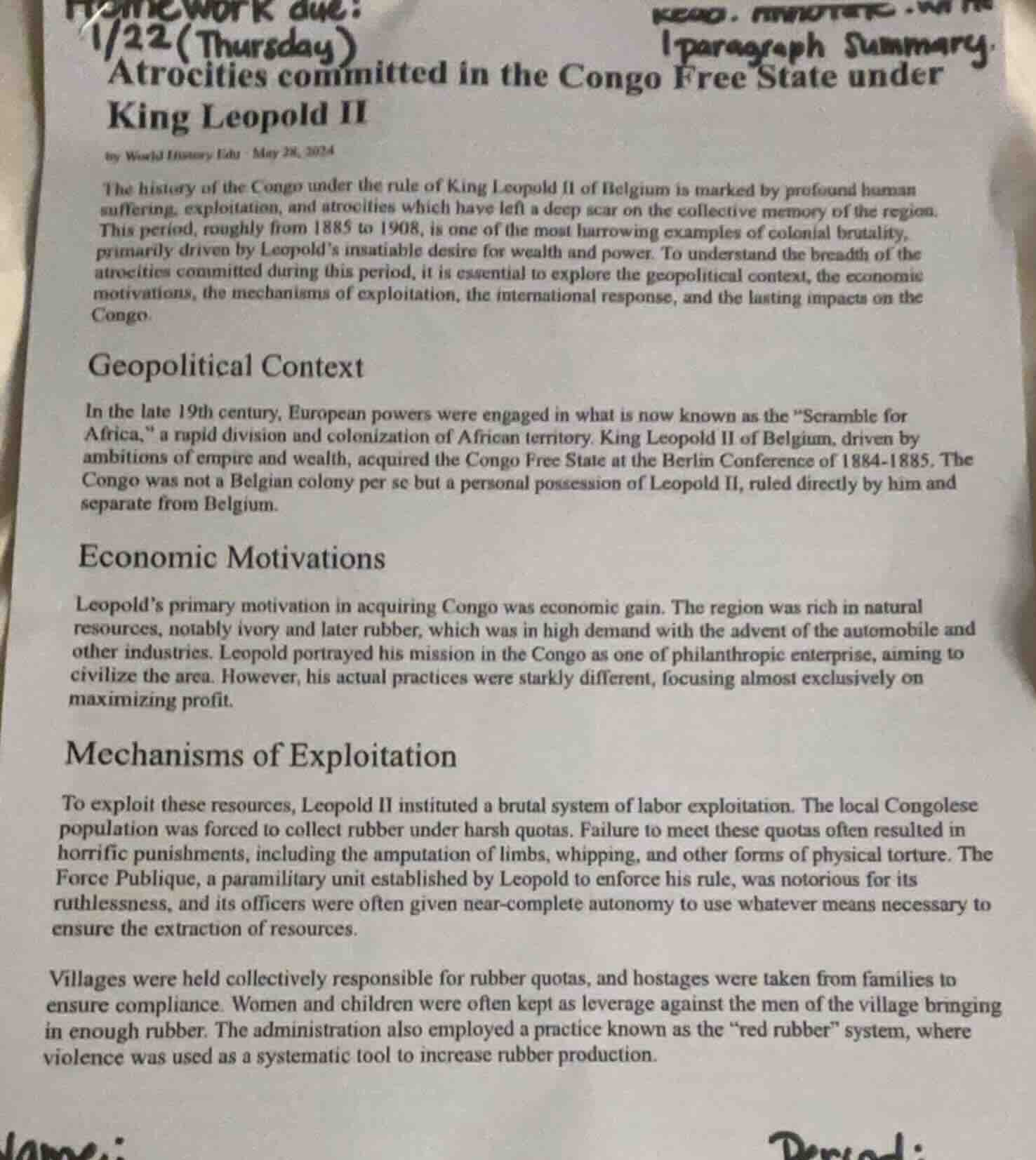
homework due: 1/22(thursday) read. 1paragraph summary. atrocities committed in the congo free state under king leopold ii by world history edu - may 28, 2024 the history of the congo under the rule of king leopold ii of belgium is marked by profound human suffering, exploitation, and atrocities which have left a deep scar on the collective memory of the region. this period, roughly from 1885 to 1908, is one of the most harrowing examples of colonial brutality, primarily driven by leopold’s insatiable desire for wealth and power. to understand the breadth of the atrocities committed during this period, it is essential to explore the geopolitical context, the economic motivations, the mechanisms of exploitation, the international response, and the lasting impacts on the congo. geopolitical context in the late 19th century, european powers were engaged in what is now known as the \scramble for africa,\ a rapid division and colonization of african territory. king leopold ii of belgium, driven by ambitions of empire and wealth, acquired the congo free state at the berlin conference of 1884 - 1885. the congo was not a belgian colony per se but a personal possession of leopold ii, ruled directly by him and separate from belgium. economic motivations leopold’s primary motivation in acquiring congo was economic gain. the region was rich in natural resources, notably ivory and later rubber, which was in high demand with the advent of the automobile and other industries. leopold portrayed his mission in the congo as one of philanthropic enterprise, aiming to civilize the area. however, his actual practices were starkly different, focusing almost exclusively on maximizing profit. mechanisms of exploitation to exploit these resources, leopold ii instituted a brutal system of labor exploitation. the local congolese population was forced to collect rubber under harsh quotas. failure to meet these quotas often resulted in horrific punishments, including the amputation of limbs, whipping, and other forms of physical torture. the force publique, a paramilitary unit established by leopold to enforce his rule, was notorious for its ruthlessness, and its officers were often given near - complete autonomy to use whatever means necessary to ensure the extraction of resources. villages were held collectively responsible for rubber quotas, and hostages were taken from families to ensure compliance. women and children were often kept as leverage against the men of the village bringing in enough rubber. the administration also employed a practice known as the
ed rubber\ system, where violence was used as a systematic tool to increase rubber production.
This summary distills the core details: the timeline of Leopold's rule, the geopolitical context of the Scramble for Africa, his false philanthropic framing vs. actual economic motives, the violent mechanisms of exploitation (forced labor, punishments, hostage-taking, the Force Publique, and the "red rubber" system), and the legacy of the atrocities. It adheres to the requirement of a single cohesive paragraph covering all key sections of the provided text.

Snap & solve any problem in the app
Get step-by-step solutions on Sovi AI
Photo-based solutions with guided steps
Explore more problems and detailed explanations
Between 1885 and 1908, King Leopold II of Belgium ruled the Congo Free State (his personal possession, secured via the 1884-1885 Berlin Conference amid the Scramble for Africa) with extreme brutality driven by greed for the region's ivory and high-demand rubber. Enforcing a brutal labor system via the ruthless Force Publique, Leopold imposed harsh rubber collection quotas on Congolese people; failure to meet them led to atrocities like limb amputations, whipping, and hostage-taking of women and children, with collective village punishment and the systematic "red rubber" violence system. While he falsely framed his rule as a philanthropic civilizing mission, his sole focus was profit, leaving deep, lasting scars on the Congo's collective memory through this harrowing example of colonial exploitation.