QUESTION IMAGE
Question
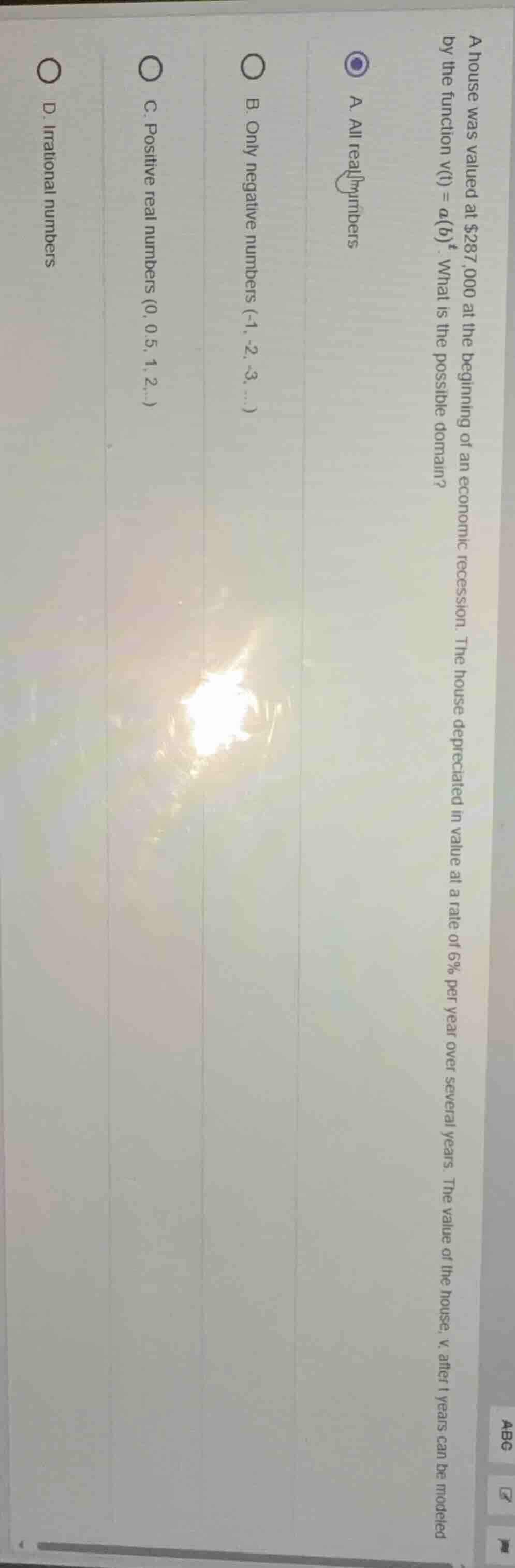
a house was valued at $287,000 at the beginning of an economic recession. the house depreciated in value at a rate of 6% per year over several years. the value of the house, v, after t years can be modeled by the function ( v(t) = a(b)^t ). what is the possible domain?
a. all real numbers
b. only negative numbers (-1, -2, -3, ...)
c. positive real numbers (0, 0.5, 1, 2, ...)
d. irrational numbers
Step1: Understand the context of \( t \)
In the function \( v(t)=a(b)^t \) modeling the house's value over time \( t \), \( t \) represents the number of years after the beginning of the recession. Time in this context (years since a starting point) can be a positive real number (including fractions of a year, like 0.5 years, 1 year, 2 years, etc.). It doesn't make sense to have negative time (so B is out) as we can't go back in time before the start of the recession for this model, and the domain isn't all real numbers (A is out) because negative \( t \) is not meaningful here, nor is it restricted to irrational numbers (D is out).
Step2: Analyze each option
- Option A: All real numbers includes negative \( t \), which is not meaningful for time since the start of the recession, so A is incorrect.
- Option B: Negative numbers for \( t \) don't make sense in this time - based context, so B is incorrect.
- Option C: Positive real numbers (including non - integer values like 0.5 for half a year) make sense for the number of years since the start of the recession, so this is correct.
- Option D: The domain isn't restricted to irrational numbers; rational positive numbers (like 1, 2, 0.5) are also valid for time, so D is incorrect.

Snap & solve any problem in the app
Get step-by-step solutions on Sovi AI
Photo-based solutions with guided steps
Explore more problems and detailed explanations
C. Positive real numbers (0, 0.5, 1, 2, ...)