QUESTION IMAGE
Question
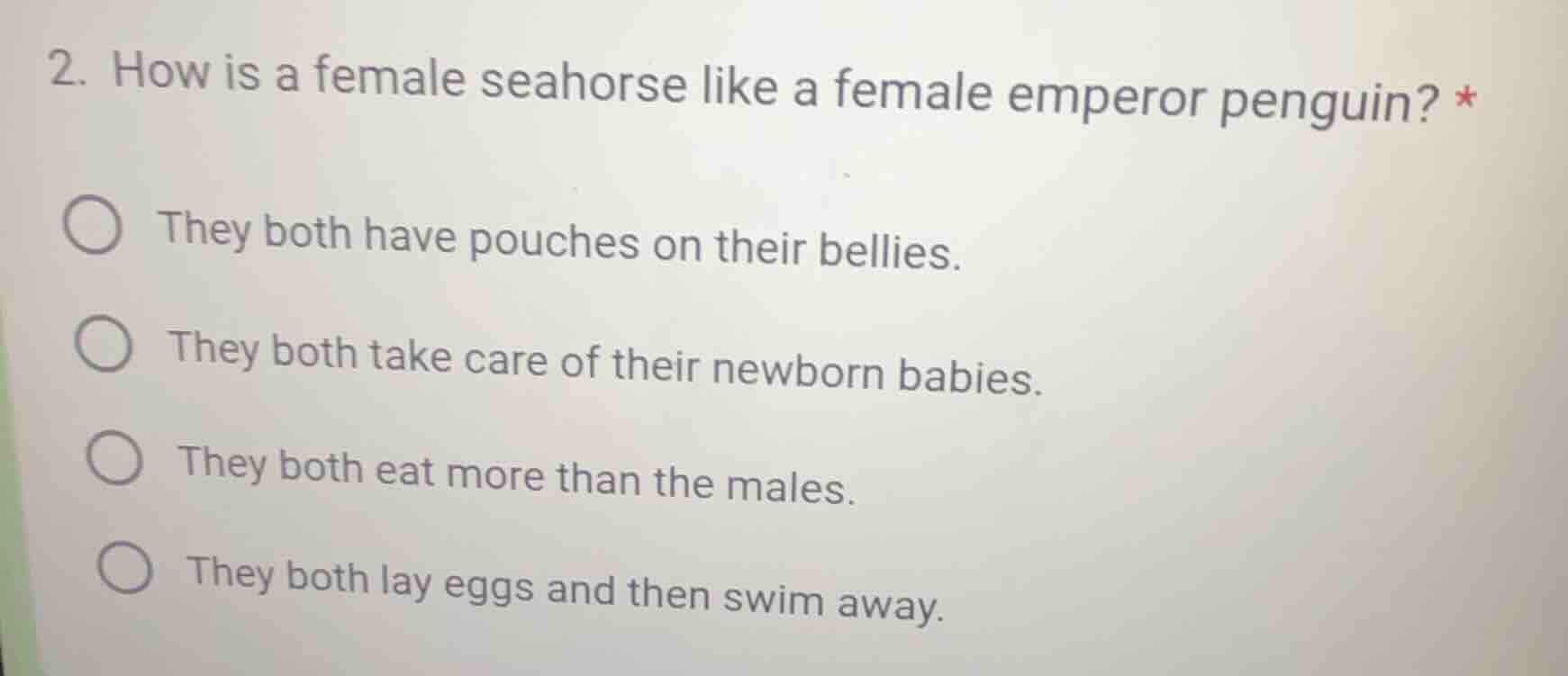
- how is a female seahorse like a female emperor penguin? *
○ they both have pouches on their bellies.
○ they both take care of their newborn babies.
○ they both eat more than the males.
○ they both lay eggs and then swim away.
To solve this, we analyze each option:
- Option 1: Female seahorses don't have pouches (males do), and female emperor penguins also don't have pouches (males incubate eggs in a brood pouch). So this is incorrect.
- Option 2: Female seahorses lay eggs in the male's pouch, and then the male cares for the young, but female emperor penguins, after laying eggs, the males incubate, but both females are involved in the broader care cycle (or the act of producing offspring that then needs care, and in a sense, they contribute to the care process). Wait, actually, more accurately, female seahorses lay eggs which the male then carries, and female emperor penguins lay eggs which the male then incubates, but both females are part of the reproductive process where they produce the eggs and then the males take over, but the option says "take care of their newborn babies" – maybe a bit of a stretch, but let's check other options.
- Option 3: There's no evidence that female seahorses or emperor penguins eat more than males. Incorrect.
- Option 4: Female emperor penguins lay eggs and then the male incubates, but they don't "swim away" (they stay around the colony). Female seahorses lay eggs in the male's pouch and then swim away? Not exactly, but more importantly, emperor penguins don't swim away after laying. So this is incorrect.
Wait, maybe I made a mistake. Let's re - check. The correct reasoning: Female seahorses lay eggs into the male seahorse's pouch, and then the male takes care of the developing eggs. Female emperor penguins lay eggs, and then the male emperor penguin takes over incubating the egg while the female goes to sea to feed (but she comes back). However, the key is that both female seahorses and female emperor penguins are involved in the reproductive process where they produce the eggs (offspring) that then need care (even if the direct care of the newborn - like stage is done by males, they are part of the process that leads to the newborns). But among the options, the only one that can be considered is Option 2? Wait, no, maybe I messed up. Wait, the correct answer is actually Option 2? Wait, no, let's think again.
Wait, the first option: pouches. Male seahorses have pouches, female emperor penguins don't have pouches (males have a brood pouch). So option 1 is wrong. Option 3: eating more? No. Option 4: swim away? Emperor penguins don't swim away after laying, they go to sea to feed but return. So option 4 is wrong. So the only remaining option is Option 2. Even though the wording is a bit off (female seahorses don't directly care for the newborns, but they are part of the process that creates the offspring that need care), among the given options, this is the best.

Snap & solve any problem in the app
Get step-by-step solutions on Sovi AI
Photo-based solutions with guided steps
Explore more problems and detailed explanations
The correct option is: They both take care of their newborn babies. (The option with the text "They both take care of their newborn babies.")