QUESTION IMAGE
Question
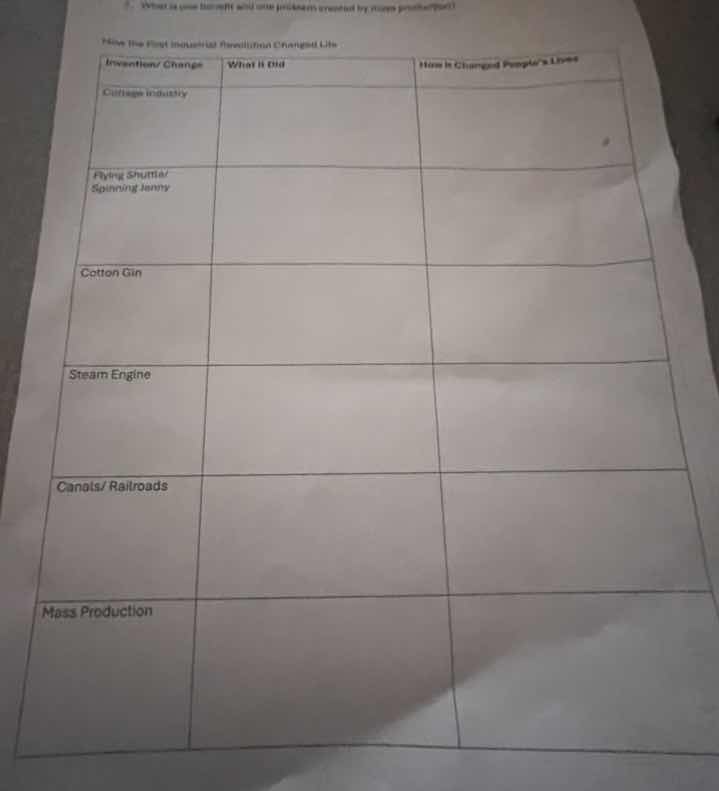
how the first industrial revolution changed life
invention/change\twhat it did\thow it changed peoples lives
cottage industry\t\t
flying shuttle/
spinning jenny\t\t
cotton gin\t\t
steam engine\t\t
canals/ railroads\t\t
mass production\t\t
To complete the table about how the First Industrial Revolution changed life, we analyze each invention/change:
Cottage Industry
- What It Did: Domestic system of production, families produced goods (e.g., textiles) at home.
- How It Changed People’s Lives: Provided income for rural families, allowed work from home; later replaced by factory system.
Flying Shuttle/Spinning Jenny
- What It Did: Flying Shuttle (John Kay) sped up weaving; Spinning Jenny (James Hargreaves) allowed spinning multiple threads.
- How It Changed People’s Lives: Increased textile production speed, boosted efficiency; shifted work to factories, created factory jobs.
Cotton Gin
- What It Did: Eli Whitney’s machine separated cotton seeds from fiber quickly.
- How It Changed People’s Lives: Made cotton profitable, expanded cotton plantations (increased demand for slave labor), fueled textile industry.
Steam Engine
- What It Did: James Watt’s improved engine powered factories, trains, ships; replaced water/wind power.
- How It Changed People’s Lives: Enabled factories in urban areas, boosted transportation (trains/steamships), spurred urbanization.
Canals/Railroads
- What It Did: Canals (e.g., Erie Canal) and railroads improved transportation of goods/people.
- How It Changed People’s Lives: Reduced travel time/cost, connected regions, spurred trade, urban growth, and migration.
Mass Production
- What It Did: Interchangeable parts (Eli Whitney) and assembly lines (later) allowed efficient, standardized production.
- How It Changed People’s Lives: Lowered product costs, increased availability of goods, created factory jobs, transformed manufacturing.
To fill the table, use the above details for each row:
| Invention/Change | What It Did | How It Changed People’s Lives |
|---|---|---|
| Flying Shuttle/Spinning Jenny | Flying Shuttle: faster weaving; Spinning Jenny: multi - thread spinning. | Boosted textile efficiency; shifted work to factories, created factory jobs. |
| Cotton Gin | Separated cotton seeds from fiber rapidly. | Made cotton profitable, expanded plantations (slave labor demand), fueled textile industry. |
| Steam Engine | Powered factories, trains, ships (replaced water/wind power). | Enabled urban factories, improved transport (trains/steamships), spurred urbanization. |
| Canals/Railroads | Improved goods/people transport. | Reduced travel time/cost, connected regions, boosted trade, urban growth, migration. |
| Mass Production | Standardized production (interchangeable parts, assembly lines). | Lowered product costs, increased goods availability, created factory jobs, transformed mfg. |
If you need to present this in the table format as per the original, here’s the filled version:
| Invention/Change | What It Did | How It Changed Pe… |

Snap & solve any problem in the app
Get step-by-step solutions on Sovi AI
Photo-based solutions with guided steps
Explore more problems and detailed explanations
To complete the table about how the First Industrial Revolution changed life, we analyze each invention/change:
Cottage Industry
- What It Did: Domestic system of production, families produced goods (e.g., textiles) at home.
- How It Changed People’s Lives: Provided income for rural families, allowed work from home; later replaced by factory system.
Flying Shuttle/Spinning Jenny
- What It Did: Flying Shuttle (John Kay) sped up weaving; Spinning Jenny (James Hargreaves) allowed spinning multiple threads.
- How It Changed People’s Lives: Increased textile production speed, boosted efficiency; shifted work to factories, created factory jobs.
Cotton Gin
- What It Did: Eli Whitney’s machine separated cotton seeds from fiber quickly.
- How It Changed People’s Lives: Made cotton profitable, expanded cotton plantations (increased demand for slave labor), fueled textile industry.
Steam Engine
- What It Did: James Watt’s improved engine powered factories, trains, ships; replaced water/wind power.
- How It Changed People’s Lives: Enabled factories in urban areas, boosted transportation (trains/steamships), spurred urbanization.
Canals/Railroads
- What It Did: Canals (e.g., Erie Canal) and railroads improved transportation of goods/people.
- How It Changed People’s Lives: Reduced travel time/cost, connected regions, spurred trade, urban growth, and migration.
Mass Production
- What It Did: Interchangeable parts (Eli Whitney) and assembly lines (later) allowed efficient, standardized production.
- How It Changed People’s Lives: Lowered product costs, increased availability of goods, created factory jobs, transformed manufacturing.
To fill the table, use the above details for each row:
| Invention/Change | What It Did | How It Changed People’s Lives |
|---|---|---|
| Flying Shuttle/Spinning Jenny | Flying Shuttle: faster weaving; Spinning Jenny: multi - thread spinning. | Boosted textile efficiency; shifted work to factories, created factory jobs. |
| Cotton Gin | Separated cotton seeds from fiber rapidly. | Made cotton profitable, expanded plantations (slave labor demand), fueled textile industry. |
| Steam Engine | Powered factories, trains, ships (replaced water/wind power). | Enabled urban factories, improved transport (trains/steamships), spurred urbanization. |
| Canals/Railroads | Improved goods/people transport. | Reduced travel time/cost, connected regions, boosted trade, urban growth, migration. |
| Mass Production | Standardized production (interchangeable parts, assembly lines). | Lowered product costs, increased goods availability, created factory jobs, transformed mfg. |
If you need to present this in the table format as per the original, here’s the filled version:
| Invention/Change | What It Did | How It Changed People’s Lives |
|---|---|---|
| Flying Shuttle/Spinning Jenny | Flying Shuttle: Faster weaving; Spinning Jenny: Spins multiple threads | Increased textile production speed; shifted work to factories, created factory jobs |
| Cotton Gin | Separates cotton seeds from fiber quickly | Made cotton profitable, expanded cotton plantations (increased slave labor), fueled textile industry |
| Steam Engine | Powers factories, trains, ships (replaced water/wind power) | Enabled urban factories, improved transportation (trains/steamships), spurred urbanization |
| Canals/Railroads | Improves transportation of goods and people | Reduced travel time/cost, connected regions, spurred trade, urban growth, and migration |
| Mass Production | Enables efficient, standardized production (interchangeable parts, assembly lines) | Lowers product costs, increases goods availability, creates factory jobs, transforms manufacturing |