QUESTION IMAGE
Question
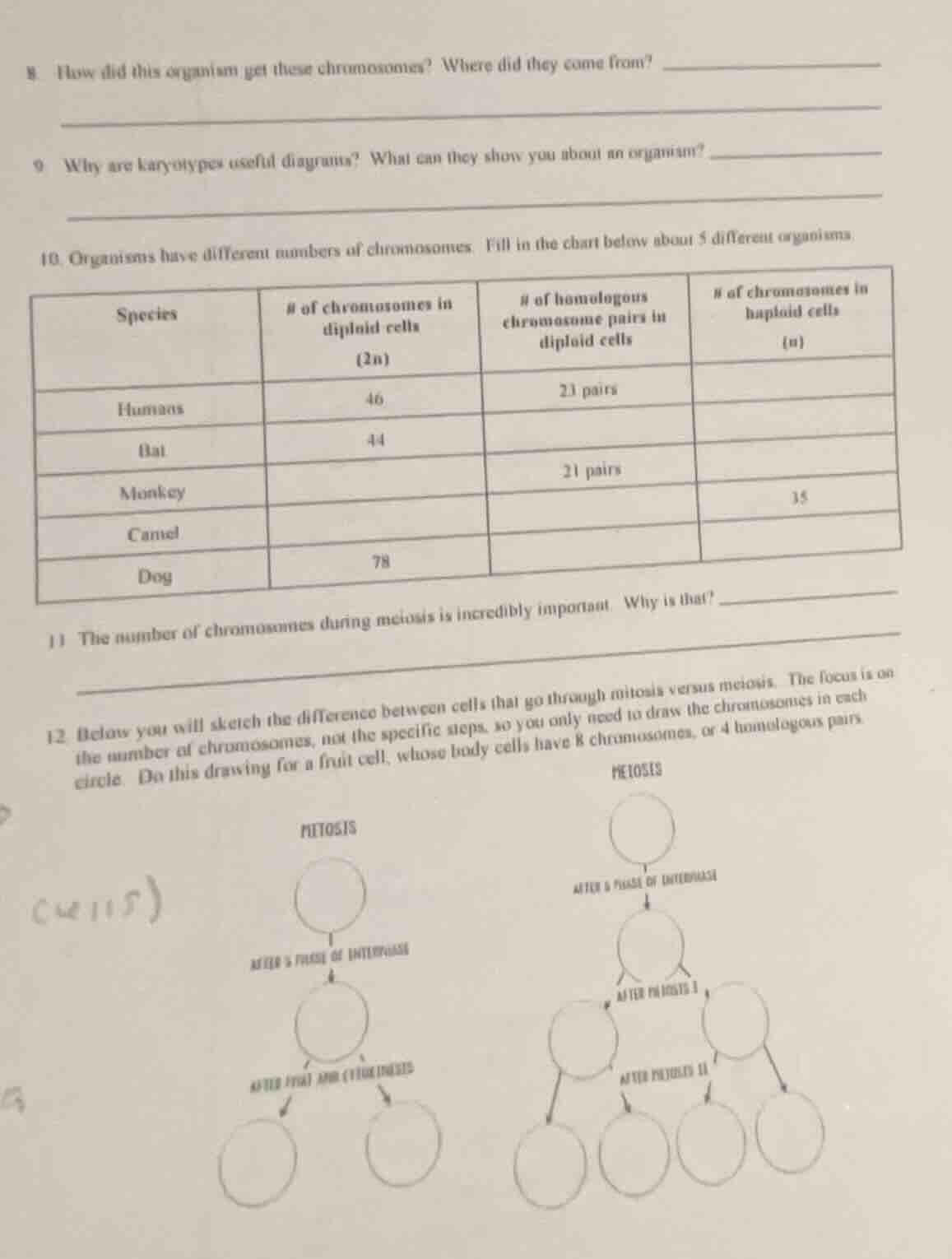
- how did this organism get these chromosomes? where did they come from?9. why are karyotypes useful diagrams? what can they show you about an organism?10. organisms have different numbers of chromosomes. fill in the chart below about 5 different organisms|species|# of chromosomes in diploid cells (2n)|# of homologous chromosome pairs in diploid cells|# of chromosomes in haploid cells (n)|| ---- | ---- | ---- | ---- ||humans|46|23 pairs| ||rat|44| | ||monkey| |21 pairs| ||camel| | |35||dog|78| | |11. the number of chromosomes during meiosis is incredibly important. why is that?12. below you will sketch the difference between cells that go through mitosis versus meiosis. the focus is on the number of chromosomes, not the specific steps, so you only need to draw the chromosomes in each circle. do this drawing for a fruit cell, whose body cells have 8 chromosomes, or 4 homologous pairs.
Brief Explanations
- Organisms inherit one set of chromosomes from their biological mother (via the egg) and one set from their biological father (via the sperm). These two sets combine during fertilization to form the organism's full chromosome complement.
- Karyotypes are visual arrangements of an organism's chromosomes. They reveal the total number of chromosomes, the presence of extra/missing chromosomes (aneuploidy), the structure of chromosomes (like deletions or translocations), and can help determine the biological sex of the organism.
- For diploid (2n) and haploid (n) cells: the number of homologous pairs equals $\frac{2n}{2}$, and $n = \frac{2n}{2}$. Use these relationships to fill the table:
- Humans: $n = \frac{46}{2} = 23$
- Rat: Homologous pairs = $\frac{44}{2} = 22$ pairs; $n = \frac{44}{2} = 22$
- Monkey: $2n = 21 \times 2 = 42$; $n = 21$
- Camel: $2n = 35 \times 2 = 70$; Homologous pairs = 35 pairs
- Dog: Homologous pairs = $\frac{78}{2} = 39$ pairs; $n = \frac{78}{2} = 39$
- Meiosis reduces the chromosome number by half (from diploid to haploid). This ensures that when gametes (sperm and egg) fuse during fertilization, the resulting zygote has the correct diploid chromosome number for the species, maintaining consistent chromosome counts across generations.
- - Mitosis:
- After S phase (interphase): 8 chromosomes (4 homologous pairs, replicated as sister chromatids)
- After mitosis + cytokinesis: 2 cells, each with 8 chromosomes (4 homologous pairs, unreplicated)
- Meiosis:
- After S phase (interphase): 8 chromosomes (4 homologous pairs, replicated as sister chromatids)
- After meiosis I: 2 cells, each with 4 chromosomes (no homologous pairs, replicated as sister chromatids)
- After meiosis II: 4 cells, each with 4 chromosomes (unreplicated, haploid)

Snap & solve any problem in the app
Get step-by-step solutions on Sovi AI
Photo-based solutions with guided steps
Explore more problems and detailed explanations
- This organism inherited one complete set of chromosomes from its biological mother (via an egg cell) and one complete set from its biological father (via a sperm cell); the two sets combined during fertilization.
- Karyotypes are useful because they show the total number of chromosomes, the presence of chromosomal abnormalities (like extra/missing chromosomes or structural changes), and the biological sex of an organism.
10.
| Species | # of chromosomes in diploid cells (2n) | # of homologous chromosome pairs in diploid cells | # of chromosomes in haploid cells (n) |
|---|---|---|---|
| Rat | 44 | 22 pairs | 22 |
| Monkey | 42 | 21 pairs | 21 |
| Camel | 70 | 35 pairs | 35 |
| Dog | 78 | 39 pairs | 39 |
- Meiosis reduces the chromosome number to haploid, so when gametes fuse during fertilization, the zygote regains the correct diploid chromosome number for the species, preserving consistent chromosome counts across generations.
12.
- Mitosis:
- Top circle: 8 chromosomes (4 replicated homologous pairs, each with sister chromatids)
- Bottom two circles: Each has 8 unreplicated chromosomes (4 homologous pairs)
- Meiosis:
- Top circle: 8 chromosomes (4 replicated homologous pairs, each with sister chromatids)
- Middle two circles: Each has 4 replicated chromosomes (no homologous pairs)
- Bottom four circles: Each has 4 unreplicated chromosomes (haploid, no homologous pairs)