QUESTION IMAGE
Question
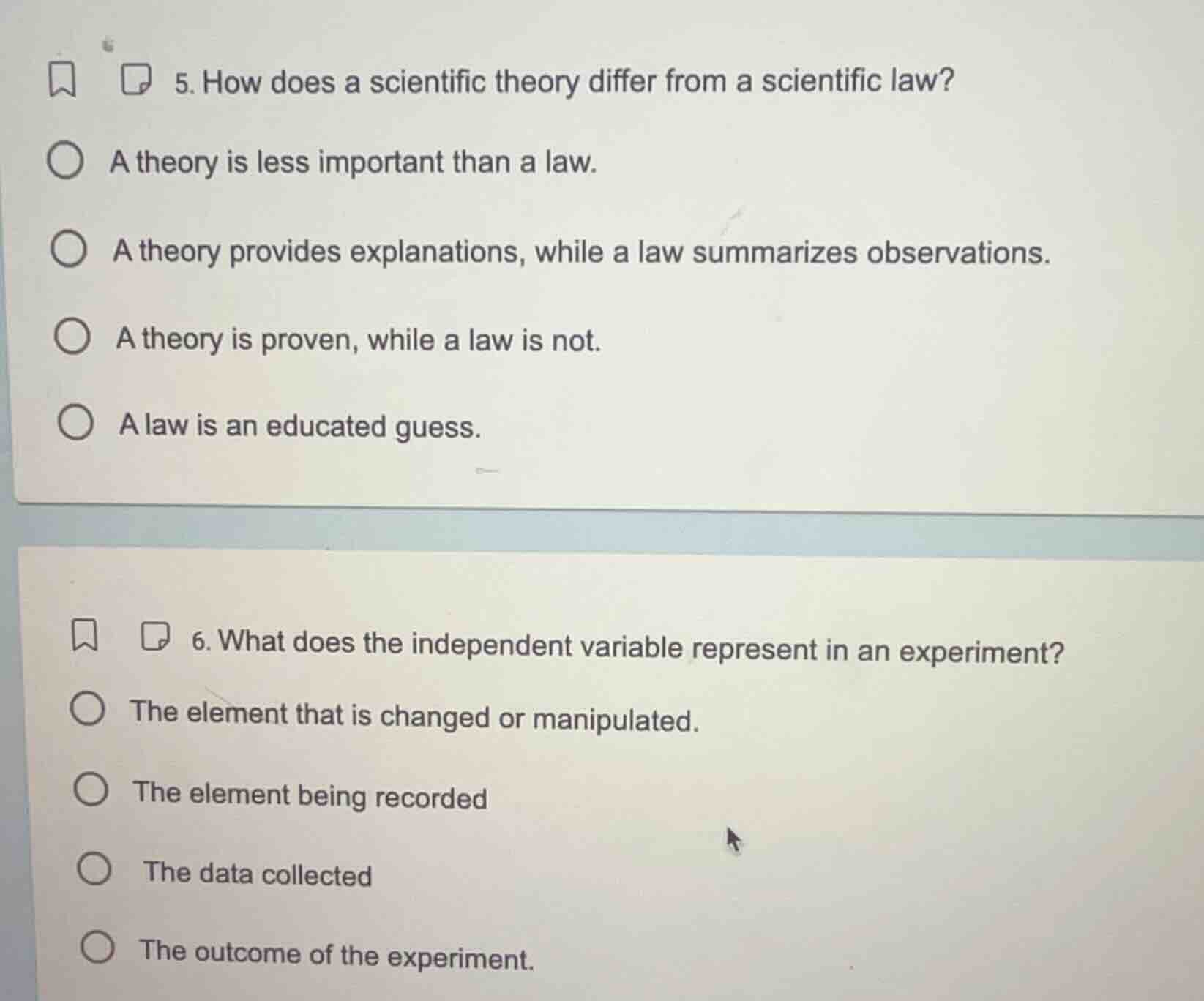
- how does a scientific theory differ from a scientific law?
a theory is less important than a law.
a theory provides explanations, while a law summarizes observations.
a theory is proven, while a law is not.
a law is an educated guess.
- what does the independent variable represent in an experiment?
the element that is changed or manipulated.
the element being recorded
the data collected
the outcome of the experiment.
Response
Question 5
Brief Explanations
- Option A: Both scientific theories and laws are important in their own ways; a theory isn't less important than a law.
- Option B: A scientific theory explains why phenomena occur (e.g., the theory of evolution explains how species change), while a scientific law summarizes observed patterns (e.g., Newton's law of gravitation summarizes how gravity acts). This matches the definitions.
- Option C: Theories are well - supported explanations but not "proven" in an absolute sense, and laws are also well - supported descriptions of natural phenomena.
- Option D: An educated guess is a hypothesis, not a law.
Brief Explanations
- Option A: The independent variable is the one that the experimenter changes or manipulates to see its effect on the dependent variable. For example, in an experiment testing the effect of light on plant growth, light is the independent variable (changed by the experimenter).
- Option B: The element being recorded is the dependent variable.
- Option C: The data collected is related to the variables but is not the independent variable.
- Option D: The outcome of the experiment is related to the dependent variable.

Snap & solve any problem in the app
Get step-by-step solutions on Sovi AI
Photo-based solutions with guided steps
Explore more problems and detailed explanations
B. A theory provides explanations, while a law summarizes observations.