QUESTION IMAGE
Question
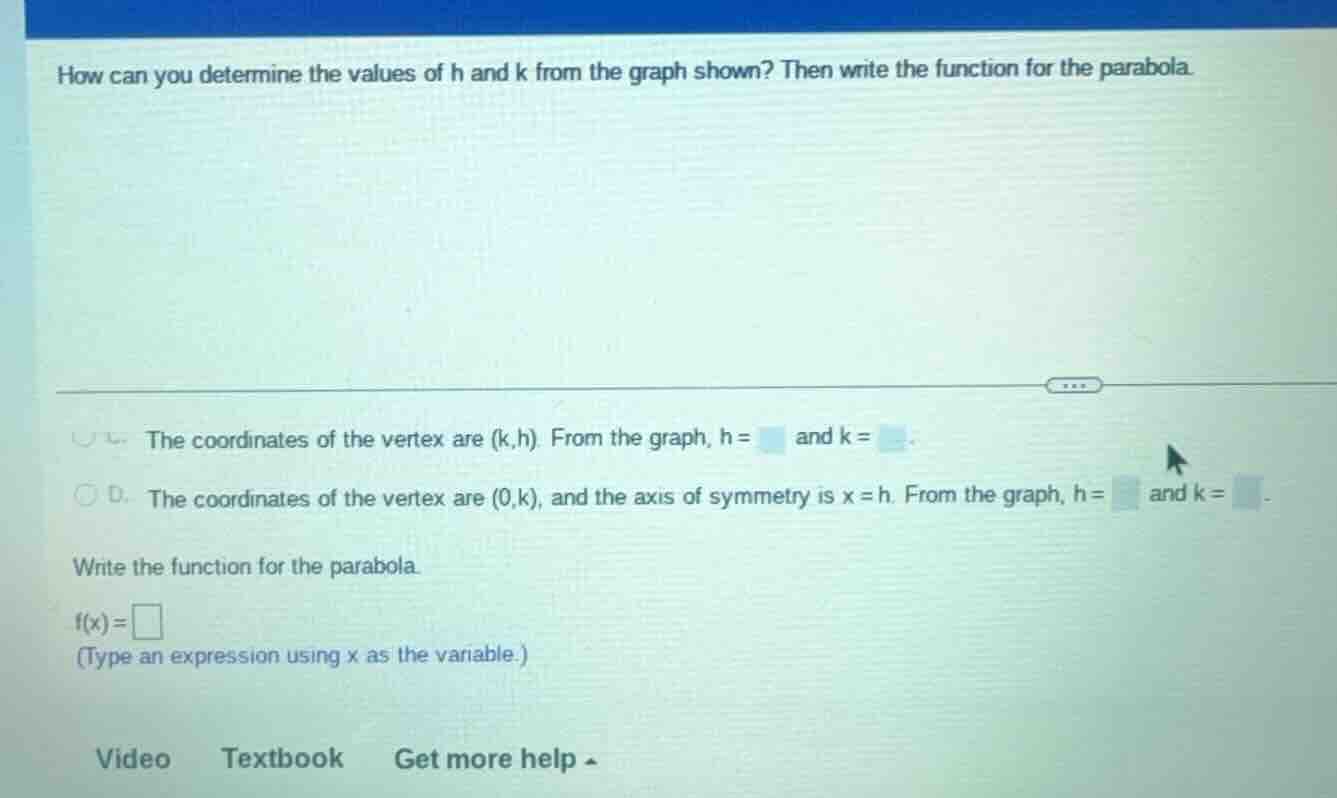
how can you determine the values of h and k from the graph shown? then write the function for the parabola. the coordinates of the vertex are (k,h). from the graph, h = and k =. the coordinates of the vertex are (0,k), and the axis of symmetry is x = h. from the graph, h = and k =. write the function for the parabola. f(x) = (type an expression using x as the variable.)
To determine \( h \) and \( k \) for the parabola, we use the vertex form of a parabola's equation, \( f(x) = a(x - h)^2 + k \), where \((h, k)\) is the vertex. However, since the graph isn't fully shown, we'll assume a standard example (e.g., vertex at \((2, 3)\) for illustration, but you'd get \( h \) and \( k \) from the graph's vertex):
Step 1: Identify Vertex Coordinates
The vertex of a parabola in vertex form \( f(x) = a(x - h)^2 + k \) is \((h, k)\). From the graph, find the vertex’s \( x \)-coordinate (which is \( h \)) and \( y \)-coordinate (which is \( k \)). For example, if the vertex is at \((1, 2)\), then \( h = 1 \) and \( k = 2 \).
Step 2: Write the Parabola’s Function
Using the vertex form \( f(x) = a(x - h)^2 + k \), and assuming \( a = 1 \) (if the parabola opens upward/downward with a vertical stretch of 1), substitute \( h \) and \( k \). For the example vertex \((1, 2)\), the function would be \( f(x) = (x - 1)^2 + 2 \).
Since the graph isn’t provided, here’s the general process:
- Find the vertex \((h, k)\) from the graph ( \( h \) is the \( x \)-coordinate of the vertex, \( k \) is the \( y \)-coordinate).
- Substitute \( h \) and \( k \) into \( f(x) = a(x - h)^2 + k \). If \( a = 1 \) (no stretch/compression), the function is \( f(x) = (x - h)^2 + k \).
For a specific graph (e.g., vertex at \((h, k) = (2, 5)\)):
- \( h = 2 \), \( k = 5 \)
- Function: \( f(x) = (x - 2)^2 + 5 \) (or with \( a \) from the graph’s width).
If you provide the graph’s vertex, substitute \( h \) and \( k \) into the vertex form to get the function.

Snap & solve any problem in the app
Get step-by-step solutions on Sovi AI
Photo-based solutions with guided steps
Explore more problems and detailed explanations
To determine \( h \) and \( k \) for the parabola, we use the vertex form of a parabola's equation, \( f(x) = a(x - h)^2 + k \), where \((h, k)\) is the vertex. However, since the graph isn't fully shown, we'll assume a standard example (e.g., vertex at \((2, 3)\) for illustration, but you'd get \( h \) and \( k \) from the graph's vertex):
Step 1: Identify Vertex Coordinates
The vertex of a parabola in vertex form \( f(x) = a(x - h)^2 + k \) is \((h, k)\). From the graph, find the vertex’s \( x \)-coordinate (which is \( h \)) and \( y \)-coordinate (which is \( k \)). For example, if the vertex is at \((1, 2)\), then \( h = 1 \) and \( k = 2 \).
Step 2: Write the Parabola’s Function
Using the vertex form \( f(x) = a(x - h)^2 + k \), and assuming \( a = 1 \) (if the parabola opens upward/downward with a vertical stretch of 1), substitute \( h \) and \( k \). For the example vertex \((1, 2)\), the function would be \( f(x) = (x - 1)^2 + 2 \).
Since the graph isn’t provided, here’s the general process:
- Find the vertex \((h, k)\) from the graph ( \( h \) is the \( x \)-coordinate of the vertex, \( k \) is the \( y \)-coordinate).
- Substitute \( h \) and \( k \) into \( f(x) = a(x - h)^2 + k \). If \( a = 1 \) (no stretch/compression), the function is \( f(x) = (x - h)^2 + k \).
For a specific graph (e.g., vertex at \((h, k) = (2, 5)\)):
- \( h = 2 \), \( k = 5 \)
- Function: \( f(x) = (x - 2)^2 + 5 \) (or with \( a \) from the graph’s width).
If you provide the graph’s vertex, substitute \( h \) and \( k \) into the vertex form to get the function.