QUESTION IMAGE
Question
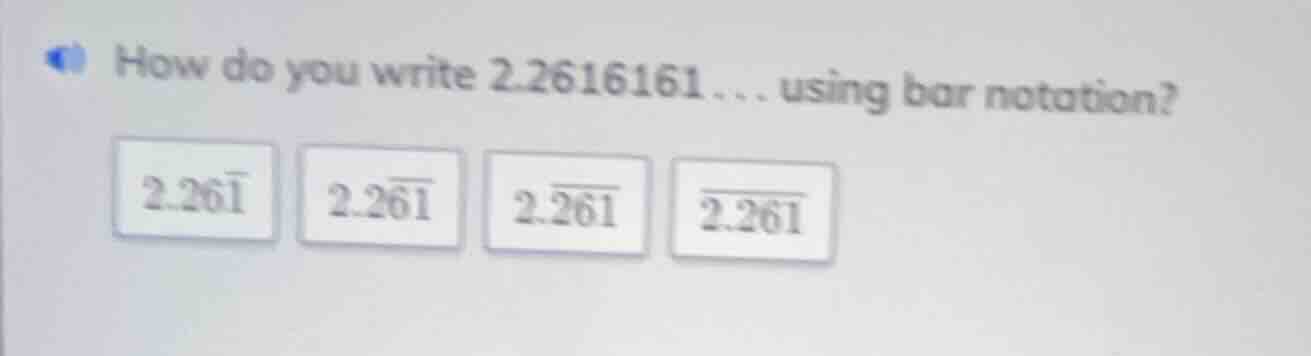
how do you write 2.2616161... using bar notation? 2.26\overline{1} 2.2\overline{61} 2.\overline{261} \overline{2.261}
Step1: Identify the repeating part
The decimal is \(2.2616161\ldots\). The repeating digits start after the first decimal place. The repeating cycle is "61" (since 61 repeats: 2.2\(\boldsymbol{61}\)\(\boldsymbol{61}\)\(\boldsymbol{61}\)...).
Step2: Apply bar notation
Bar notation is used to indicate the repeating part. So we place the bar over the repeating digits "61". Looking at the options, the one with the bar over "61" is \(2.2\overline{61}\). Wait, wait, let's re - check. Wait, the decimal is \(2.2616161\ldots\). Let's write out the decimal: the integer part is 2, the first decimal digit is 2, then 6, then 1, then 6, then 1, etc. So the repeating part is "61" (digits 6 and 1 repeat). So the bar should be over "61". So the correct notation is \(2.2\overline{61}\)? Wait, but looking at the options, the second option (assuming the options are presented as: first: \(2.26\overline{1}\), second: \(2.2\overline{61}\), third: \(2.\overline{261}\), fourth: \(\overline{2.261}\))? Wait, maybe I misread the options. Let's re - examine the problem. The decimal is \(2.2616161\ldots\). Let's list the digits:
- The number is \(2.2\) (non - repeating) followed by \(616161\ldots\). So the repeating cycle is "61". So to represent this with bar notation, we put the bar over the repeating cycle "61". So the correct form is \(2.2\overline{61}\). Among the given options, if the second option is \(2.2\overline{61}\) (assuming the options are: 1. \(2.26\overline{1}\), 2. \(2.2\overline{61}\), 3. \(2.\overline{261}\), 4. \(\overline{2.261}\)), then the correct one is the second option ( \(2.2\overline{61}\) ). Wait, maybe the options are written as: first: \(2.26\overline{1}\) (bar over 1), second: \(2.2\overline{61}\) (bar over 61), third: \(2.\overline{261}\) (bar over 261), fourth: \(\overline{2.261}\) (bar over the whole number).
Let's analyze each option:
- Option 1: \(2.26\overline{1}\): This would mean the decimal is \(2.261111\ldots\), but our decimal is \(2.2616161\ldots\), so incorrect.
- Option 2: \(2.2\overline{61}\): This means \(2.2616161\ldots\), which matches our decimal.
- Option 3: \(2.\overline{261}\): This would mean \(2.261261261\ldots\), but our decimal starts with \(2.2\) (then 61 repeats), not \(2.261\) repeating as a three - digit cycle.
- Option 4: \(\overline{2.261}\): This is incorrect as the bar over the whole number is not the correct way to represent a repeating decimal (the bar is for the fractional part's repeating cycle).

Snap & solve any problem in the app
Get step-by-step solutions on Sovi AI
Photo-based solutions with guided steps
Explore more problems and detailed explanations
\(2.2\overline{61}\) (assuming the second option in the given set of options is \(2.2\overline{61}\))