QUESTION IMAGE
Question
Question was provided via image upload.
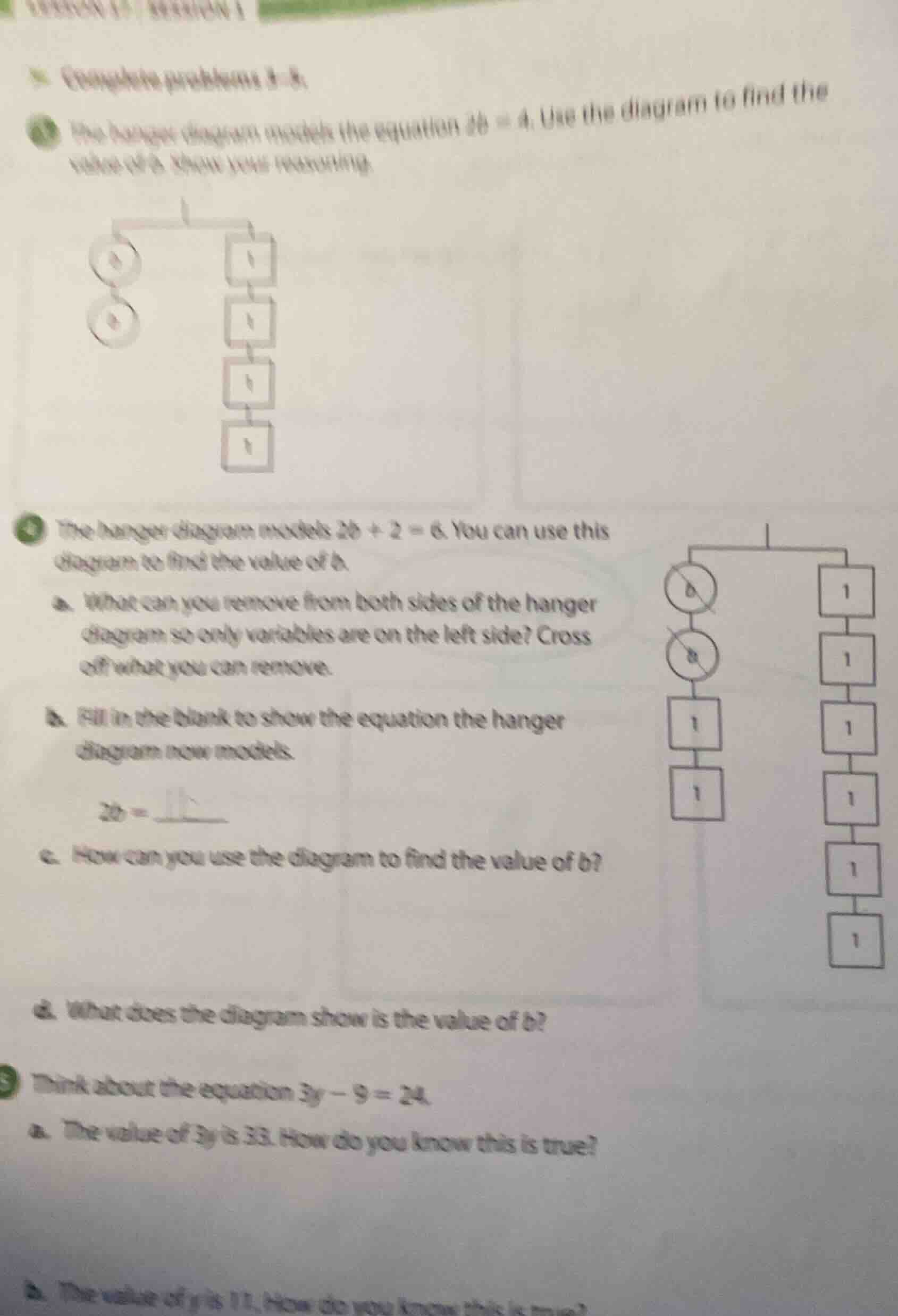
Problem 3 (Hanger Diagram for \(2b = 4\))
Step1: Analyze the hanger diagram
The left side has 2 circles labeled \(b\), and the right side has 4 squares labeled 1. The hanger is balanced, so \(2b = 4\).
Step2: Solve for \(b\)
To find \(b\), we divide both sides of the equation \(2b = 4\) by 2.
\(b=\frac{4}{2}\)
Step3: Calculate the value
\(\frac{4}{2}=2\)
To have only variables on the left, we remove the non - variable (constant) terms from both sides. The left side has 2 \(b\)s and 2 ones, the right side has 6 ones. We can remove 2 ones from both sides (since the hanger is balanced, removing equal amounts from both sides keeps it balanced).
Step1: Start with the original equation
The original equation from the hanger is \(2b + 2=6\).
Step2: Apply the operation from part (a)
After removing 2 ones from both sides, the left side becomes \(2b\) (since we removed 2 ones from \(2b + 2\)) and the right side becomes \(6 - 2\).
\(6-2 = 4\), so the equation is \(2b=4\)

Snap & solve any problem in the app
Get step-by-step solutions on Sovi AI
Photo-based solutions with guided steps
Explore more problems and detailed explanations
The value of \(b\) is \(2\) because when we divide the total value on the right (4) by the number of \(b\)s on the left (2), we get \(b = 2\).