QUESTION IMAGE
Question
Question was provided via image upload.
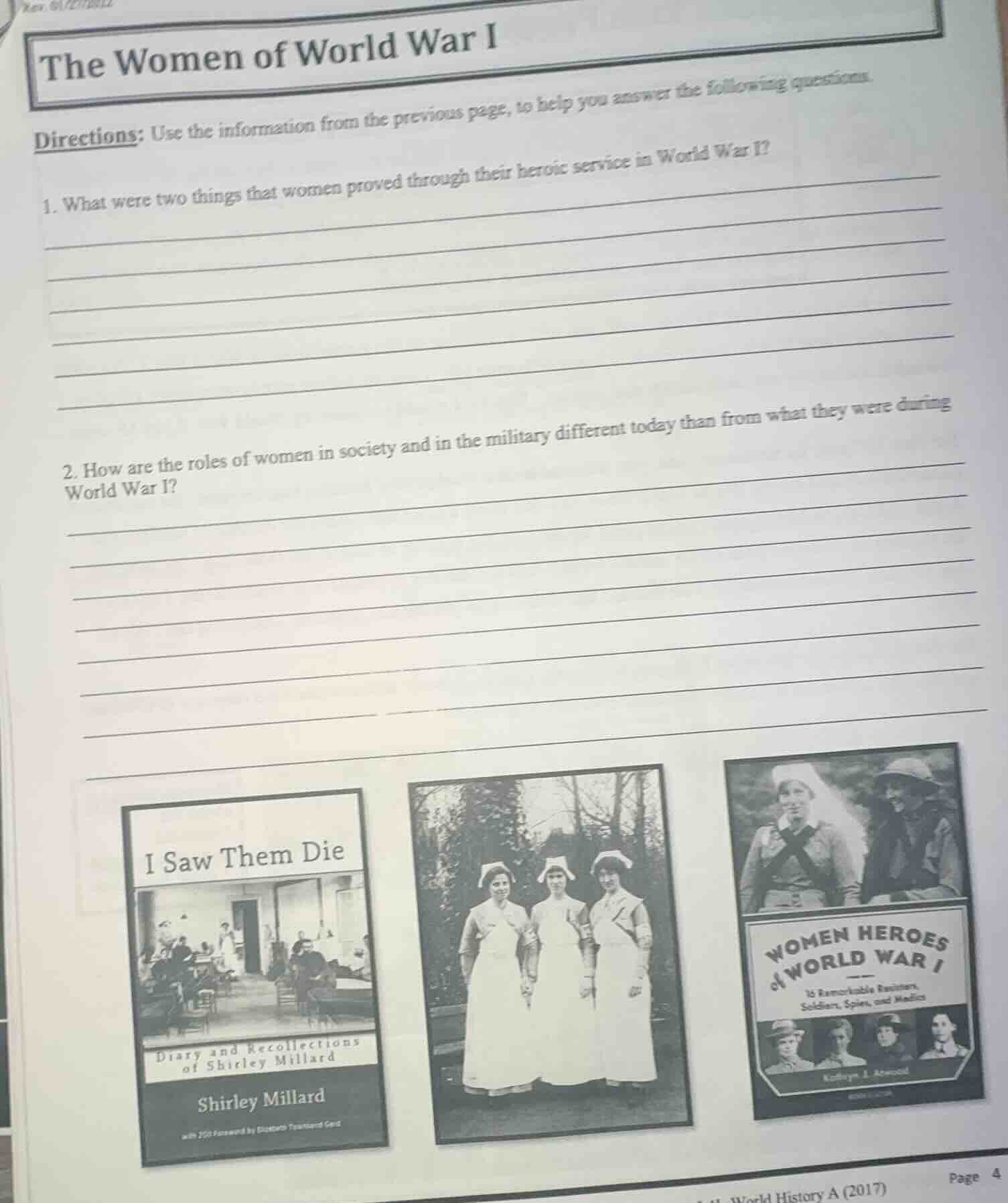
To answer these questions, we would need the information from the "previous page" referenced in the directions. Since that content isn't provided here, I can offer general guidance on how to approach them based on typical World War I women's history:
For Question 1:
Women’s service in WWI often demonstrated:
- Capability in non - traditional roles: They took on jobs (like factory work, nursing, clerical roles) previously dominated by men, proving they could handle “male - oriented” tasks.
- Patriotism and bravery: Many served as nurses in war zones, spies, or in support roles, showing courage and dedication to their countries.
For Question 2:
- Societal roles: During WWI, women’s work outside the home was often temporary (to fill labor shortages) and focused on “auxiliary” roles. Today, women have broader career access, hold leadership positions, and gender - based job restrictions are far less rigid.
- Military roles: In WWI, women’s military involvement was mostly non - combat (nurses, administrative support). Today, women serve in combat roles, hold high - ranking military positions, and have more equal access to military career paths.
If you can share the information from the previous page (key details about WWI women’s service), I can help craft more specific answers!

Snap & solve any problem in the app
Get step-by-step solutions on Sovi AI
Photo-based solutions with guided steps
Explore more problems and detailed explanations
To answer these questions, we would need the information from the "previous page" referenced in the directions. Since that content isn't provided here, I can offer general guidance on how to approach them based on typical World War I women's history:
For Question 1:
Women’s service in WWI often demonstrated:
- Capability in non - traditional roles: They took on jobs (like factory work, nursing, clerical roles) previously dominated by men, proving they could handle “male - oriented” tasks.
- Patriotism and bravery: Many served as nurses in war zones, spies, or in support roles, showing courage and dedication to their countries.
For Question 2:
- Societal roles: During WWI, women’s work outside the home was often temporary (to fill labor shortages) and focused on “auxiliary” roles. Today, women have broader career access, hold leadership positions, and gender - based job restrictions are far less rigid.
- Military roles: In WWI, women’s military involvement was mostly non - combat (nurses, administrative support). Today, women serve in combat roles, hold high - ranking military positions, and have more equal access to military career paths.
If you can share the information from the previous page (key details about WWI women’s service), I can help craft more specific answers!